Liverpool Football Formation
 November 9, 2024


Starting Lineup
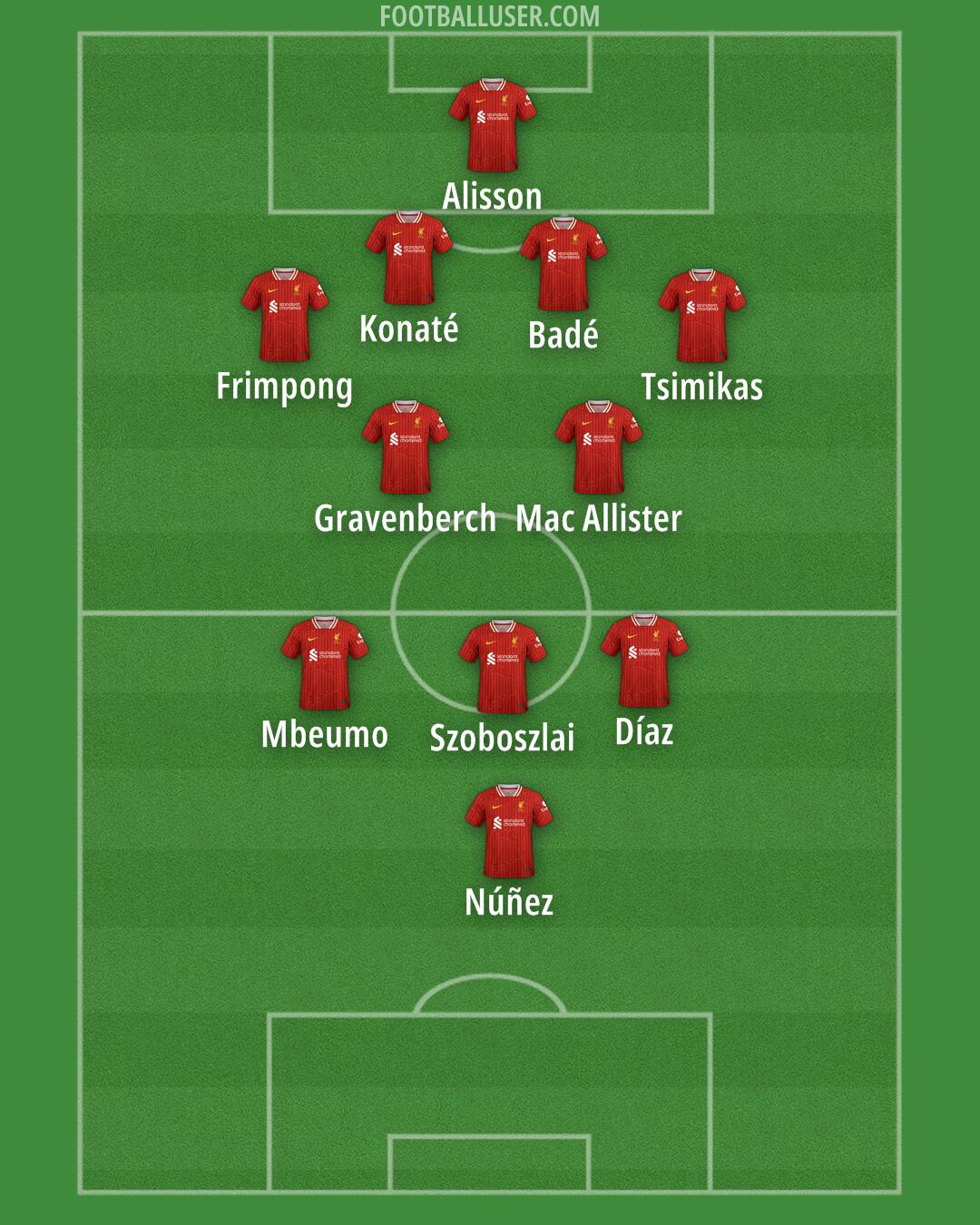
Frimpong · Konaté · Tsimikas · Badé · Gravenberch · Mac Allister · Szoboszlai · Díaz · Núñez · Alisson · MbeumoLiverpool focus on a vertical and aggressive style of play with this 4-2-4 formation. The goal is to win the ball high up the pitch and attack with speed to catch the opposition out of position. This lineup is built to stretch the defence and progress through the thirds with directness. By pushing the players forward, the team aims to maintain constant pressure.
Alisson plays behind a back four that must remain disciplined to prevent long balls. Frimpong operates as an attacking full back who will push high and overlap the winger to provide width on the right. Tsimikas does the same on the left to stretch the opposition and deliver crosses. Konaté uses his aerial strength to defend set pieces and win the header when balls are played into the box. Badé works as a covering centre back to pick up runners and help the unit hold a compact line.
In the middle of the pitch, Gravenberch and Mac Allister form a double pivot. Gravenberch acts as a carrier to drive the ball forward with his physicality. Mac Allister looks to receive the ball and play through the lines to reach the forwards. This pairing must protect the centre of the pitch and squeeze the space to stop the opposition from playing through the middle. They act as the link to recycle possession when the attack stalls.
The attacking unit uses four players to pin the last defender. Díaz plays as an inverted winger who will cut inside to find pockets of space and create chances. Mbeumo stays wider on the flank to pull the defence apart. Szoboszlai functions as a second striker who will press from the front and arrive late into the box. Núñez stays high as a pressing centre forward who will look to knock it in behind and use his runs to break the line.
A major strength of this Liverpool lineup is the ability to press in coordinated waves. Having four players in the front line allows the team to trigger a press high up the pitch. The wide overloads created by Frimpong and Tsimikas force the opposition to stay narrow or drop deep. This creates space for the central attackers to combine in tight spaces or find runners in behind. The speed of transition is a key advantage here.
This formation is designed for high intensity and rapid transitions. It is most effective when Liverpool face teams that defend in a low block and need to be broken down through constant pressure.