
Fluminense Football Formation
 November 10, 2024


Starting Lineup
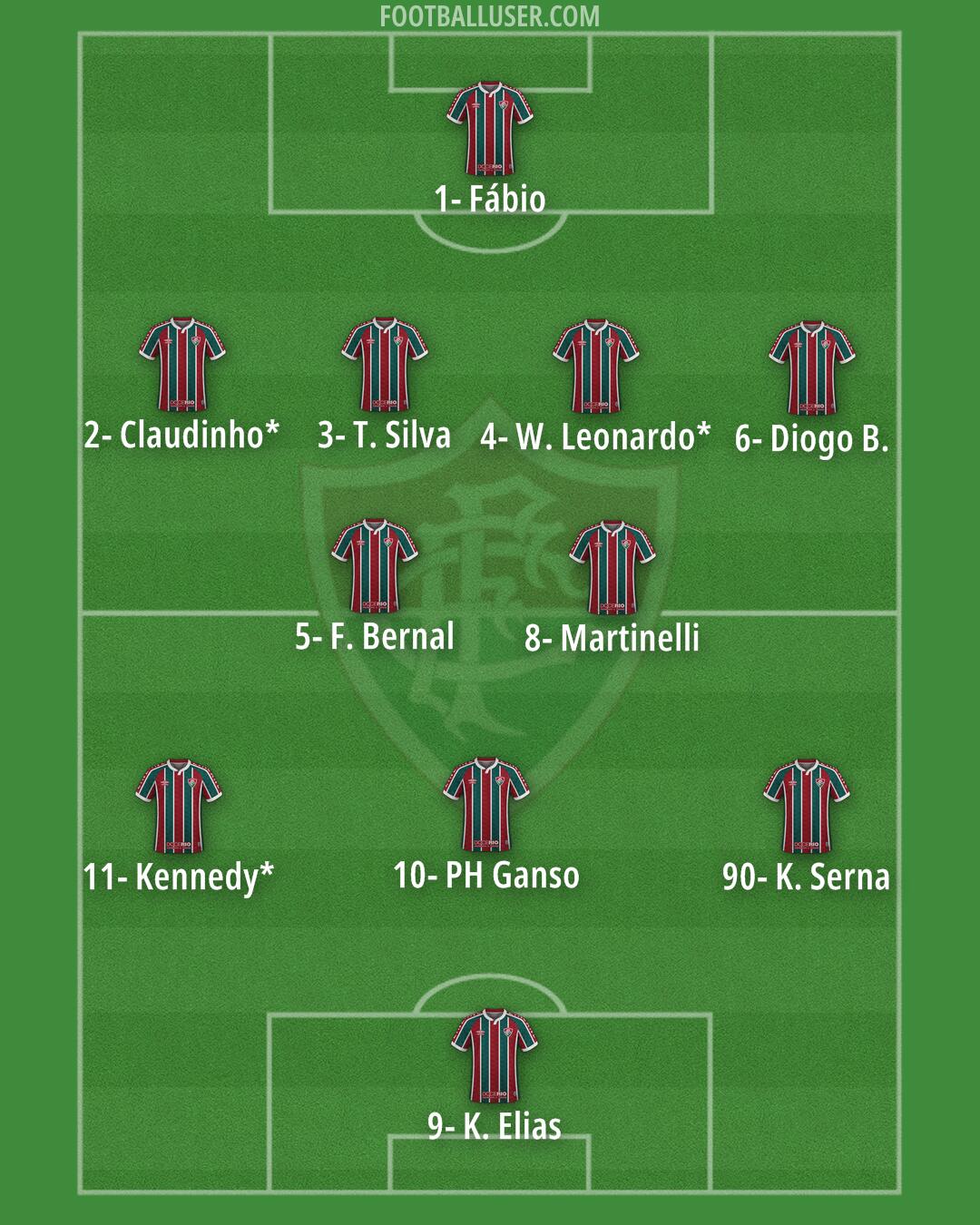
1- Fábio2- Claudinho*
3- T. Silva
4- W. Leonardo*
6- Diogo B.
5- F. Bernal
8- Martinelli
10- PH Ganso
9- K. Elias
11- Kennedy*
90- K. Serna
Fluminense aims to control the tempo through heavy possession and technical control within a 4-5-1 formation. This lineup is built to dominate the middle of the pitch and use high levels of ball retention to tire the opposition. By occupying the central zones, the team seeks to dictate the rhythm of the match and limit the chances for the opponent to attack.
Fábio starts in goal to anchor the back line. The defense operates in a flat back four where Claudinho and Diogo B. act as full backs. Claudinho provides width by pushing up the right flank, while Diogo B. covers the left side. In the center, T. Silva acts as a ball playing defender with high intelligence to read the game, paired with W. Leonardo who provides strength and covers the space behind the line. This defensive unit stays compact to protect the middle.
The midfield relies on a central trio with a double pivot sitting in front of the defense. Martinelli and F. Bernal work together to shield the defense and win the second ball. Martinelli holds his position to protect the center, while F. Bernal works to disrupt play and win possession. Kennedy and K. Serna operate in the half spaces to link the play, with Kennedy driving the ball forward. PH Ganso operates as the main playmaker, receiving the ball to play through the lines and find teammates with his passing range.
K. Elias leads the line as a lone striker tasked with holding up the ball to allow others to join the attack. He must fight against the opposition center backs to create space for the advancing midfielders. The attacking threat comes from the combination of the five midfielders and the lone striker, often using quick passes to move the opposition back line. Kennedy and K. Serna look to make runs into the box to support Elias, while the wingers or wide midfielders look to find space behind the defense.
This formation offers Fluminense significant numerical superiority in the central areas. By packing the midfield, the team can control the ball and force the opponent to run for long periods. Another advantage is the ability to compress the space between the lines when defending, making it very difficult for opponents to play through the center.
The Fluminense lineup focuses on technical control to dominate the ball and manage the game. This formation is best suited for matches where the team wants to starve the opposition of possession and dictate the tempo from the center.