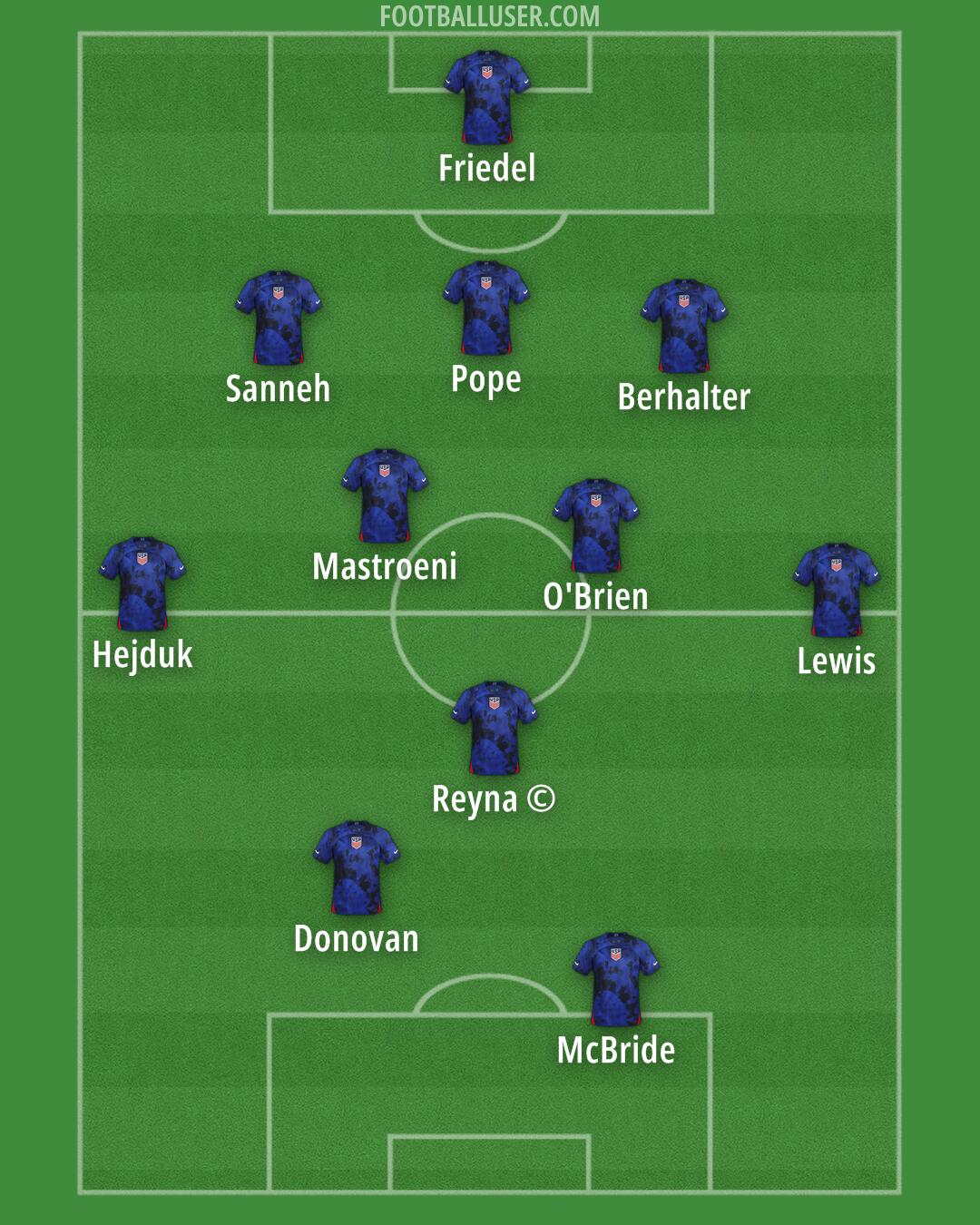
United States National Soccer Team Formation
 November 12, 2024


Starting Lineup
Friedel · Reyna © · McBride · Donovan · O'Brien · Lewis · Hejduk · Mastroeni · Pope · Berhalter · SannehUnited States aims to control the tempo through a high press and a dense central presence using a 3-6-1 formation. This lineup focuses on winning the ball high up the pitch to drive the game forward quickly. By crowding the middle, the team seeks to dominate possession and force opponents into mistakes in their own half.
Friedel guards the goal as the last line of defense. In front of him, a back three consists of Pope, Sanneh, and Berhalter. Sanneh and Berhalter act as wide centre-backs to cover the flanks, while Pope operates as the central defender to win the header and clear the lines. This unit remains compact to prevent through balls, with the defenders stepping up to squeeze the space when the team pushes forward.
The midfield is a crowded engine room designed to dominate the center of the pitch. Mastroeni sits as a single pivot to shield the defense and recycle possession. Ahead of him, O'Brien and Lewis work to connect the lines, with Lewis often looking to carry the ball forward. Hejduk operates on the left side of this midfield block to provide extra cover, while the captain Reyna © plays in an advanced role to create from deep and pick up runners. Donovan moves between the lines to link the midfield to the attack.
The attacking structure relies on McBride acting as a lone striker to hold up the ball. He works to pin the last defender, creating space for the players behind him. Donovan and Reyna © operate as attacking midfielders who move into the half-spaces to support the front line. This allows the team to attack in combinations, with the wide midfielders pulling wide to stretch the defence and then cutting inside to find the feet of the striker.
United States gains a significant advantage through numerical superiority in the midfield. This allows them to control the rhythm of the game and win the second ball frequently. The ability to press in coordinated waves from the front line makes it difficult for opponents to build play from the back. Furthermore, the formation provides flexibility to shift between a compact mid-block and an aggressive high press.
This 3-6-1 formation is built to dominate games where the opposition allows space in the middle of the park. It is best suited for matches against teams that struggle to play out from the back under heavy pressure.