
Lecce Football Formation
 November 17, 2024


Starting Lineup
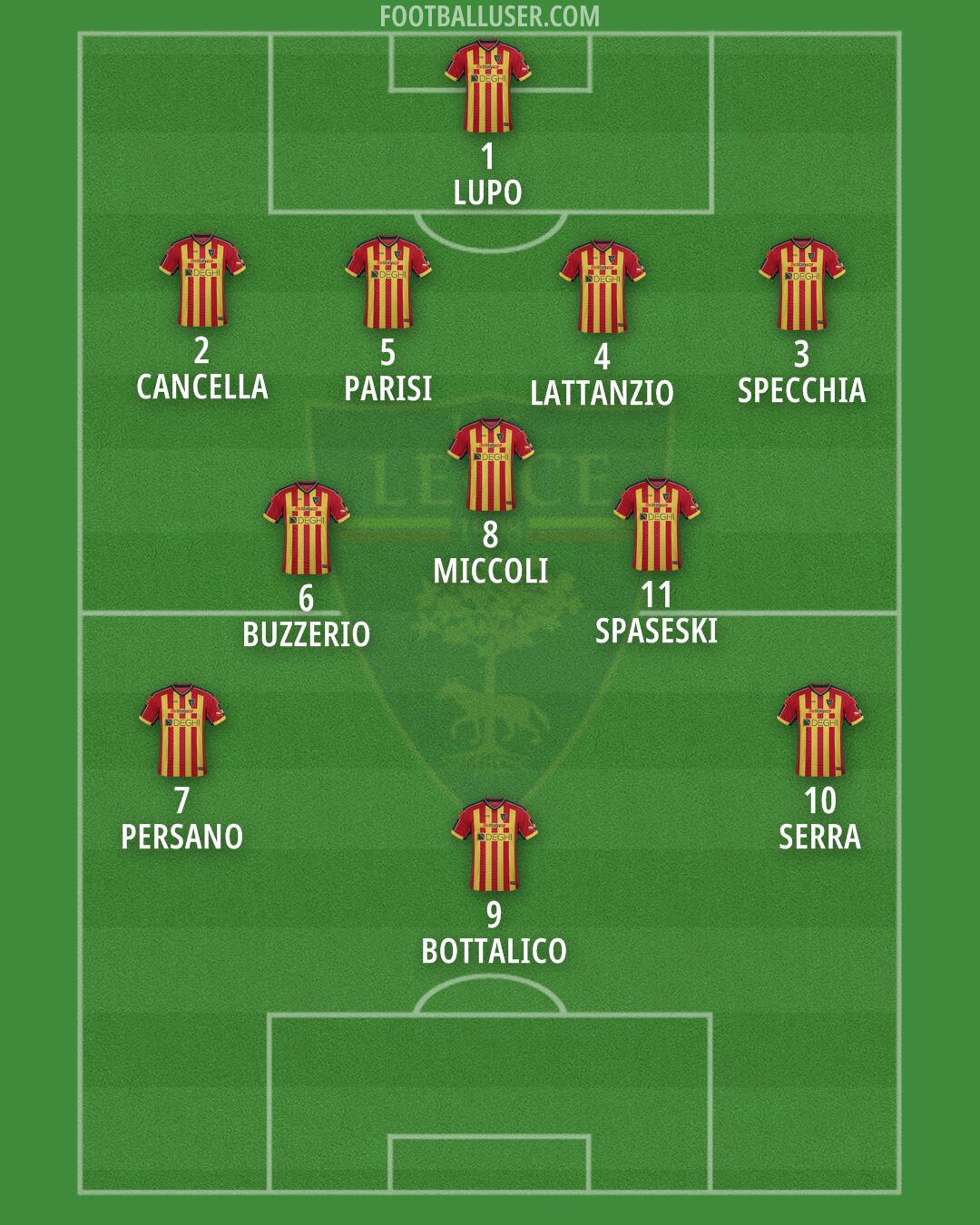
1 (LUPO)2 (CANCELLA)
5 (PARISI)
4 (LATTANZIO)
3 (SPECCHIA)
8 (MICCOLI)
6 (BUZZERIO)
11 (SPASESKI)
7 (PERSANO)
10 (SERRA)
9 (BOTTALICO)
Lecce aims to play a vertical style of football built around a 4-3-3 formation. The team focuses on winning the ball high up the pitch to trigger a quick break. This formation is designed to use the width of the field to stretch the defence and create openings in the middle. By playing with three attackers, the team looks to keep the opposition pinned back.
In the defensive phase, 1 stands in goal to command the area. The back line operates as a flat back four that can shift left or right to cover the ball. 4 and 5 act as the central defenders, with 5 tasked to win the header and 4 to cover the space behind. On the flanks, 2 and 3 work to maintain the width. 2 can move up to overlap the winger, while 3 must be ready to track back if the team loses possession. The whole unit works to hold a compact block and defend zonally.
The midfield features a three man midfield with a single pivot. 6 sits in front of the back four to shield the defence and intercept passes. 8 and 11 work as the two eight roles to connect the defensive and attacking lines. 11 has the job to carry the ball forward into the half spaces, while 8 looks to recycle possession and play through the lines. 6 must stay disciplined to win the second ball and prevent the opponent from playing through the middle.
The attacking front line consists of three players. 9 plays as a lone striker to hold up the ball and pin the last defender. 7 and 10 act as inverted wingers who cut inside to attack the near post or the far post. 10 looks to arrive late into the box to support 9, while 7 tries to isolate the fullback in a one on one situation. This formation allows for quick combinations, where the wingers can cut it back to the arriving midfielders or hit in behind on the transition.
A key strength of this Lecce lineup is the ability to press high in coordinated waves. When 7, 10, and 9 press from the front, it forces the opposition to play long balls. Another advantage is the wide overloads created when 2 or 3 push up to overlap the winger. This creates numerical superiority on the flanks. The team also benefits from speed of transition to break quickly once the ball is won.
This 4-3-3 formation provides a strong balance between pressing and width. It is best suited for matches against teams that play a high line and struggle to defend against quick transitions.