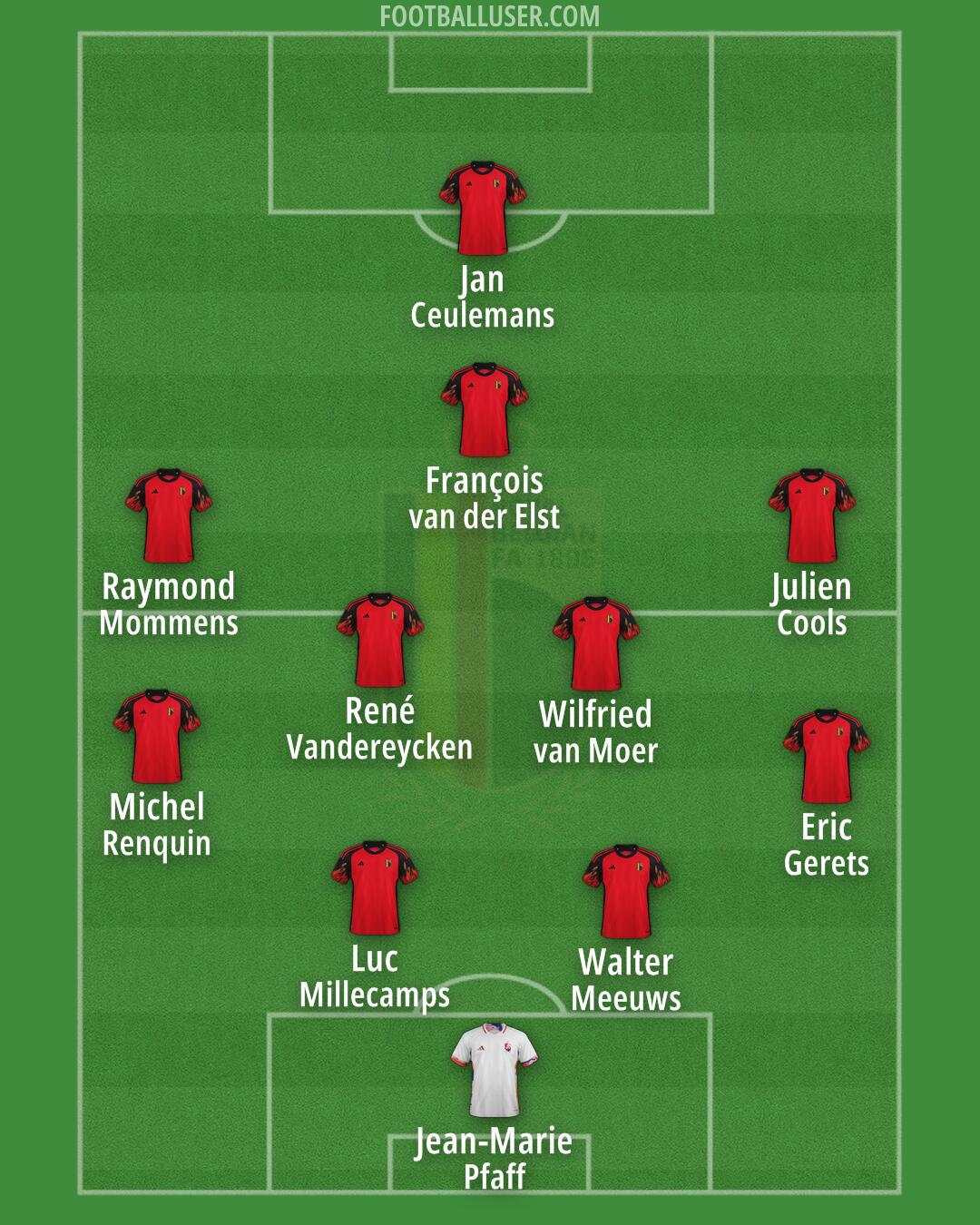

Belgium National Football Team Formation
 November 18, 2024


Starting Lineup
Walter (Meeuws) · Jean-Marie (Pfaff) · Jan (Ceulemans) · Raymond (Mommens) · René (Vandereycken) · Wilfried (van Moer) · Eric (Gerets) · François (van der Elst) · Julien (Cools) · Luc (Millecamps) · Michel (Renquin)Belgium looks to play a direct style of football using a 4-5-1 formation. This lineup focuses on being defensively solid while looking to hit the opposition on the break. The Red Devils aim to squeeze the space in the middle of the pitch and win the second ball to launch attacks quickly toward the lone striker.
Jean-Marie stays between the posts to command his area. The back four maintains a flat line to keep the defensive unit together. Luc and Walter act as the central defenders, where Walter uses his strength to win the header and Luc works to cover the space behind him. On the flanks, Eric and Michel provide width but must track back to defend against wide runners. They work as a unit to hold the line and deny the turn to any attacking players.
The midfield is built around a double pivot consisting of Wilfried and René. They sit in front of the defense to shield the back four and intercept passes. Raymond and Julien operate in the half-spaces to connect the defensive and attacking lines, often looking to drive forward with the ball into the final third. François plays as an attacking ten behind the striker, looking to find the feet of Jan or make runs into the box to support the attack. This group works to compress the midfield and win it back high up the pitch when possible.
In the attacking phase, Jan serves as the lone striker and target man. He works to hold up the ball and allow the midfielders to push forward. The wide players, Raymond and Julien, often tuck inside to create central presence, which allows Eric and Michel to overlap the winger and provide crosses. Belgium builds play by finding the feet of the striker or using the midfielders to play through the lines. The goal is to create runs in behind the opposition defense through quick combinations.
This formation offers significant advantages in terms of compactness when defending. By using a five man midfield, Belgium can create numerical superiority in the center of the pitch to deny the opposition time on the ball. The team also benefits from a high pressing intensity in the middle, which can trigger a quick transition once the ball is won.
The 4-5-1 formation provides a reliable way to stay compact and frustrate larger teams. This setup is best suited for games where Belgium needs to sit deep and counter at pace against dominant possession sides.