
Austria National Football Team Formation
 November 19, 2024


Starting Lineup
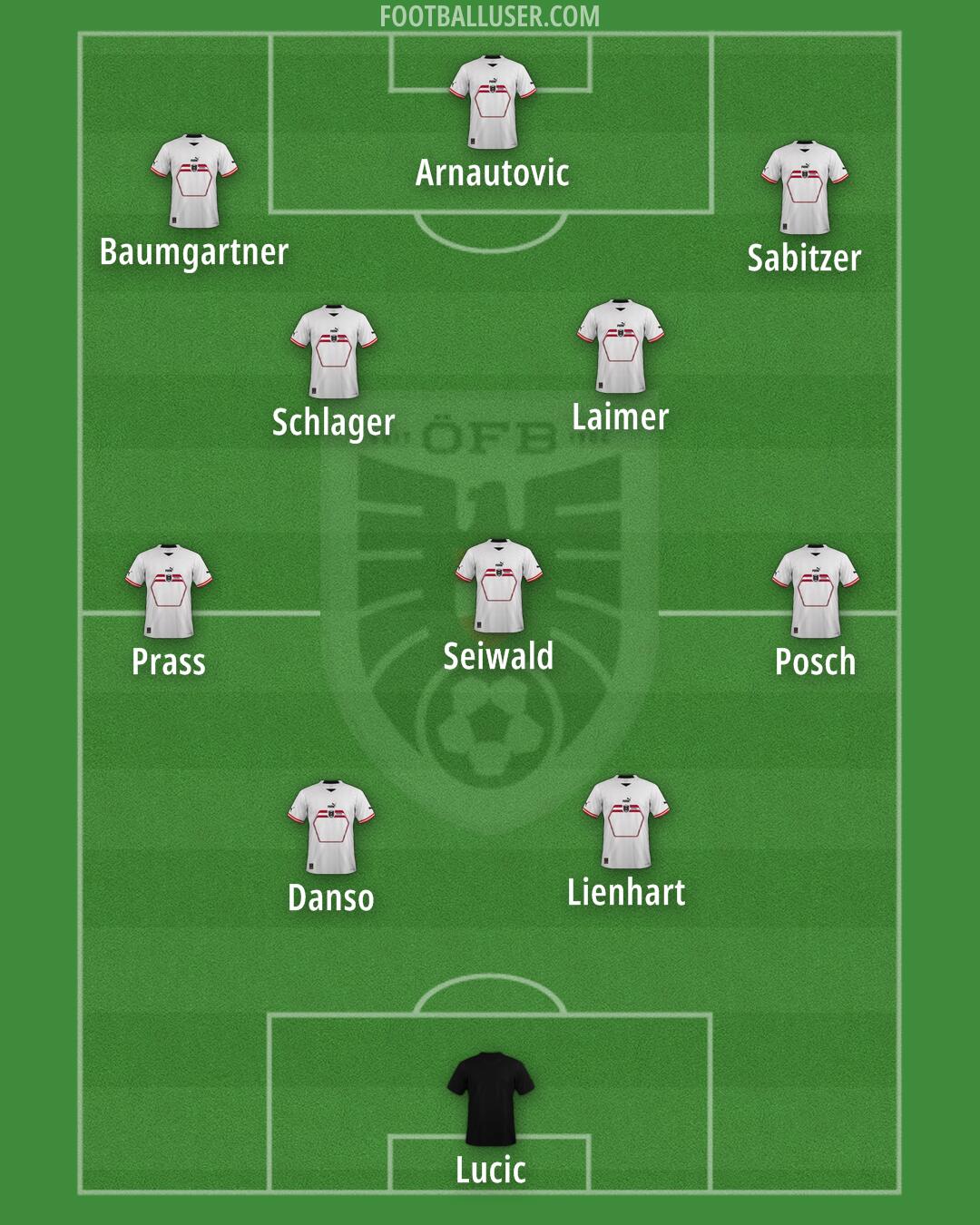
Arnautovic · Baumgartner · Schlager · Laimer · Seiwald · Sabitzer · Prass · Danso · Lienhart · Posch · LucicAustria relies on a high press and verticality to disrupt opponents using a 5-2-3. This lineup is built to win the ball high up the pitch and move quickly through the thirds. By using this formation, the team aims to squeeze the space in the opposition half and strike through rapid transitions.
Lucic protects the goal as the lone goalkeeper. The defensive unit operates with a back five that can act as a narrow defensive block or step up into a high line. Seiwald sits in the middle to win headers and hold the line, while Danso and Lienhart operate as the wide centre-backs to cover the space left by the wide defenders. Prass and Posch act as attacking wing backs who push high to provide width, but they must also track back to defend the flanks and maintain a compact unit when the team sits deep.
The midfield consists of a double pivot with Schlager and Laimer. Laimer uses his pressing intensity and high work rate to drive forward with the ball and disrupt the opposition. Schlager works to shield the defense and recycle possession, ensuring the team can move from defense to attack. This pairing connects the back five to the front three, often stepping up to trigger a press and win the second ball in central areas to keep the pressure on.
The attacking front line employs three players across the pitch. Arnautovic works as a target man to hold up the ball and find the feet of others. Sabitzer and Baumgartner act as wide attackers who often cut inside to create central presence, leaving the touchlines for the wing backs. The front three press the opposition back line to force mistakes. This movement allows the team to play through the lines and create runs in behind, or use the wing backs to get to the byline and deliver early crosses to the strikers.
A major advantage for Austria is the ability to press high in coordinated waves, forcing the opponent to play long balls or make mistakes under pressure. The formation also creates wide overloads when Prass and Posch overlap the attackers, forcing the opposition defense to stretch and pull wide. This provides space for the wingers to operate in one on one situations or receive the ball in the half spaces to break the line.
This 5-2-3 formation creates a strong balance between defensive compactness and attacking verticality. It is best suited for matches against possession based teams where high intensity pressing can force turnovers.