Wolves Football Formation
 November 24, 2024


Starting Lineup
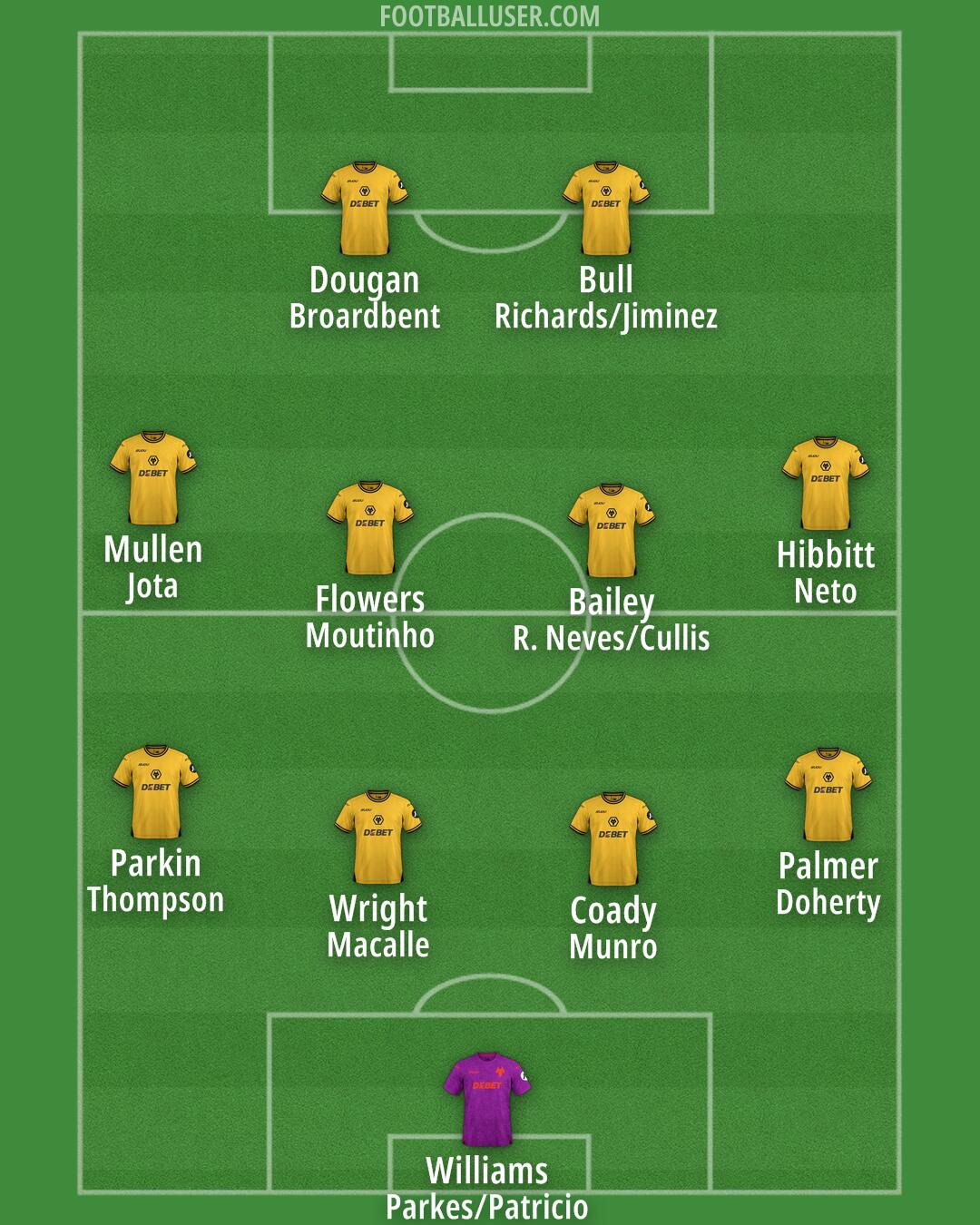
Williams (Parkes/Patricio) · Palmer (Doherty) · Coady (Munro) · Wright (Macalle) · Parkin (Thompson) · Bailey (R. Neves/Cullis) · Flowers (Moutinho) · Hibbitt (Neto) · Mullen (Jota) · Bull (Richards/Jiminez) · Dougan (Broardbent)Wolves aim to control the game through a direct and vertical style of play using a 4-4-2. This formation relies on tight lines and quick transitions to catch opponents off guard. The team works to win the second ball and move forward rapidly once possession is regained.
Williams sits between the posts to command his area. The defensive unit operates as a flat back four with Palmer and Parkin acting as full backs. Coady and Wright form the central pairing, where Coady uses his aerial strength and leadership to defend the box. Wright provides cover and works to maintain a high line when the team pushes up. The back four stays compact to deny space in the channels.
The midfield functions as a four man block. Bailey and Flowers operate in the center, acting as a double pivot to shield the defense. Bailey drives forward with the ball to link the lines, while Flowers holds his position to protect the center. On the flanks, Hibbitt and Mullen provide width and energy. They work to track back and help the full backs while looking to carry the ball forward into the final third.
Wolves use two forwards to stretch the opposition. Dougan operates as a pressing centre-forward to harass the back line, while Bull acts as the primary target man to hold up the ball. The duo works in combinations to create runs in behind. Hibbitt and Mullen look to whip it in from wide areas to find Bull, who can win the header or lay it off to Dougan. This attacking setup focuses on creating quick movement between the lines.
A major advantage for Wolves is the ability to press in a mid-block and force long balls. The compactness of the two banks of four makes it difficult for opponents to play through the middle. Furthermore, the speed of transition allows the team to hit in behind on the transition using the pace of the wide players and the movement of the two strikers.
This 4-4-2 lineup provides a solid foundation for teams that want to hit opponents on the break. It is best suited for matches against sides that dominate possession but leave space behind their defensive line.