Blackburn Football Formation
 November 24, 2024


Starting Lineup
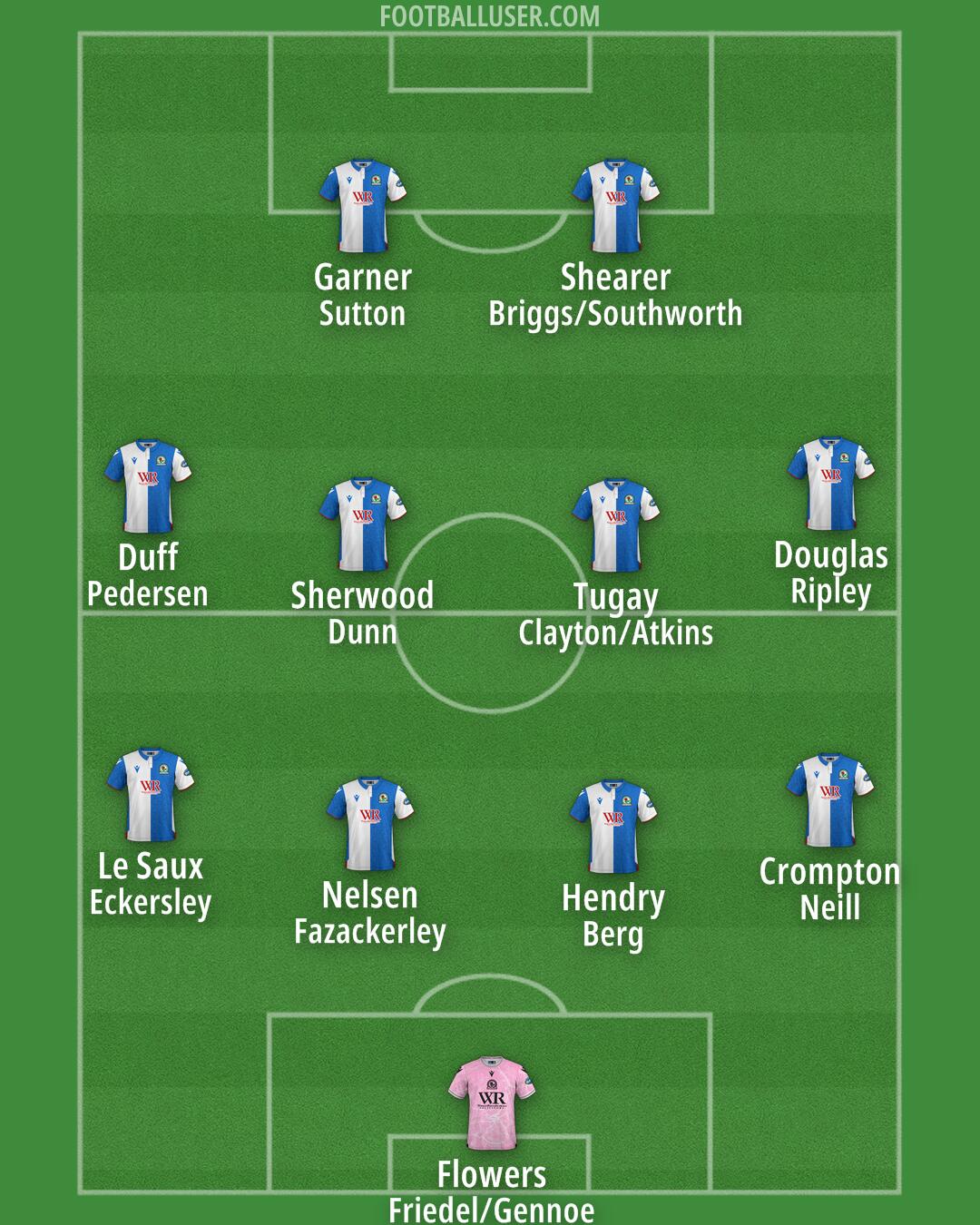
Flowers (Friedel/Gennoe) · Crompton (Neill) · Hendry (Berg) · Nelsen (Fazackerley) · Le Saux (Eckersley) · Tugay (Clayton/Atkins) · Sherwood (Dunn) · Douglas (Ripley) · Duff (Pedersen) · Shearer (Briggs/Southworth) · Garner (Sutton)Blackburn focuses on a direct and efficient style of play through a 4-4-2 formation. This lineup is built to rely on high energy and rapid transitions to catch opponents off guard. The team seeks to use the width of the pitch to create chances before looking to exploit the central areas with quick vertical passes.
Flowers stays between the posts to organize the defensive unit. A flat back four provides the foundation for the Blackburn defense, with Le Saux and Crompton acting as full backs. Le Saux looks to overlap the winger to provide crosses while Crompton offers balance on the opposite side. In the center, Nelsen and Hendry form a sturdy pairing, with Nelsen using his aerial strength and Hendry acting as a covering defender to sweep behind the line. They work together to hold a compact line and win the second ball in their own half.
The midfield operates in two banks of four to squeeze the space between the lines. Tugay acts as the deep lying playmaker, using his passing range to distribute the ball and recycle possession. Beside him, Sherwood works to connect the defensive and attacking lines, often picking up runners to drive the team forward. Duff and Douglas occupy the wide areas, with Duff looking to cut inside to create space for the full backs. This midfield unit is tasked to press in a mid block and work to win it back high up the pitch when the ball enters their zone.
Two strikers lead the line to pin the last defender and create constant pressure. Garner works as a pressing centre forward to force a long ball from the opposition, while Shearer plays as a clinical finisher who can hold up the ball and link up play with the advancing midfielders. The attack is built through combinations in the final third, where the wingers aim to get to the byline and deliver early balls. They often look to hit in behind on the transition to catch the opposition defense out of position.
This formation provides significant advantages through its ability to maintain compactness when defending and its speed of transition. Blackburn can also create wide overloads by having the full backs push high to support the wide midfielders. These movements allow the team to stretch the defence and create space for late arrivals into the box.
Blackburn utilizes this 4-4-2 to maximize directness and physical presence in the final third. This lineup is best suited for games against teams that leave space behind their defensive line.