
Spain National Football Team Formation
 November 25, 2024


Starting Lineup
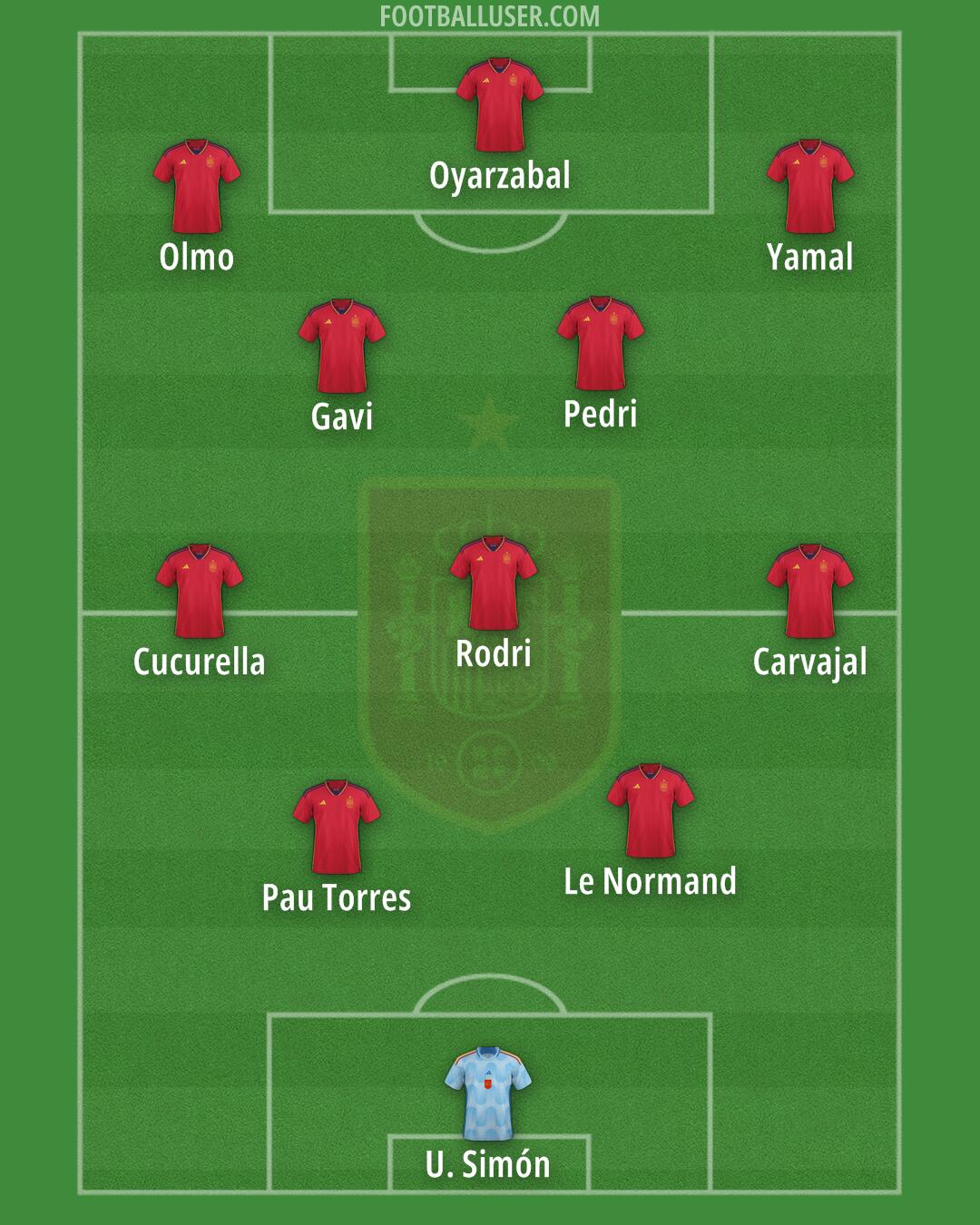
Oyarzabal · Olmo · Yamal · Gavi · Pedri · Rodri · Cucurella · Pau Torres · Le Normand · Carvajal · U. SimónSpain prioritizes heavy ball possession and high pressure within a 5-2-3 formation. This lineup is built to dominate the ball and pin opponents back in their own half. By using a wide attacking front, the team seeks to stretch the opposition and create chances through constant ball circulation and movement.
U. Simón stays between the posts to organize the defensive unit. The back line works as a back five, using a staggered arrangement to cover the pitch. Rodri sits in the middle as a ball playing defender to help play out from the back, while Le Normand and Pau Torres provide strength in the air and help clear the lines. Carvajal and Cucurella act as attacking wing backs who push high to provide width, while they remain ready to track back and cover the space behind.
In the middle of the pitch, a midfield pair works to control the tempo and connect the lines. Pedri works as a creator with a wide passing range who can receive on the half turn to move the ball forward, while Gavi provides the intensity to press aggressively and win it back high up the pitch. These two help to recycle possession and play through the lines to reach the attackers. They must move to squeeze the space and prevent the opposition from breaking quickly during transitions.
The front line uses three attackers to pin the opposition defense. Oyarzabal acts as the central striker to hold up the ball and find the feet of the midfielders. Yamal plays as an inverted winger on the right, using his dribbling style to cut inside, while Olmo operates on the left to stretch the defense. The wing backs, Carvajal and Cucurella, often overlap the wingers to create wide overloads. This movement is designed to create runs in behind and allow for quick combinations in the final third.
A significant advantage for Spain is the ability to create wide overloads through the combination of wingers and wing backs. This forces opponents to defend in a narrow block and often leaves space for the wingers to isolate defenders one on one. Another strength is the ability to press in coordinated waves, where the front three and the midfield work together to trigger a press high up the pitch.
This 5-2-3 formation provides a way to maintain control through high possession and intense pressure. It is best suited for matches where the team needs to break down a deep defensive block and exploit wide areas.