Liverpool Football Formation
 November 25, 2024


Starting Lineup
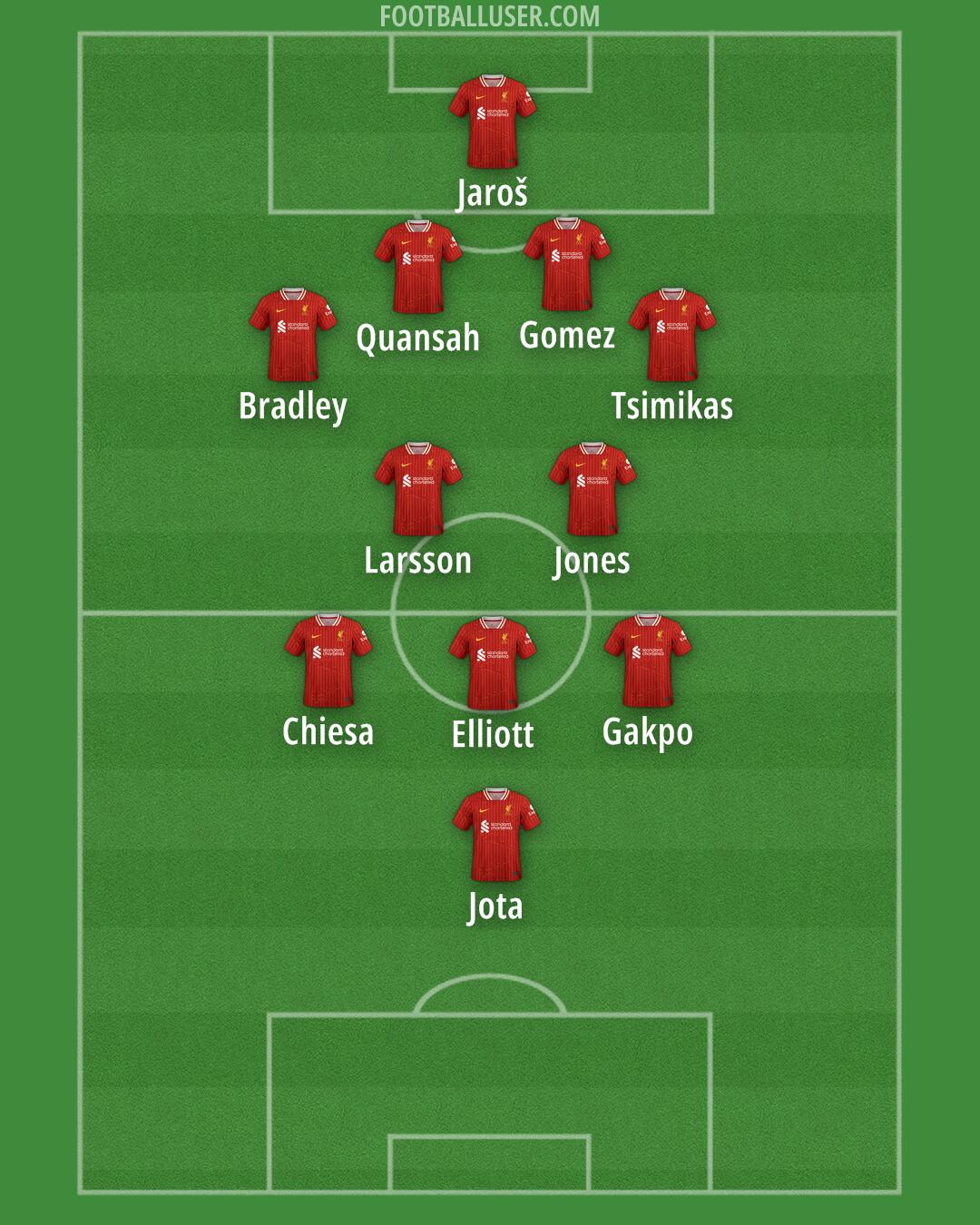
Tsimikas · Gomez · Quansah · Bradley · Jones · Elliott · Gakpo · Chiesa · Jota · Jaroš · LarssonLiverpool look to play with extreme verticality and high intensity in this 4-2-4 formation. The lineup is built to stretch the opposition and win the ball back high up the pitch to catch teams in transition. This is a high risk, high reward system that relies on getting enough bodies forward to pin the opponent back.
Jaroš starts in goal to oversee the defensive unit. The back line operates as a flat back four with Gomez and Quansah acting as the central defenders. Gomez provides experience in covering for teammates while Quansah uses his aerial strength to win headers in the box. Bradley pushes high from right back to provide width, while Tsimikas plays as an attacking left back to support the left side of the pitch. The defensive unit must hold a high line to keep the team compact.
The midfield relies on a double pivot consisting of Jones and Larsson to control the center of the pitch. Jones works to carry the ball forward and connect the defense to the attack, while Larsson looks to win the second ball and cover the space left behind by the advancing full backs. This pair must work hard to press in a mid-block and ensure they do not get bypassed by direct passes. They serve as the engine that allows the front four to stay high.
Up front, Liverpool use two forwards in a partnership with Elliott and Jota leading the line. Elliott acts as a pressing centre-forward to force long balls, while Jota looks to find the feet of his teammates and make runs in behind the defense. On the flanks, Gakpo plays as an inverted winger on the left to cut inside and create space for Tsimikas, while Chiesa operates on the right wing to drive at the defense. This front four aims to isolate wide players in one on one situations and deliver crosses into the box.
This formation offers significant attacking pressure through its ability to press high in coordinated waves. By playing with four attackers, Liverpool create wide overloads and can quickly switch play to exploit the flanks. The speed of transition is a major advantage, as the team is always positioned to strike immediately after winning possession.
Liverpool utilize this 4-2-4 to overwhelm opponents through aggressive forward movements and width. This formation is best suited for games where the team needs to break down a deep defensive block through sheer numbers in the final third.