
Austria Klagenfurt Football Formation
 November 25, 2024


Starting Lineup
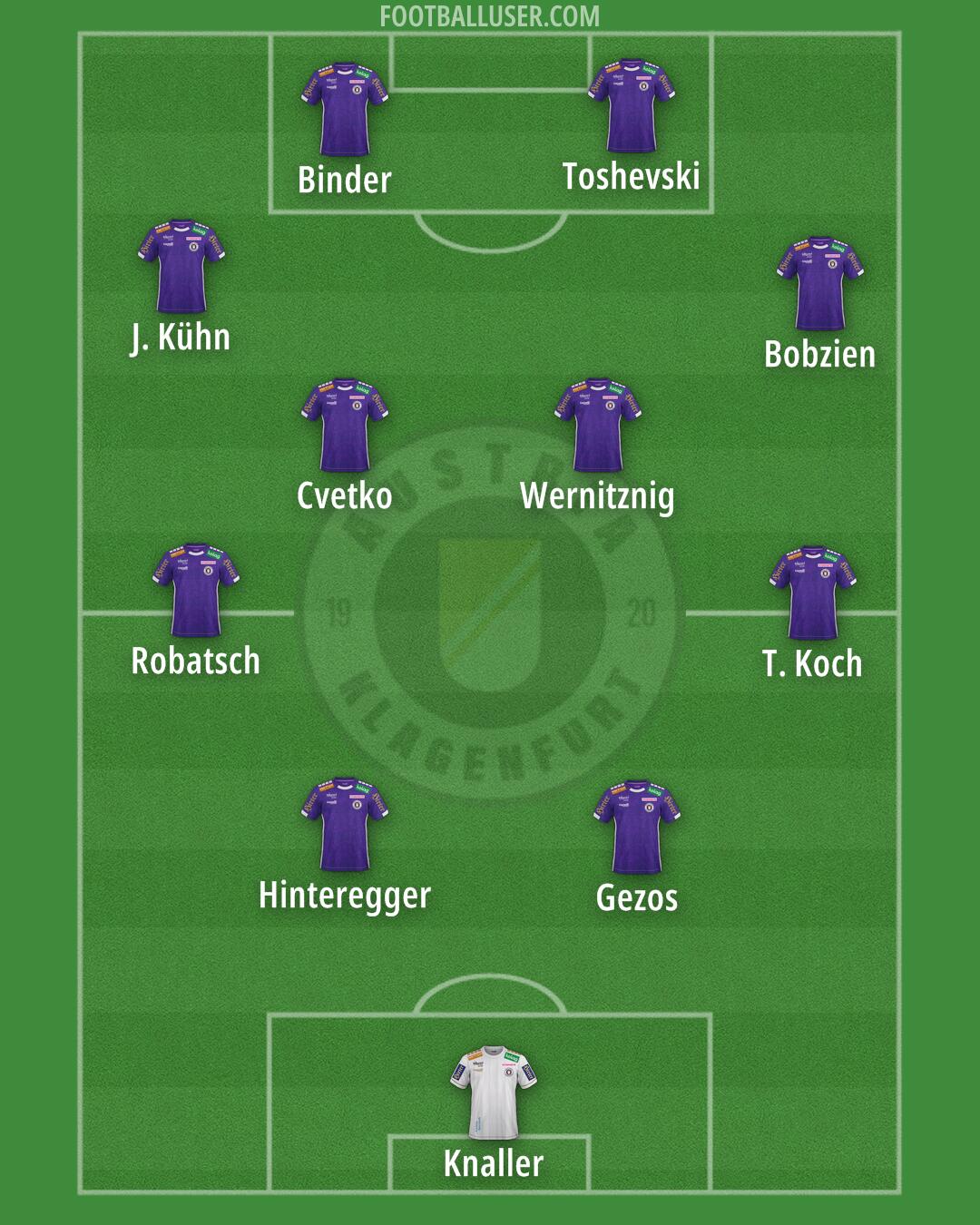
Robatsch · Toshevski · Hinteregger · Gezos · Wernitznig · T. Koch · Binder · Cvetko · Bobzien · J. Kühn · KnallerAustria Klagenfurt plays with an aggressive, vertical intent using a 2-4-4 formation. This lineup is built to overwhelm the opposition through direct play and high intensity. The team seeks to pin the opposition back and score through rapid transitions and heavy pressure.
Knaller operates as the lone goalkeeper behind a very thin defensive line. Gezos and Hinteregger function as the two central defenders, meaning they must play with a high line to squeeze the space. They have to be dominant in the air and ready to sweep behind to cover any balls played into the channels. Since there are no traditional full backs, these two must stay compact to prevent the opposition from finding space between them.
The midfield consists of a double pivot and two attacking players. T. Koch and Robatsch sit in front of the defense to shield the two center backs and win the second ball. They must be ready to recover possession and immediately find the players in front of them. Cvetko and Wernitznig operate in the half spaces to connect the defensive and attacking lines. These two players drive forward to create passing lanes and ensure the team can progress through the thirds.
The attacking unit is composed of four players working in unison. Bobzien and J. Kühn act as wide wingers to stretch the defence and provide width. They look to get to the byline or cut inside to create chances. In the middle, Binder and Toshevski function as two forwards in a partnership. They focus on combination play and making runs in behind to exploit the space left by the opposition. The movement of these four is designed to create constant pressure on the back line.
This formation provides a clear advantage through numerical superiority in the final third. By having four players close to the goal, Austria Klagenfurt can easily create wide overloads and force the opposition to defend in very tight spaces. The team also benefits from the ability to press from the front in coordinated waves, which often forces a long ball from the opponent.
This aggressive lineup is built for dominance and attacking pressure. It is most effective when facing a team that defends in a low block and allows the opposition to control the ball.