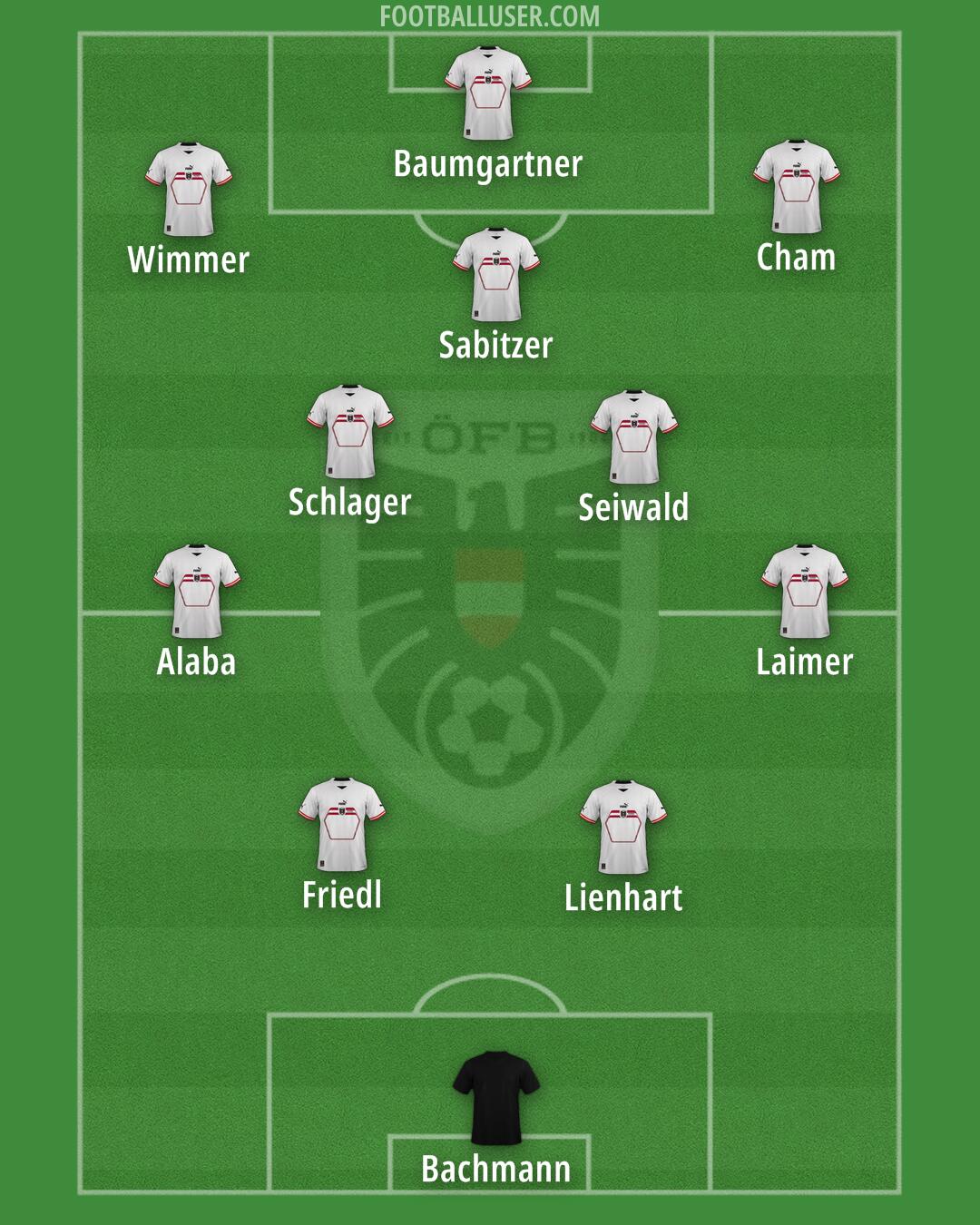

Austria National Football Team Formation
 November 25, 2024


Starting Lineup
Bachmann · Alaba · Friedl · Lienhart · Laimer · Schlager · Seiwald · Cham · Sabitzer · Baumgartner · WimmerAustria plays with a highly vertical identity built around a 2-5-3 formation. This lineup seeks to overwhelm the opposition through aggressive ball winning and quick transitions. The team wants to occupy as much of the pitch as possible to squeeze the space and dominate the central areas through constant movement.
Bachmann stands between the posts to manage the defensive line. Lienhart and Friedl form a two man back line that must hold a high line to support the midfielders. Lienhart uses his passing range to play out from the back while Friedl focuses on covering the space and winning headers in aerial duels. These two central defenders must be ready to step up and trigger a press when the ball enters their zone.
The midfield is a five man unit with an attacking ten, designed to control the game. Alaba acts as a deep lying playmaker, dropping between the centre backs when needed to recycle possession and spread wide. Laimer provides the energy to carry the ball forward and press aggressively to win the ball back high up the pitch. Seiwald and Schlager work as a central pair to win the second ball and ensure the team stays compact in the middle. Sabitzer operates in the hole, looking to arrive late into the box and connect the lines. This heavy midfield presence allows Austria to bypass the midfield with direct passes to the attackers.
Up front, the team uses three attackers to stretch the defence. Wimmer and Cham play as wide wingers who hug the touchline to pull the opposition full backs out of position. Baumgartner leads the line as a pressing centre forward, tasked to mark the opposition defenders and force a long ball. This trio works to create runs in behind and look for cutbacks from the byline once they reach the final third. The goal is to use the wide players to isolate a one on one situation.
A key advantage of this formation is the numerical superiority in midfield, which makes it difficult for opponents to play through the lines. The density of players around the ball allows for quick interception and immediate counter attacks. Additionally, the ability to press in coordinated waves creates immense pressure on the opposition goalkeeper and defenders, forcing mistakes in the defensive third.
This 2-5-3 formation is built for aggressive, high pressing football. It is most effective against teams that struggle to play short from the back and are vulnerable to direct attacks in transition.