Arsenal Football Formation
 November 30, 2024


Starting Lineup
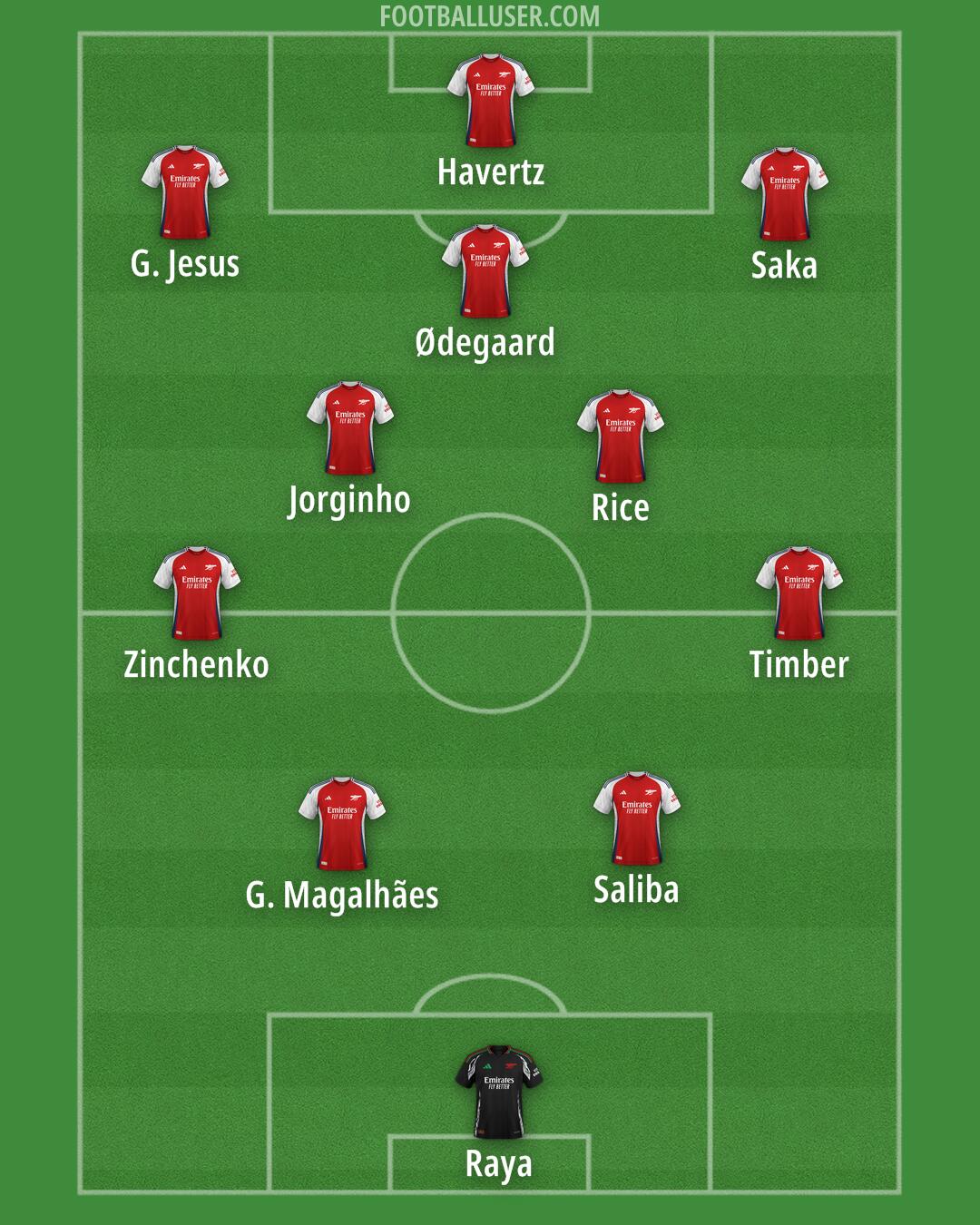
Zinchenko · Timber · G. Magalhães · Saliba · Jorginho · Rice · Saka · Havertz · Ødegaard · G. Jesus · RayaArsenal aims to control the ball and dominate through high pressing in a 2-4-4 formation. This lineup is built to pin the opposition back in their own half and use extreme verticality to break lines. By pushing many players into advanced positions, Arsenal seeks to win the ball back high up the pitch and immediately exploit the space behind the opponent's defensive line.
Raya operates as the lone goalkeeper, acting as a sweeper behind a high line. The defensive unit consists of a narrow pair of central defenders, G. Magalhães and Saliba, who must be ready to cover large amounts of space. G. Magalhães is dominant in the air and provides strength, while Saliba uses his recovery pace to sweep behind the high line when the team is caught on the break. These two central defenders play out from the back to start every attack, focusing on ball retention rather than just clearing the lines.
The midfield is a four man block designed to squeeze the space in the center. Zinchenko and Timber act as the double pivot, with Zinchenko often dropping deep to help build play and Timber providing more balance. Ahead of them, Rice and Jorginho operate in the half spaces to connect the defensive and attacking lines. Rice drives forward with the ball to carry it into the final third, while Jorginho looks to recycle possession and find the feet of the attackers. This midfield group works to press aggressively to win the ball high and prevent the opposition from playing through the middle.
In the attacking phase, the team utilizes four players to stretch the defence. Saka stays wide as an inverted winger to isolate defenders one on one, while G. Jesus occupies the left flank to create room for others. Ødegaard and Havertz operate as the two forwards, with Ødegaard playing as a second striker in the hole to find pockets of space. Havertz acts as a pressing centre-forward to harass the opposition back line. This front four works to create combinations in tight spaces, with Saka and G. Jesus looking to cut inside to allow others to overlap or make runs in behind.
This formation offers significant tactical advantages, particularly the ability to press high in coordinated waves. By having four attackers and two attacking midfielders, Arsenal can create massive numerical superiority in the final third. The team also benefits from the speed of transition, as the proximity of the midfielders to the forwards allows them to hit in behind on the transition before the opponent can get organized.
The 2-4-4 formation creates a heavy offensive presence designed to overwhelm defensive blocks. It is best suited for games where Arsenal needs to break down a low block through sustained pressure.