
Monaco Football Formation
 November 30, 2024
 Spartacus2898


Starting Lineup
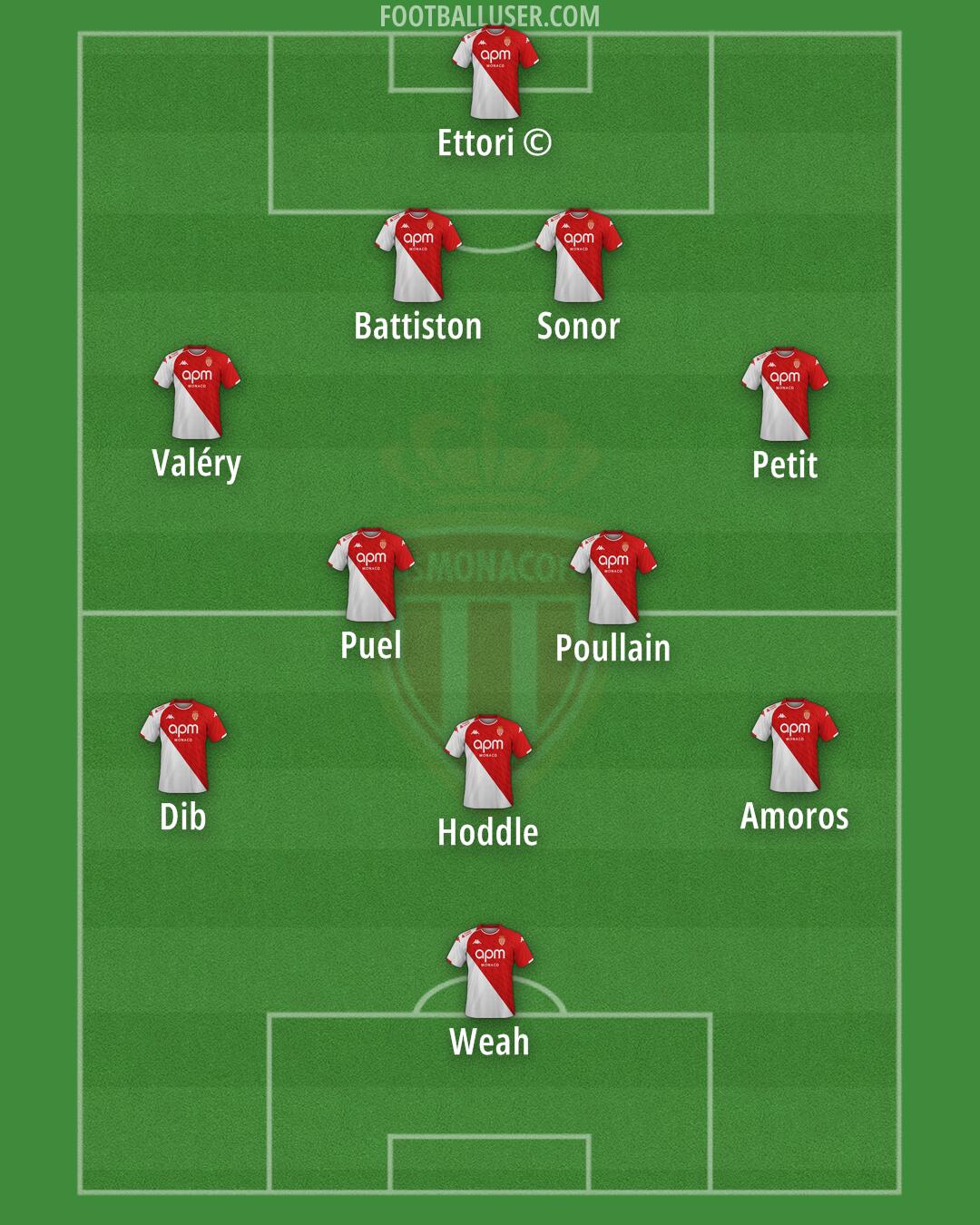
Ettori © · Battiston · Sonor · Valéry · Petit · Puel · Dib · Amoros · Hoddle · Poullain · WeahMonaco relies on a deep defensive block to frustrate opponents in this 4-5-1 formation. This lineup is built to sit deep and win the ball back to launch quick attacks in transition. The team focuses on staying compact to prevent opponents from playing through the center.
Ettori (C) commands the area from goal to lead the defensive unit. The back four consists of Valéry at right back and Petit at left back. Petit can overlap to support the play while Valéry holds his position. Sonor and Battiston form the central pair, where Sonor works to cover the space and Battiston is dominant in the air. They work together to defend zonally and maintain a compact unit across the pitch.
In the middle of the pitch, Monaco uses a five man midfield to control the tempo. Puel and Poullain act as a double pivot to shield the defence. They sit in front of the back four to intercept passes and win the second ball. Hoddle uses his passing range to play through the lines and connect the defence to the attack. Amoros and Dib work to occupy the half spaces, with Amoros looking to carry the ball forward to drive the team into the final third.
The attacking unit relies on a lone striker, Weah, to lead the line. Weah uses his pace to hit in behind on the transition and can hold up the ball to bring others into play. He works to press from the front to force a long ball. When the team moves forward, Hoddle and Amoros arrive late into the box to support the play. Switching play quickly allows the team to find Weah in one on one situations.
This formation offers great compactness when defending in a mid block. Having five midfielders creates numerical superiority in the center, making it hard for opponents to find space. The speed of transition is a major threat because Weah can break quickly once the ball is won in the middle third.
This 4-5-1 lineup is built for teams that want to defend deep and strike on the counter. It is best suited for facing dominant sides that hold much of the possession.