
Racing Club Football Formation
 December 3, 2024


Starting Lineup
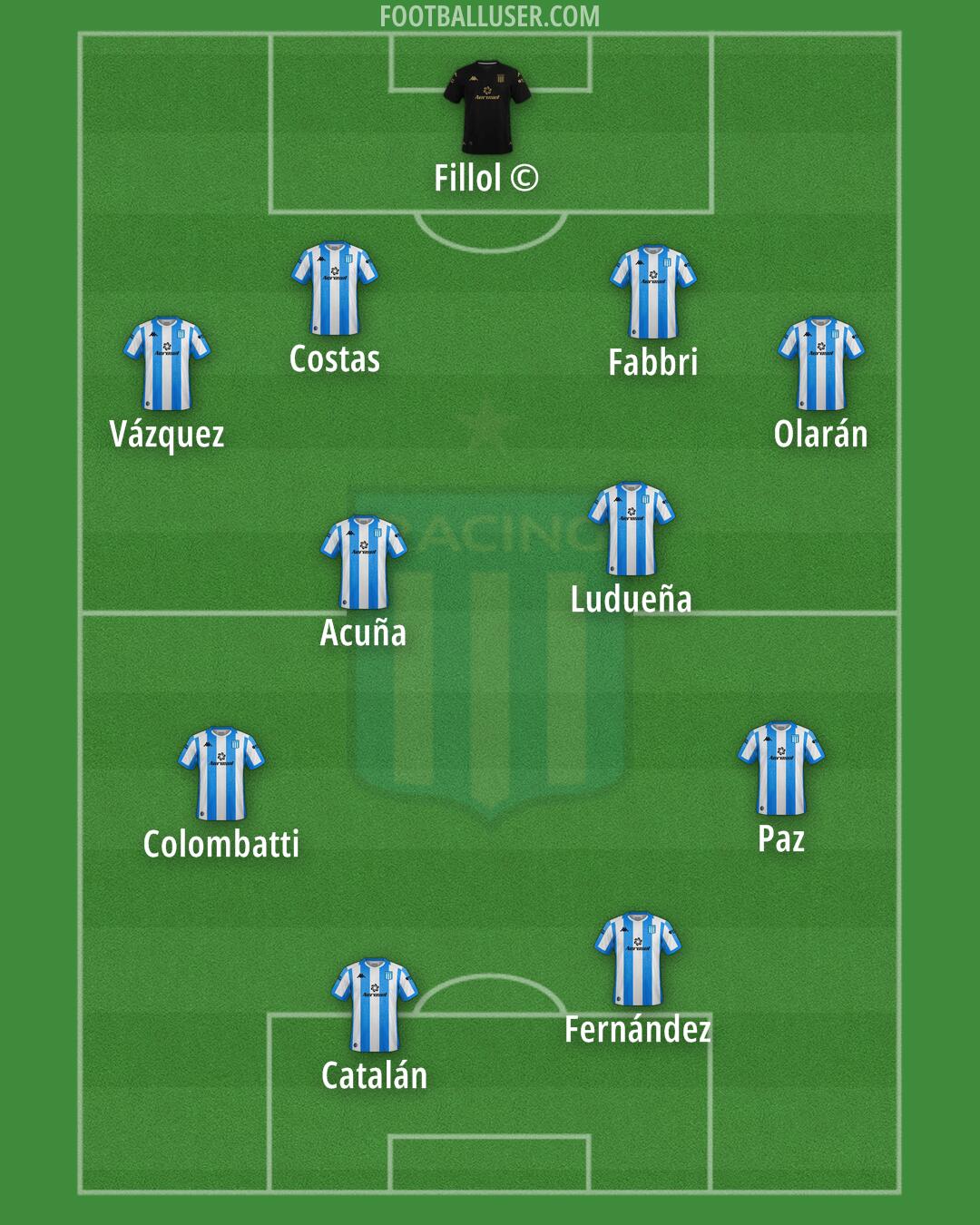
Fillol © · Costas · Vázquez · Fabbri · Olarán · Colombatti · Acuña · Ludueña · Paz · Fernández · CatalánRacing Club relies on a heavy offensive presence to overwhelm opponents, operating with a 4-2-4 formation. This lineup is built to play vertical football and use high numbers in the final third to create scoring chances. By committing many players forward, the team seeks to dominate the attacking phase and win the ball back high up the pitch.
In the defensive phase, Fillol © acts as the last line of defense in goal. The back line operates as a flat back four, with Vázquez acting as the right back and Olarán playing as the left back. Costas and Fabbri serve as the two central defenders, tasked with defending zonally and managing the space behind the high line. The defensive unit must stay compact to avoid being caught out when the team loses possession, ensuring the full backs do not leave too much space on the flanks.
The midfield functions as a double pivot, tasked with controlling the center of the pitch. Ludueña and Acuña work as the two central midfielders, providing the link between the defense and the heavy front line. One of them must drop between the centre backs to help build from the back, while the other is expected to press aggressively to win the ball back. This duo must work hard to cover the ground left vacant by the advancing attackers, ensuring they can intercept passes and protect the back four.
Racing Club employs four attackers to stretch the defense and pin the last defender. Paz and Colombatti operate as wide wingers, with the instruction to stay wide and then cut inside to create chaos. In the center, Fernández and Catalán act as a pair of forwards, looking to run in behind the opposition defense or hold up the ball to bring others into play. The front line is designed to press from the front, forcing the opposition into mistakes and long balls.
This formation offers significant tactical advantages, such as the ability to create wide overloads when the full backs push up. The high number of attackers allows the team to pin the opposition back and dominate the final third. Furthermore, Racing Club can use the speed of transition to hit opponents on the break, utilizing the direct runs of the four forwards to exploit spaces.
The 4-2-4 is a high risk, high reward system that prioritizes offensive output. It is best suited for matches where the team needs to break down a deep block or chase a result through constant pressure.