
Austria National Football Team Formation
 December 10, 2024


Starting Lineup
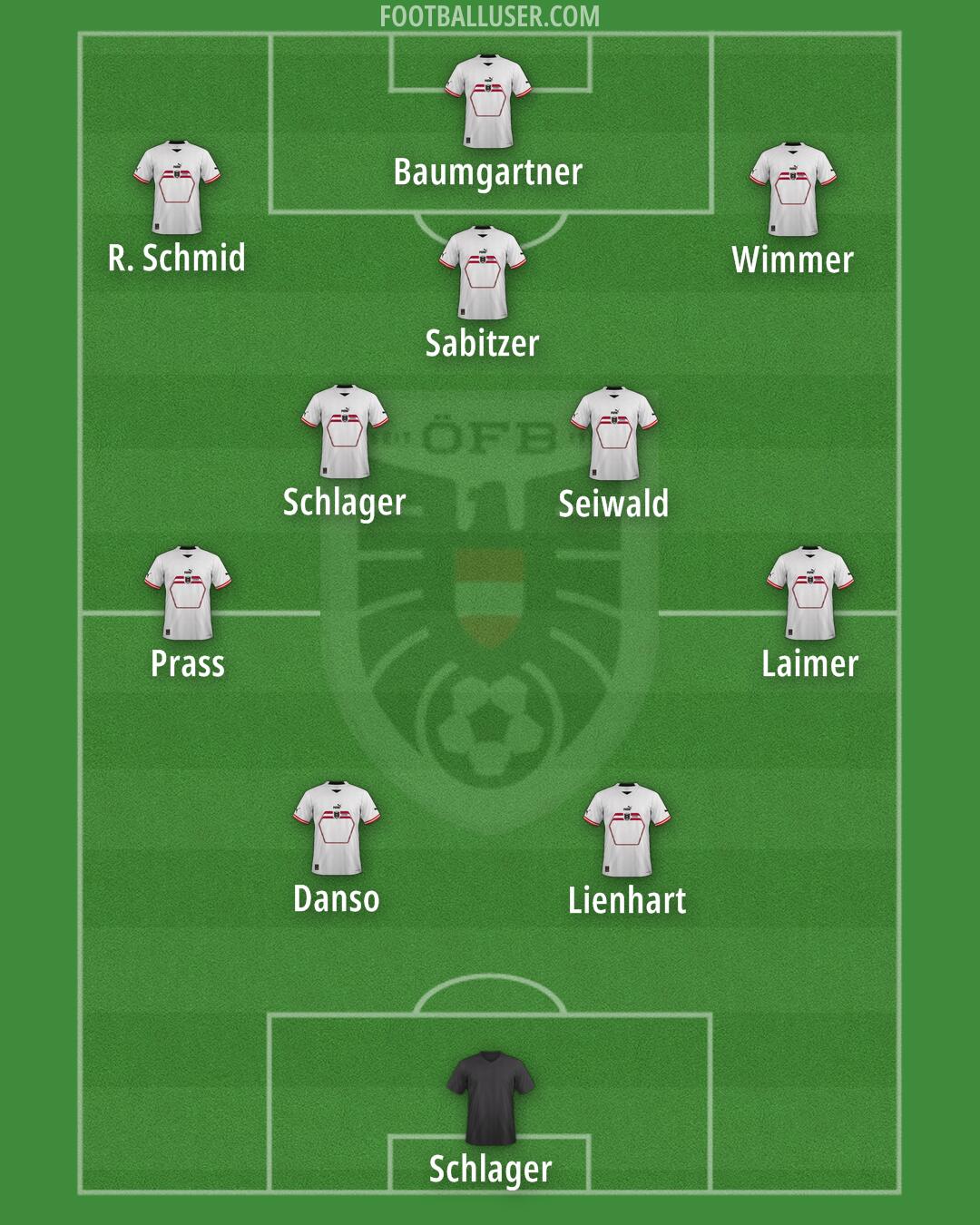
Prass · Lienhart · Danso · Seiwald · Schlager · Laimer · Sabitzer · R. Schmid · Baumgartner · Schlager · WimmerAustria plays with an aggressive identity built on a high press and verticality using a 2-5-3. This formation is designed to pin the opposition in their own half and win the ball back immediately. The team seeks to use intense pressure to force mistakes and launch quick attacks in the final third.
Schlager guards the goal and must be ready to sweep behind a high line. The defensive unit features a pair of central defenders, Lienhart and Danso, who must remain compact. Lienhart and Danso need to be dominant in the air and capable of covering space when the team pushes up the pitch. They defend zonally and must be ready to intercept long balls or tackle any runners who try to break the line.
The midfield functions as a massive block to control the center of the pitch for Austria. Laimer and Prass sit in a double pivot to shield the two central defenders and protect the central zone. Seiwald and Schlager operate in the half spaces to drive forward with the ball and connect the defensive and attacking lines. Sabitzer plays as an attacking ten behind the striker, looking to arrive late into the box and create chances. This midfield of five can press in pairs to win the ball high up the pitch.
In the final third, the team uses three attackers to stretch the defence. Baumgartner acts as a pressing centre forward to lead the line and look to hit in behind on the transition. Wimmer and R. Schmid act as wide wingers who often cut inside to create central overloads. Wimmer and R. Schmid work to pull wide and stretch the defence before looking to play through the lines. Their movements allow the midfielders to make runs into the box and support the attack.
A major strength of this formation is the numerical superiority in midfield. Laimer, Prass, Seiwald, Schlager, and Sabitzer can easily squeeze the space and win the second ball. The team also benefits from the ability to press high in coordinated waves, which forces the opposition to play long balls. This pressure often leads to quick transitions where Wimmer and R. Schmid can exploit space.
The 2-5-3 is a bold formation built for teams that want to dominate possession and pressure the ball. It is most effective against opponents who struggle to build play from the back under heavy pressure.