
Spain National Football Team Formation
 December 13, 2024
 Spartacus2898


Starting Lineup
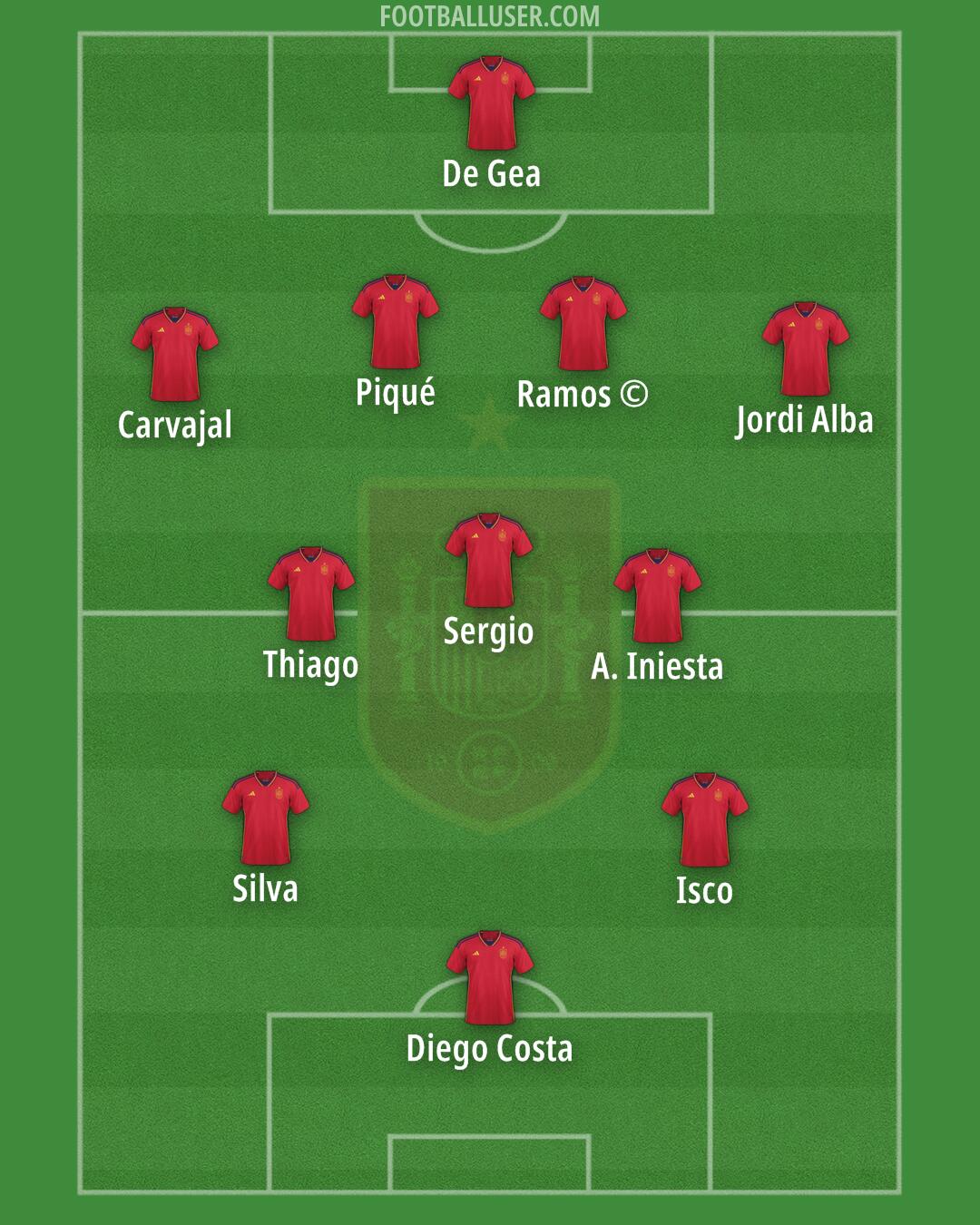
De Gea · Piqué · Ramos © · Carvajal · Jordi Alba · Sergio · Thiago · A. Iniesta · Isco · Silva · Diego CostaSpain aims to control games through high possession and constant passing within the 4-3-3 formation. This lineup focuses on keeping the ball to control the tempo and move the opposition around. The team uses short passing and positional dominance to dictate how the match is played.
De Gea starts the build up from the back. The back four plays with a high line to squeeze the space in the middle of the pitch. Carvajal operates as an attacking full back to provide width on the right side, while Jordi Alba pushes up to overlap the winger. Piqué acts as a ball playing defender to progress through the thirds. Ramos © serves as a dominant force in the air and provides cover to sweep behind the line. The defensive unit works to stay compact and win the second ball when the opposition tries to go direct.
A three man midfield acts as the engine room for Spain. Sergio sits in a single pivot role to shield the defence and recycle possession. Thiago works to receive on the half turn and connect the defensive and attacking lines with his passing range. A. Iniesta operates in the half spaces to create from deep and drive forward with the ball. This midfield trio focuses on keeping the ball in tight spaces to bypass the opposition midfield.
The attack uses three players across the front to stretch the defence. Diego Costa acts as a pressing centre forward to pin the last defender and hold up the ball for others. On the flanks, Silva plays as an inverted winger who cuts inside to find space in the middle. Isco also drifts from the left wing to act as a second striker in the hole. These movements create runs in behind and allow the team to play through the lines with quick combinations.
Spain offers several tactical advantages with this lineup. The midfield provides numerical superiority in the center of the pitch to dominate possession. The attacking full backs allow the wingers to move inside, creating wide overloads that force the opposition to shift constantly. This movement makes it difficult for opponents to mark runners as players arrive late into the box.
This 4-3-3 formation is built to dominate games through control and technical superiority. It is best suited for matches where the team can use their passing to break down a deep low block.