
Real Madrid Football Formation
 December 16, 2024
 RMA_Mind


Starting Lineup
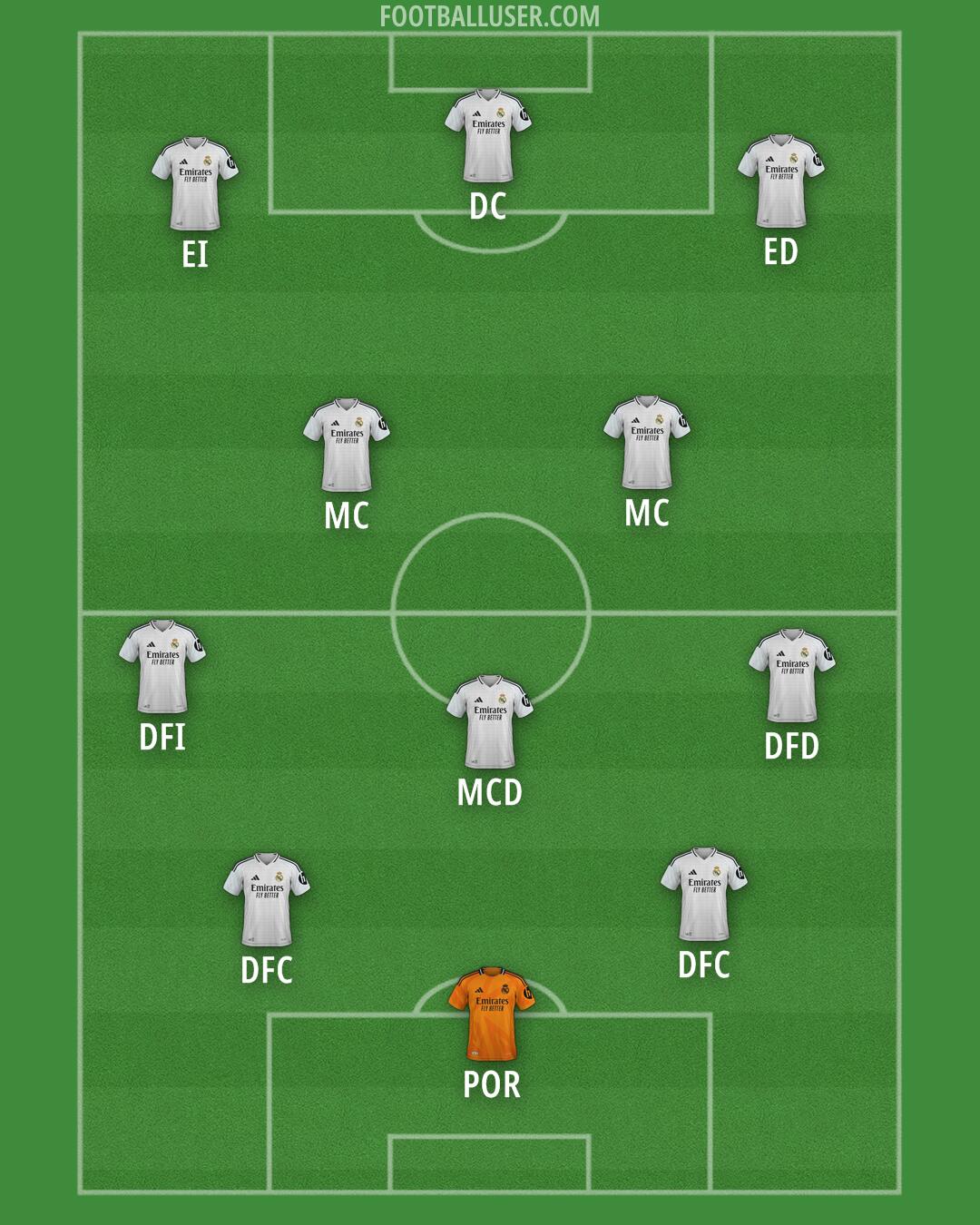
POR · DFI · DFD · DFC · DFC · MC · MC · DC · MCD · EI · EDReal Madrid aims to control the game through quick transitions and high pressure with this 5-2-3 formation. This lineup works to win the ball high up the pitch and hit the opposition on the break. The team relies on heavy verticality to move from a defensive block to a scoring position in seconds.
In goal, the goalkeeper acts as the first point of distribution to start attacks. The back five consists of a central defender, MCD, who sits deep to protect the area, flanked by two wide centre backs, DFC, and DFC. These central players must be dominant in the air and able to sweep behind a high line. On the flanks, the attacking wing backs, DFI and DFD, provide the necessary width. They are tasked to push high to support the attack while tracking back to form a narrow defensive block when the team loses possession.
The midfield relies on a double pivot system to link the defensive line to the front three. The two central midfielders, MC and MC, act as the engines of the team. One midfielder is tasked to shield the defence and pick up runners, while the other works to carry the ball forward and connect the lines. These players must win the second ball and press aggressively to ensure the opposition cannot play through the middle. By controlling the central area, the Real Madrid midfield ensures they can quickly recycle possession and switch play to the wide areas.
The attacking front three uses wide wingers and a central striker to stretch the defence. The inverted wingers, EI and ED, cut inside to create passing lanes and find the feet of the striker. This movement opens space for the attacking wing backs to overlap the winger and deliver crosses. The striker, DC, acts as a focal point to hold up the ball and wait for support. When the team wins the ball, the forwards press from the front to force a long ball and gain possession in dangerous areas.
One major advantage is the ability to create wide overloads through the overlapping runs of DFI and DFD. This forces the opposition to defend wide areas and leaves gaps in the middle. Additionally, the formation provides great compactness when defending in a mid-block. The presence of three attackers allows the team to trigger a press much higher up the pitch, making it difficult for opponents to build from the back.
This formation is built for teams that want to punish opponents through lightning fast transitions. It is best suited for games where the opposition leaves space behind their full backs.