
Milan Football Formation
 December 22, 2024


Starting Lineup
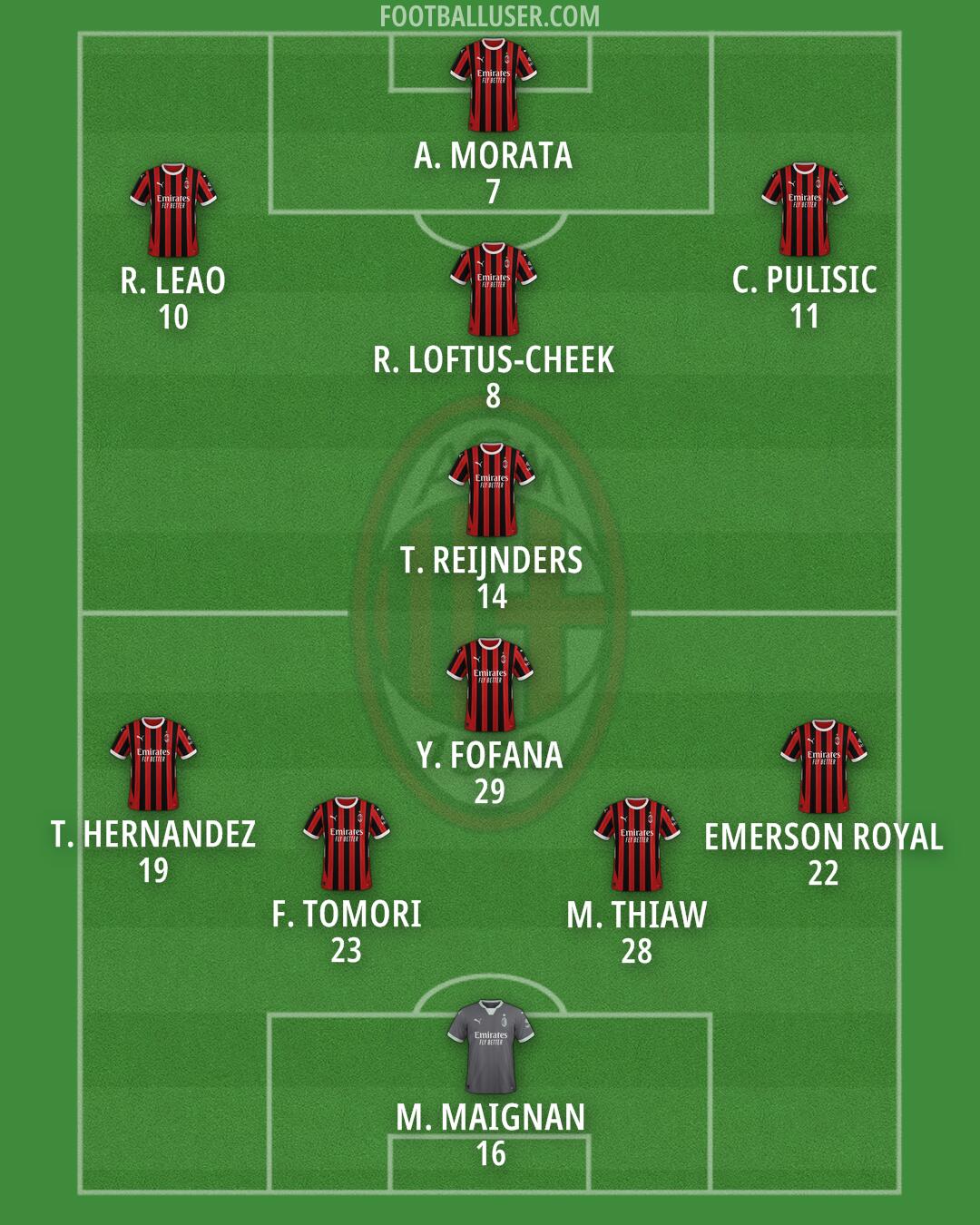
M. MAIGNAN (16) · EMERSON ROYAL (22) · M. THIAW (28) · F. TOMORI (23) · T. HERNANDEZ (19) · Y. FOFANA (29) · T. REIJNDERS (14) · C. PULISIC (11) · R. LOFTUS-CHEEK (8) · R. LEAO (10) · A. MORATA (7)Focusing on a direct and vertical style of play, Milan utilizes a 5-4-1 formation to control games through defensive stability and quick transitions. This lineup is built to sit in a compact mid-block, waiting for the opposition to commit numbers forward before hitting them on the break. The intention is to remain hard to beat while relying on individual quality to break lines.
M. MAIGNAN operates between the posts, acting as a reliable last line of defense with his ability to sweep behind the line. The defensive unit functions as a back five, featuring three central defenders in M. THIAW, F. TOMORI, and Y. FOFANA. F. TOMORI provides pace to cover the space behind while M. THIAW and Y. FOFANA focus on winning the second ball and dominating in the air. On the flanks, T. HERNANDEZ and EMERSON ROYAL act as attacking wing backs, pushing high to provide width and overlapping the midfielders.
The midfield works as a four-man block to squeeze the space between the lines. T. REIJNDERS sits deeper to shield the defense and recycle possession, while R. LOFTUS-CHEEK drives forward with the ball to carry it into the final third. In the half-spaces, R. LEAO uses his explosive dribbling style to move the ball forward, and C. PULISIC operates with high intensity to link the midfield to the attack. This group works to press in a mid-block, forcing the opponent into wide areas or long balls.
In the attacking phase, A. MORATA acts as a lone striker and a pressing centre-forward. He works to hold up the ball and link up play with the four players behind him. The attack relies on the width provided by T. HERNANDEZ and EMERSON ROYAL to stretch the defence. When Milan wins the ball, the movement is designed to create runs in behind or allow R. LEAO to cut inside and isolate defenders in one on one situations.
Milan gains a significant advantage through their ability to maintain compactness when defending, making it difficult for opponents to play through the middle. The team also benefits from the speed of transition, moving from a low block to an attacking shape very quickly. By using the wing backs to provide width, they create wide overloads that force the opposition to shift constantly.
This 5-4-1 formation provides a solid foundation for a team that prefers to absorb pressure and strike with pace. It is best suited for matches against dominant sides where Milan needs to deny the turn and counter at pace.