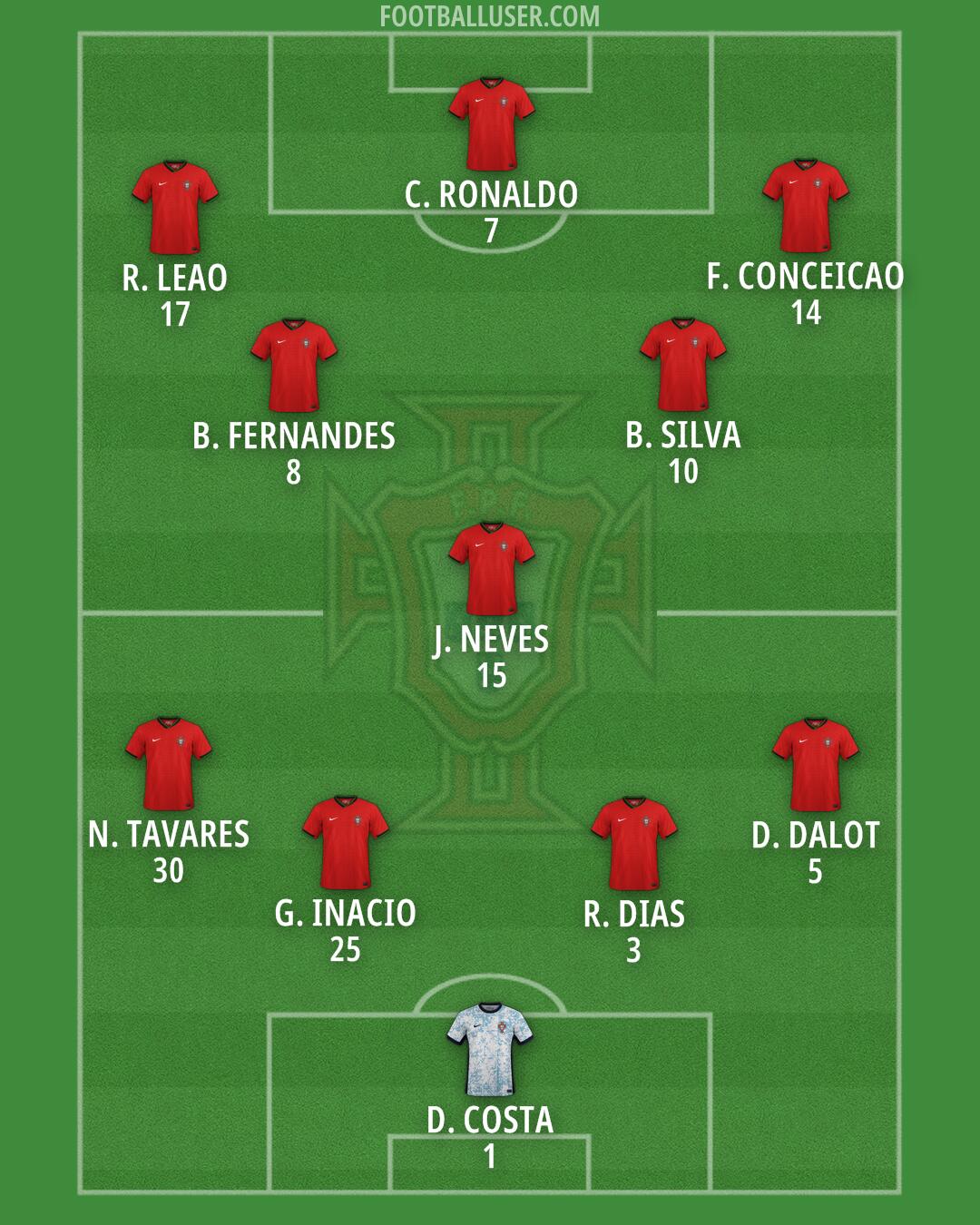

Portugal National Football Team Formation
 December 26, 2024


Starting Lineup
D. COSTA (1) · D. DALOT (5) · N. TAVARES (30) · R. DIAS (3) · G. INACIO (25) · J. NEVES (15) · B. SILVA (10) · B. FERNANDES (8) · R. LEAO (17) · F. CONCEICAO (14) · C. RONALDO (7)Portugal aims to play with a high press and quick transitions using a 5-2-3 formation. This lineup is built to win the ball high up the pitch and use verticality to punish teams in the transition. The Seleção focuses on squeezing the space in the opponent half to force a long ball.
Diogo Costa plays behind a back five that can shift between a narrow block and a wide defensive unit. Ruben Dias and Joao Neves act as the central defenders, with Dias providing aerial strength and Neves covering the space behind. Goncalo Inacio completes the central trio, allowing the wing backs to push high. Diogo Dalot and Nuno Tavares act as attacking wing backs, providing the width necessary to stretch the defence. This unit defends zonally, ensuring they can shift quickly to cover the wide areas.
The midfield consists of a two man central pairing with Bruno Fernandes and Bernardo Silva. Bruno Fernandes uses his passing range to break the line, while Bernardo Silva connects the defensive and attacking lines by carrying the ball forward. These two work to press in a mid block and win the second ball to keep the momentum high. They must also track back to help the wing backs when the team loses possession.
In the attacking phase, Portugal uses three attackers across the front. Cristiano Ronaldo operates as a pressing centre forward, looking to find the feet of the striker or make runs in behind. Rafael Leao acts as an inverted winger on the left to cut inside, while Francisco Conceicao stays wide on the right to provide width. This combination allows the team to use overlaps from the wing backs to create numbers in the final third. The forwards often combine in tight spaces to pull the defenders out of position.
This formation offers several tactical advantages for Portugal. The use of attacking wing backs creates wide overloads, making it difficult for the opposition to mark both the winger and the defender. Additionally, the five man back line provides compactness when defending, making it hard for opponents to play through the lines. The speed of transition from the midfield to the front three allows the team to hit in behind on the transition with great effect.
The 5-2-3 formation provides a strong defensive base while maintaining enough numbers to attack with pace. It is a setup best suited for facing teams that play with high defensive lines or those that struggle to deal with rapid wing play.