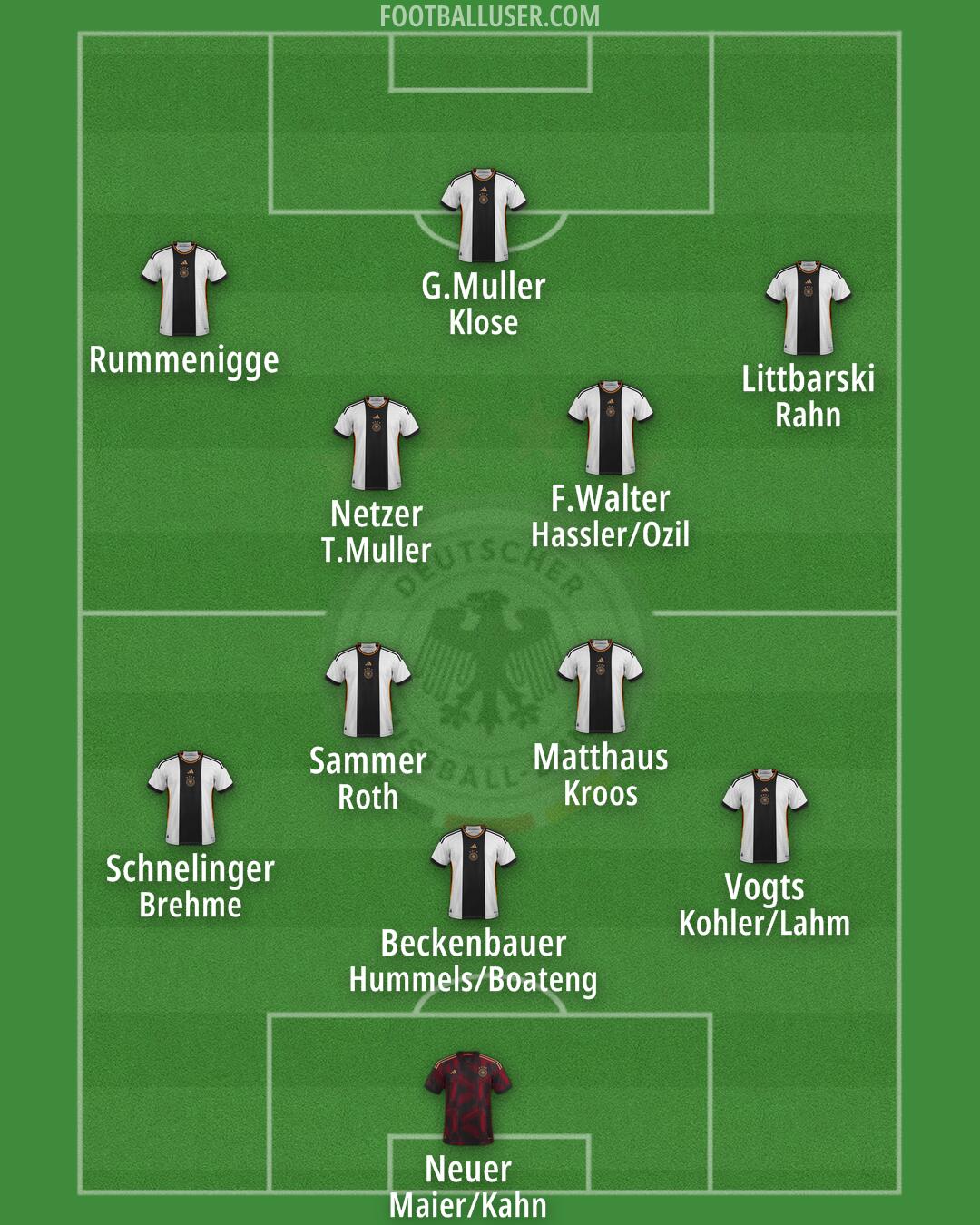

Germany National Football Team Formation
 December 28, 2024


Starting Lineup
Beckenbauer (Hummels/Boateng) · Matthaus (Kroos) · Vogts (Kohler/Lahm) · G.Muller (Klose) · Rummenigge · Littbarski (Rahn) · Sammer (Roth) · Neuer (Maier/Kahn) · Schnelinger (Brehme) · Netzer (T.Muller) · F.Walter (Hassler/Ozil)Germany play a vertical style of football using a 5-2-3 formation. This lineup aims to overwhelm opponents by pushing many players into the attacking third. The focus is on rapid transitions and using the full width of the pitch to stretch the opposition. Die Mannschaft use this formation to create constant pressure in the final third.
Neuer acts as the goalkeeper and plays a sweeping role behind a high defensive line. The back five consists of Vogts as the right wing back and Schnelinger as the left wing back. Matthaus, Beckenbauer, and Sammer form the central defensive unit. Beckenbauer acts as a ball playing defender with the ability to step into midfield to progress the play. Matthaus and Sammer provide tackling strength to win the second ball and cover the space behind the wing backs.
The midfield works with a double pivot consisting of Netzer and F.Walter. These two players must cover a large area of the pitch to bridge the gap between the defense and the attack. Netzer is tasked to create and play through the lines with his passing range. F.Walter helps to control the tempo and recycle possession to keep the pressure on. They act as the engine that allows the wing backs and attackers to push high up the pitch.
Up front, Germany employ three attackers to pin the last defender. Rummenigge plays as an inverted winger on the left, often cutting inside to use his pace and strength. Littbarski provides width on the right side. G.Muller operates as the central striker and focuses on finding space in the box to finish chances with his clinical finishing. The wing backs, Vogts and Schnelinger, overlap the wingers to create overloads. This movement forces the opposition back line to make difficult decisions.
This formation offers significant tactical advantages, particularly through wide overloads. When Vogts and Schnelinger push high, they create two on one situations against the opposition full backs. The presence of Beckenbauer and Matthaus allows the team to play out from the back with confidence. Another strength is the ability to press high in coordinated waves because the three attackers and the wing backs can squeeze the space in the opponent half.
The 5-2-3 formation makes Germany a dangerous side capable of rapid attacks in transition. It is best suited for matches against teams that play a narrow defensive block and struggle to deal with wide runners.