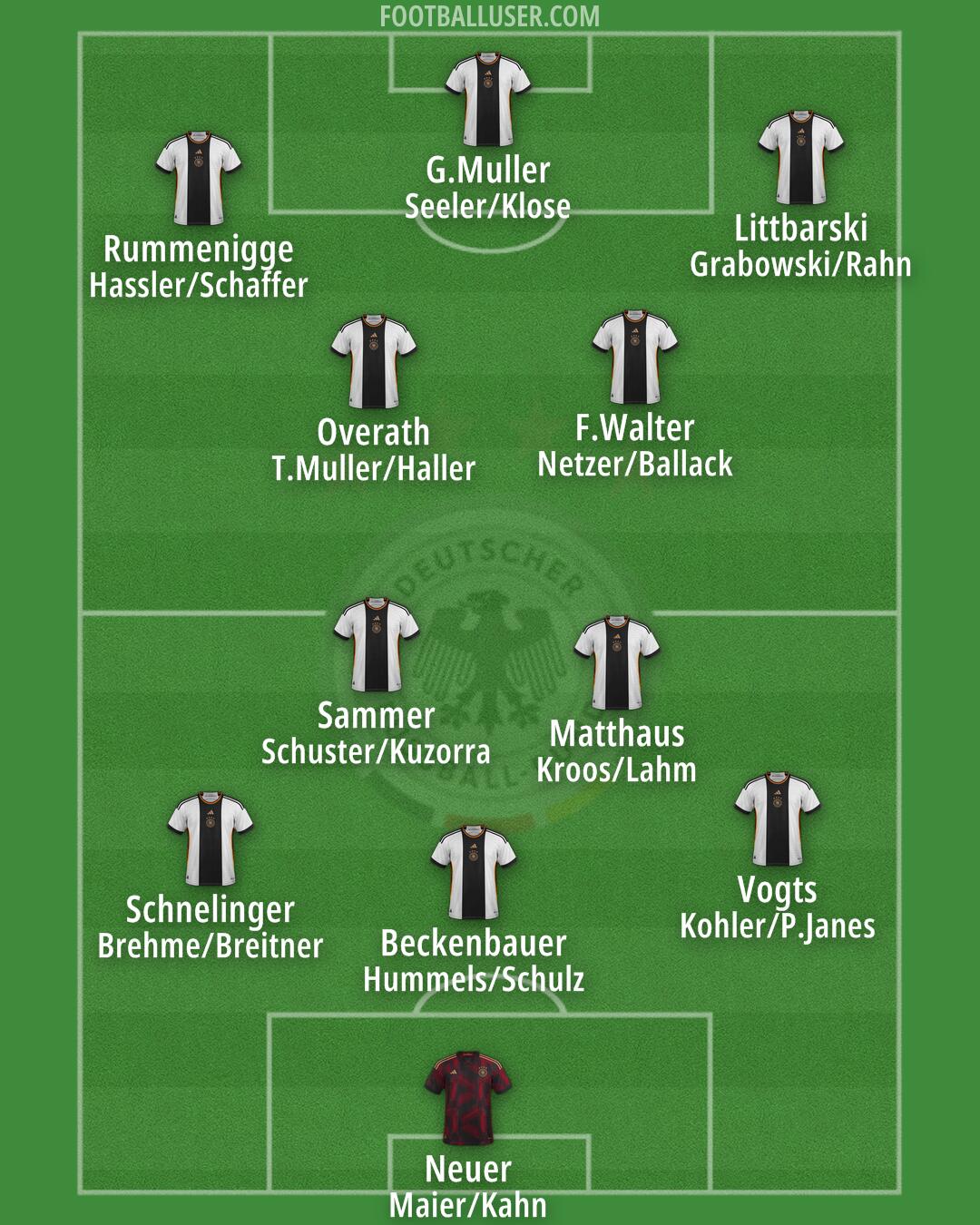

Germany National Football Team Formation
 December 28, 2024


Starting Lineup
Beckenbauer (Hummels/Schulz) · Matthaus (Kroos/Lahm) · Vogts (Kohler/P.Janes) · G.Muller (Seeler/Klose) · Rummenigge (Hassler/Schaffer) · Littbarski (Grabowski/Rahn) · Sammer (Schuster/Kuzorra) · Neuer (Maier/Kahn) · Schnelinger (Brehme/Breitner) · Overath (T.Muller/Haller) · F.Walter (Netzer/Ballack)Germany looks to control games through a high press and verticality in a 5-2-3. This lineup relies on immediate pressure and quick ball movement to disrupt opponents. The formation is built to win the ball back high up the pitch and strike rapidly before the opposition can settle into a defensive block.
Manuel Neuer plays between the posts, acting as a sweeper behind a high line. The defensive unit operates as a back five with Beckenbauer leading the line as a ball playing centre back. Sammer and Matthaus sit alongside him to provide physical presence and aerial strength, while Beckenbauer steps into midfield to create an extra man in build up play. Schnelinger and Vogts act as attacking wing backs, tasked to spread wide and provide crosses. This back five can shift to a flat back three when the wing backs push high to ensure the team remains solid.
The midfield utilizes a two man pairing to connect the defense to the attack. Overath and F.Walter occupy the central areas, acting as the engine room for Germany. Overath drives forward with the ball to carry it into the final third, while F.Walter holds his position to shield the defense and recycle possession. They work to win the second ball and find the feet of the attackers. This duo must be prepared to press in a mid-block to prevent the opposition from playing through the lines.
The attack features three players across the front to stretch the defense. G.Muller operates as a pressing centre-forward, constantly looking to find space in the box and finish chances. On the flanks, Rummenigge and Littbarski act as inverted wingers who cut inside to create central overloads. These attackers press the opposition back line relentlessly to force a long ball. The movement is designed to create runs in behind and allow for cutbacks from the byline when the wing backs overlap.
A major strength of this formation is the ability to press high in coordinated waves. Germany can use the front three to trigger a press that forces errors near the opponent goal. Another advantage is the width provided by Schnelinger and Vogts, which allows the team to isolate wide players in one on one situations. This setup also offers great flexibility to shift between a defensive five and an attacking three when in possession.
This 5-2-3 formation creates a lethal balance between defensive stability and attacking intent. It is best suited for games against teams that try to build play from the back and struggle under intense pressure.