
Spain National Football Team Formation
 December 29, 2024


Starting Lineup
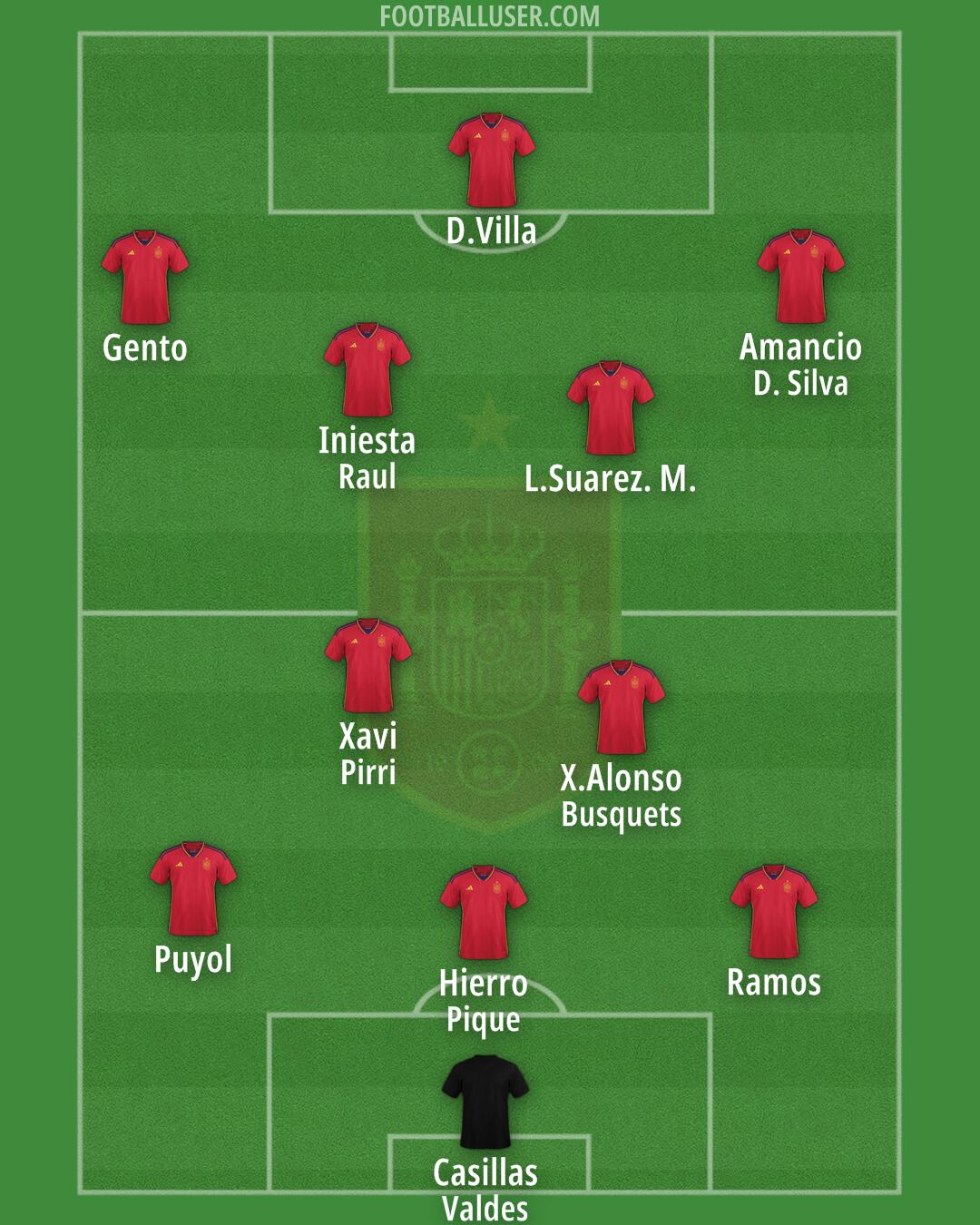
Iniesta (Raul) · Xavi (Pirri) · X.Alonso (Busquets) · Hierro (Pique) · Ramos · Puyol · L.Suarez. M. · Amancio (D. Silva) · Gento · D.Villa · Casillas (Valdes)Spain operates with a heavy focus on defensive solidity and quick transitions within a 5-4-1. This formation is built to absorb pressure and frustrate opponents by keeping a compact block that is hard to break down. The team looks to sit deep and wait for the right moment to hit in behind on the transition.
Casillas guards the goal, providing shot stopping and command of the area. The back line consists of a back five where Ramos acts as an attacking wing back on the right to push up the flank. Puyol plays as an attacking wing back on the left to provide width. In the middle, X.Alonso works as a right centre-back with a notable long passing range, while Hierro holds the center with his aerial strength. Xavi occupies the left centre-back position to help play out from the back and progress through the thirds.
The midfield relies on a single pivot with L.Suarez. M. sitting deep to shield the defense and win the second ball. Amancio and Iniesta occupy the central roles to link the lines, with Iniesta using his ability to play in tight spaces to move the ball forward. Gento plays on the left side of the midfield four to help cover the wide areas and press in a mid-block. This group works to compress the midfield and deny the turn to opposition playmakers.
The attack is centered around a lone striker, D.Villa, who acts as a pressing centre-forward to disrupt the opposition back line. He works to find runs in behind or hold up the ball to bring the team forward. When Spain wins the ball, the width is provided by Ramos and Puyol, who can overlap to stretch the defence. This allows the midfielders to arrive late into the box and combine in tight spaces when the ball is progressed through the thirds.
One major advantage is the numerical superiority in the defensive line which makes it very hard for opponents to find gaps. The team also gains an advantage through its speed of transition, moving from a low block to an attacking formation in seconds. The ability to compress the space between the lines ensures that opponents cannot easily pass through the middle.
This 5-4-1 formation relies on a strong defensive block and clinical attacking movements. It is most effective when playing against teams that hold high possession and can be punished on the break.