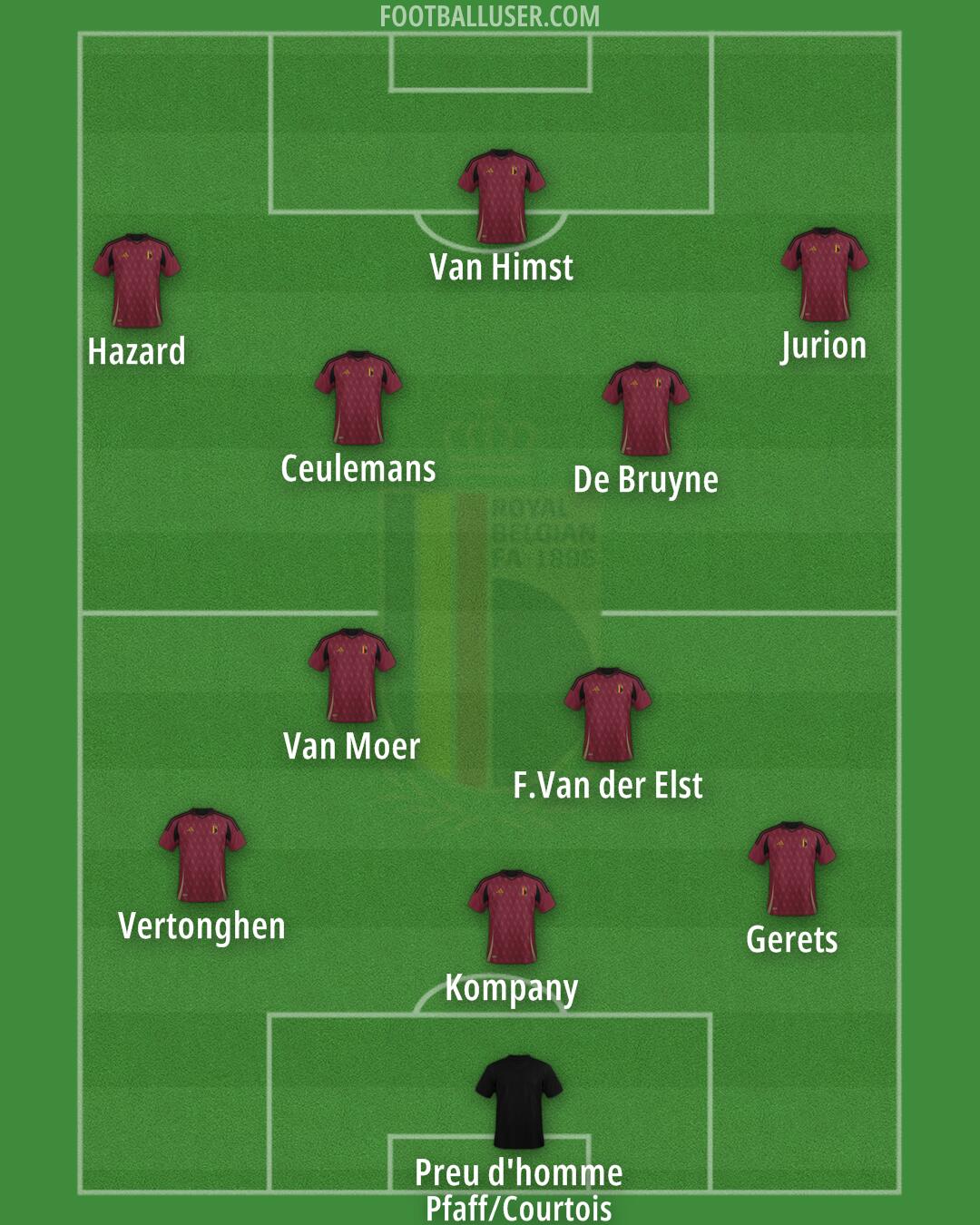

Belgium National Football Team Formation
 December 29, 2024


Starting Lineup
De Bruyne · Van Himst · Ceulemans · Jurion · Hazard · Kompany · Gerets · Van Moer · Preu d'homme (Pfaff/Courtois) · F.Van der Elst · VertonghenFocusing on quick transitions and verticality, Belgium operates with a 5-2-3 formation. The Red Devils aim to win the ball high up the pitch and strike rapidly before the opposition can recover. This lineup is built to exploit spaces behind the defense through wide players and a central striker.
Preu d'homme guards the goal as the lone goalkeeper. The defensive unit sits in a back five with Kompany acting as the central leader. To his side, F.Van der Elst and Van Moer function as the wide centre-backs to provide cover and win the second ball. The wing backs, Gerets on the right and Vertonghen on the left, are tasked to push high and provide width. This allows the central defenders to drop into a low block when the team loses possession, ensuring they remain difficult to break down.
The midfield relies on a two man engine room to connect the defense to the attack. De Bruyne operates as a central midfielder with a high passing range to find the forwards, while Ceulemans provides support to protect the central area. De Bruyne works to carry the ball forward and find gaps in the opposition lines. This duo must manage the space between the back five and the front three, ensuring they do not get caught too far up the pitch during a change in possession.
In the attacking phase, Belgium uses three attackers to stretch the defense. Van Himst leads the line as a pressing centre-forward to disrupt the opponent. Hazard plays as a wide winger on the left, looking to cut inside and create chances, while Jurion stays wide on the right to deliver crosses. The movement of Hazard and Jurion is designed to isolate defenders in one on one situations. They work to pull the opposition defense apart, creating room for Van Himst to find space in the box.
A major strength for Belgium is the ability to create wide overloads when Gerets and Vertonghen overlap the wingers. This creates extra passing options in the final third. The team also benefits from the speed of transition, moving from a compact defensive block to an attacking wave in seconds. The combination of technical quality in the midfield and pace on the flanks makes them a constant threat.
This formation is built to punish teams that leave space behind their full backs. It is best suited for matches against opponents who play a high line and allow space for quick breaks.