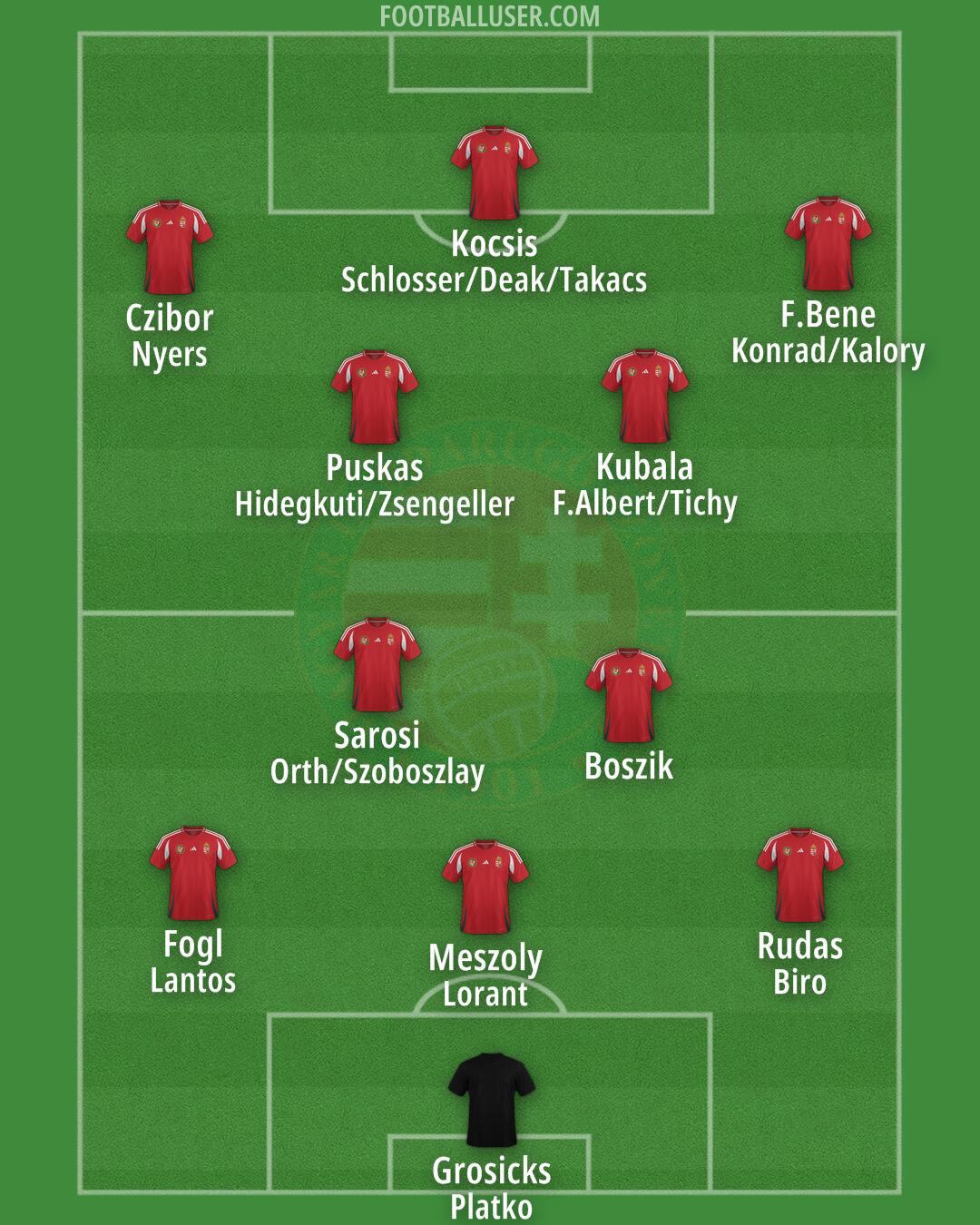

Hungary National Football Team Formation
 December 30, 2024


Starting Lineup
Puskas (Hidegkuti/Zsengeller) · Kocsis (Schlosser/Deak/Takacs) · Kubala (F.Albert/Tichy) · Czibor (Nyers) · Boszik · Meszoly (Lorant) · Rudas (Biro) · Sarosi (Orth/Szoboszlay) · F.Bene (Konrad/Kalory) · Fogl (Lantos) · Grosicks (Platko)Hungary plays a direct, counter attacking game using a 5-2-3. This formation is built to win the ball and hit the opposition quickly in transition. By staying compact, the team looks to squeeze the space in the middle before spreading wide to move forward and exploit the flanks.
Grosicks acts as the last line of defence in goal. Sarosi, Boszik, and Meszoly form the central three in the back line to provide a solid base. Rudas operates as an attacking wing back on the right, while Fogl plays as an attacking wing back on the left. The central defenders focus on winning the header and protecting the area against long balls. The unit will defend zonally to maintain a tight block.
The midfield features a two-man unit with Puskas and Kubala. Puskas works to carry the ball forward and drive into the middle third, while Kubala sits deeper to shield the defence and win the second ball. These two players act as the link between the back five and the attackers. They must press in a mid-block to prevent the opposition from playing through the lines or finding a way into the box.
Hungary uses three attackers to stretch the opposition defence. Kocsis plays as a lone striker to hold up the ball and find the feet of his teammates. Czibor plays as an inverted winger on the left to cut inside and create space, while F.Bene stays wide on the right to stretch the defence. This movement allows Rudas to overlap the winger and cross. The front line will press from the front to force a long ball.
This formation offers several tactical advantages for Hungary. The presence of five defenders provides great compactness when defending deep. The team can create wide overloads from the overlapping wing backs to overwhelm the opposition flanks. Additionally, the speed of transition allows them to break quickly when they win possession in the middle of the pitch.
This 5-2-3 formation is ideal for absorbing pressure and striking with pace. It is best suited for matches against teams that control possession and leave space behind their defence.