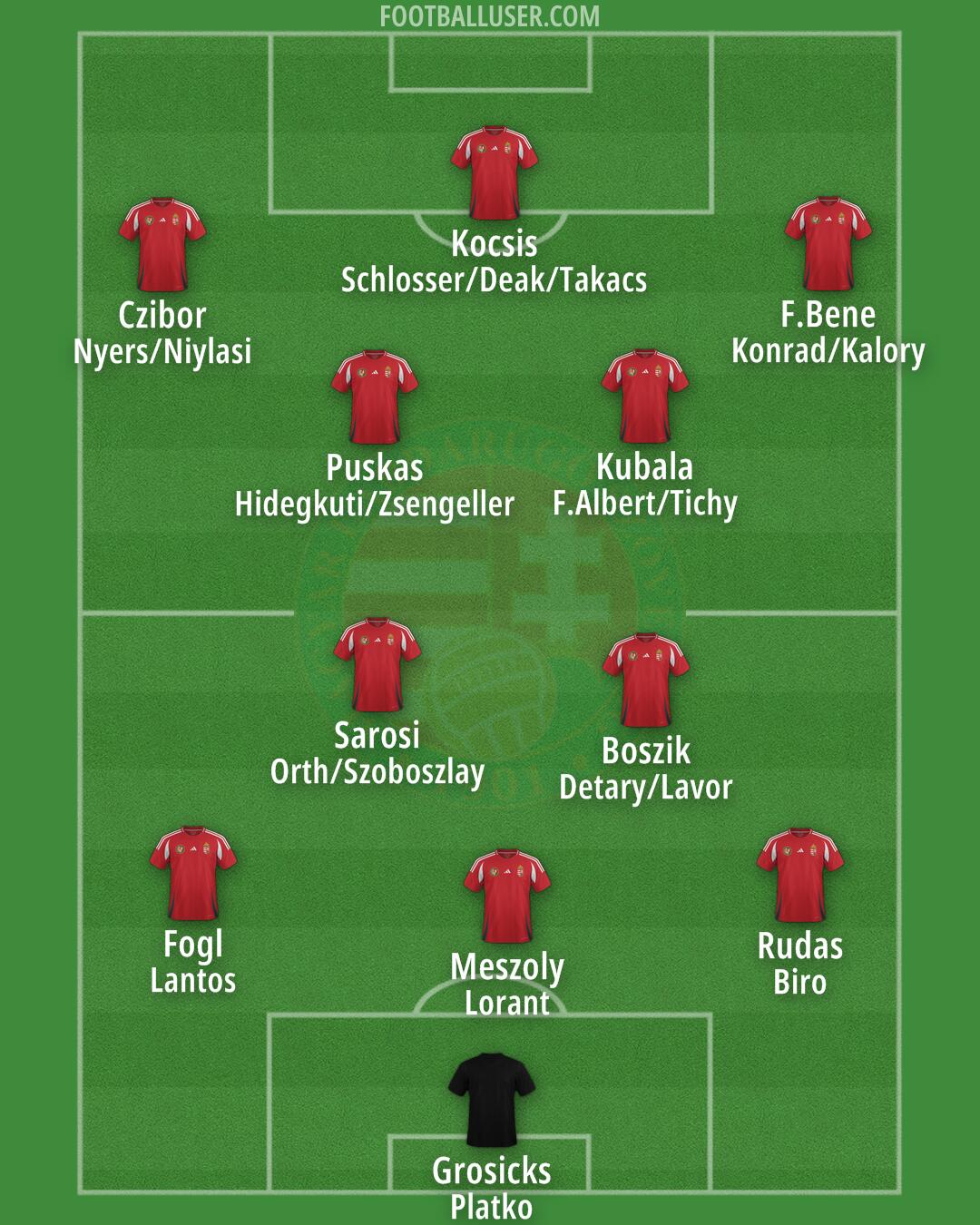

Hungary National Football Team Formation
 December 30, 2024


Starting Lineup
Puskas (Hidegkuti/Zsengeller) · Kocsis (Schlosser/Deak/Takacs) · Kubala (F.Albert/Tichy) · Czibor (Nyers/Niylasi) · Boszik (Detary/Lavor) · Meszoly (Lorant) · Rudas (Biro) · Sarosi (Orth/Szoboszlay) · F.Bene (Konrad/Kalory) · Fogl (Lantos) · Grosicks (Platko)Hungary aims to play a high press and vertical game to catch opponents off guard. This 5-2-3 formation is built to win the ball high up the pitch and move forward with speed. The team relies on quick transitions to bypass the opponent midfield.
Grosicks operates as the lone goalkeeper behind a five-man defensive line. The back line consists of a central defender, Meszoly, flanked by two wide centre-backs, Boszik and Sarosi. This back three provides a solid base to defend zonally. Rudas acts as the right wing back and Fogl plays as the left wing back. Both Rudas and Fogl push high to provide width during attacks. Boszik and Sarosi are tasked to cover the space left by the wing backs and step up to intercept passes. Meszoly stays central to win the header and anchor the defense.
The midfield relies on a two-man pairing with Puskas and Kubala. This central duo must work hard to cover the ground between the defense and the attack. Puskas acts as a carrier to drive forward with the ball while Kubala works to shield the defense and pick up runners. They must win the second ball to keep the momentum. Puskas and Kubala connect the back five to the front three by recycling possession and playing through the lines.
In the attacking phase, Hungary uses three attackers. Kocsis leads the line as a lone striker who can hold up the ball and find the feet of his teammates. Czibor plays on the left as an inverted winger to cut inside and create chances. F.Bene operates on the right and also looks to cut inside to occupy the half-spaces. This formation allows for runs in behind and creates combinations in tight spaces. The front three press from the front to force a long ball from the opposition.
One major advantage of this lineup is the ability to create wide overloads when Rudas and Fogl overlap the wingers. The team also maintains a compact defensive block when defending in a mid-block. This makes it very difficult for opponents to play through the center. The speed of transition involving Kocsis and the wingers allows Hungary to hit teams on the break.
This 5-2-3 formation relies on defensive solidity and rapid counter attacks. It is best suited for games against teams that dominate possession and leave space behind their defenders.