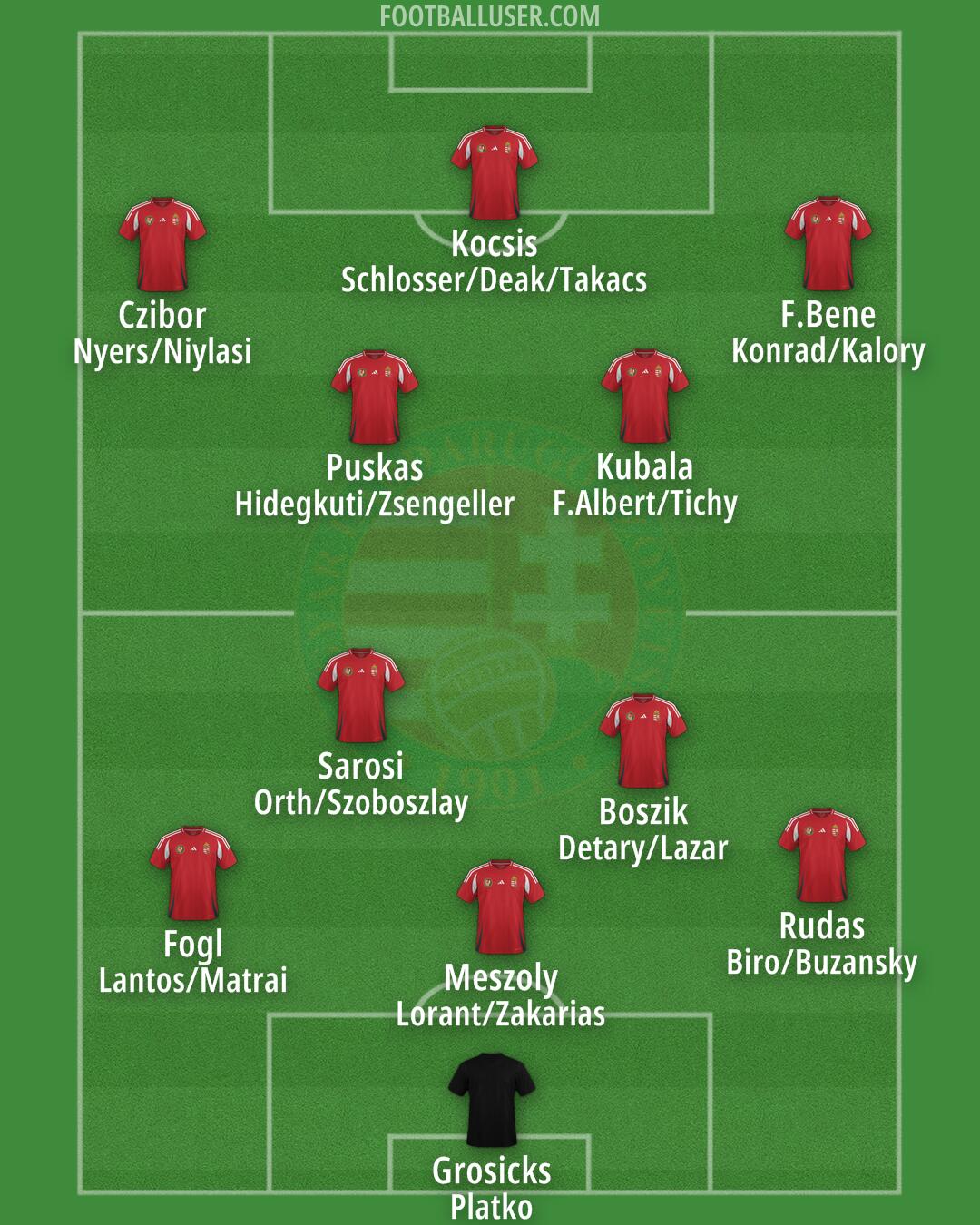

Hungary National Football Team Formation
 December 30, 2024


Starting Lineup
Puskas (Hidegkuti/Zsengeller) · Kocsis (Schlosser/Deak/Takacs) · Kubala (F.Albert/Tichy) · Czibor (Nyers/Niylasi) · Boszik (Detary/Lazar) · Meszoly (Lorant/Zakarias) · Rudas (Biro/Buzansky) · Sarosi (Orth/Szoboszlay) · F.Bene (Konrad/Kalory) · Fogl (Lantos/Matrai) · Grosicks (Platko)Hungary focuses on a compact defensive presence to launch rapid counter attacks using a 5-2-3. This formation is built to sit deep and absorb pressure before hitting the opposition with speed. The team works to stay close together to deny space and then uses verticality to progress through the thirds once the ball is won.
Grosicks stays in goal to organize the defensive unit. A back five features Sarosi at left centre-back and Boszik in the right centre-back role. Meszoly sits in the middle to anchor the defense and win headers. Fogl and Rudas operate as attacking wing backs to provide the width necessary for the team to stretch the defense. These defenders work as a single unit to hold the line and cover for one another during transitions.
In the center of the pitch, Puskas and Kubala form a double pivot. This pair works to shield the defense and win the second ball in the midfield zone. Puskas and Kubala are responsible for connecting the defensive lines to the attack by recycling possession and looking for quick passes. They must track back to help the wing backs and manage the space in front of the back five to prevent runners from breaking the line.
The attack is led by Kocsis who operates as a lone striker to find the feet of the midfielders. Czibor and F.Bene play as wide attackers to create width and pull the opposition defenders out of position. Both wingers look to exploit the spaces on the flanks, often looking to get to the byline and deliver early crosses. All three forwards work to press from the front to force a long ball and create chances in transition.
This lineup provides several tactical advantages, particularly the ability to create wide overloads through the overlapping runs of Fogl and Rudas. Having a back five allows Hungary to maintain a compact formation when defending in a mid-block. The team also benefits from the speed of transition when Puskas or Kubala can immediately find the runners behind the opposition defense.
This 5-2-3 formation is defined by its defensive solidity and its ability to strike on the break. It is best suited for games against high pressing teams that leave gaps behind their back line.