Aston Villa Football Formation
 December 31, 2024


Starting Lineup
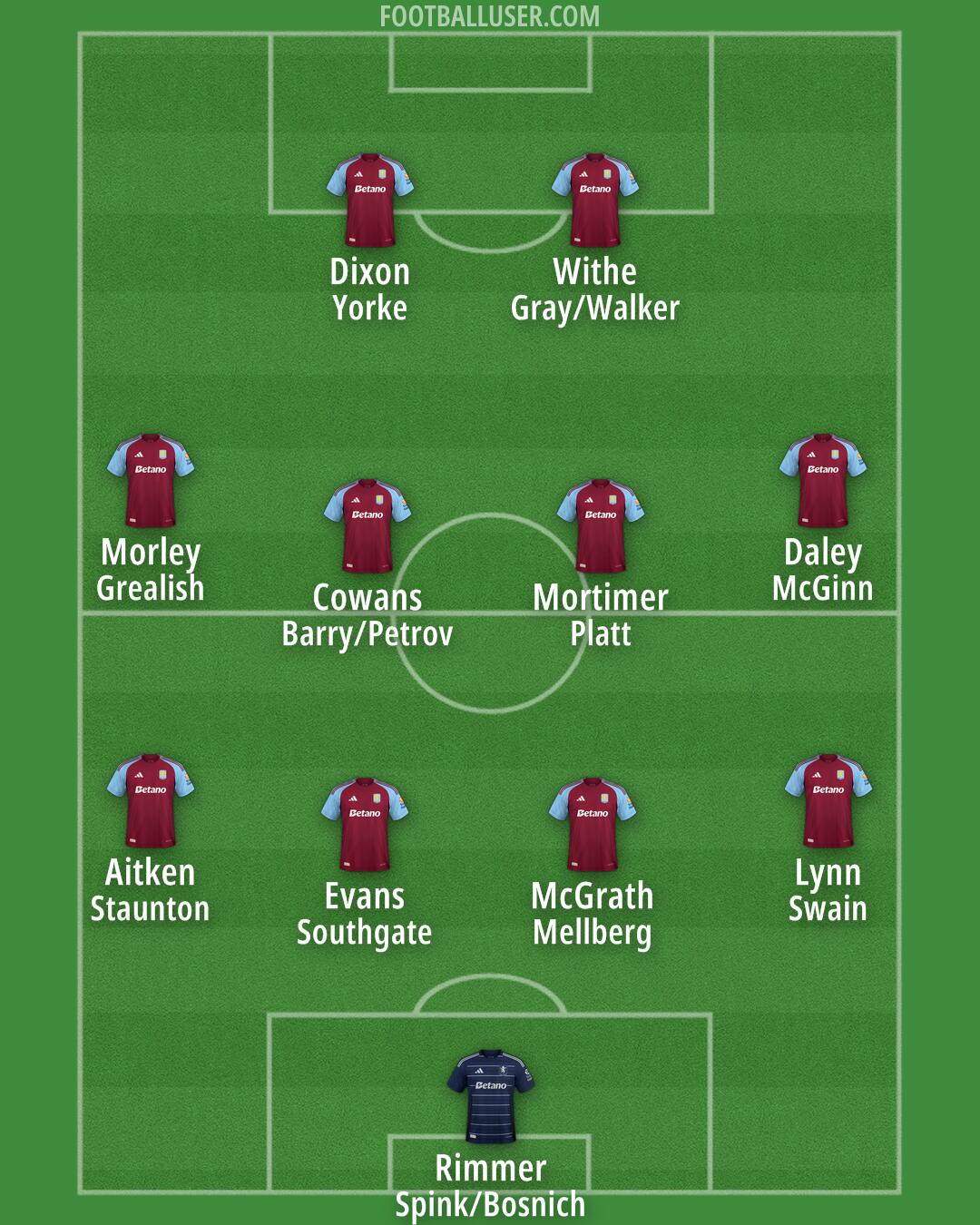
Rimmer (Spink/Bosnich) · Lynn (Swain) · McGrath (Mellberg) · Evans (Southgate) · Aitken (Staunton) · Mortimer (Platt) · Cowans (Barry/Petrov) · Daley (McGinn) · Morley (Grealish) · Withe (Gray/Walker) · Dixon (Yorke)Aston Villa utilizes a 4-4-2 formation designed to play a direct and vertical style of football. This lineup focuses on maintaining a compact block to deny space between the lines while looking to transition quickly once the ball is won. The team aims to move the ball forward with purpose rather than recycling possession endlessly.
In goal, Rimmer keeps watch over the defensive unit. The back line operates as a flat back four where Lynn acts as the right back and Aitken covers the left side. McGrath and Evans form the central pairing, with McGrath acting as a ball playing defender to initiate play and Evans providing cover to sweep behind the line. The unit stays close together to squeeze the space and prevent opponents from playing through the middle.
The midfield consists of a central pairing of Mortimer and Cowans who link the defense to the attack. Mortimer works to drive forward with the ball, while Cowans looks to create from deep and shield the center. On the flanks, Daley operates as the right midfielder and Morley plays as the left midfielder. These wide players must track back to help the full backs and ensure the team remains compact when defending in a mid-block.
The attacking line features a partnership of two forwards, Dixon and Withe. Dixon plays as the left striker to press the opposition back line, while Withe operates as a target man to hold up the ball and win the second ball. They work in combinations to create runs in behind the defense. This front two can also pull wide to stretch the defense or combine in tight spaces to split the defense with a through ball.
One major advantage for Aston Villa is the ability to create wide overloads when Daley and Morley push high to support the attack. The team also benefits from a high level of compactness when defending, making it difficult for opponents to find passing lanes. The speed of transition allows them to hit in behind on the transition before the opposition can get organized.
This 4-4-2 formation provides a reliable platform for a team that wants to strike quickly on the break. It is a lineup best suited for matches against teams that leave large gaps behind their midfield.