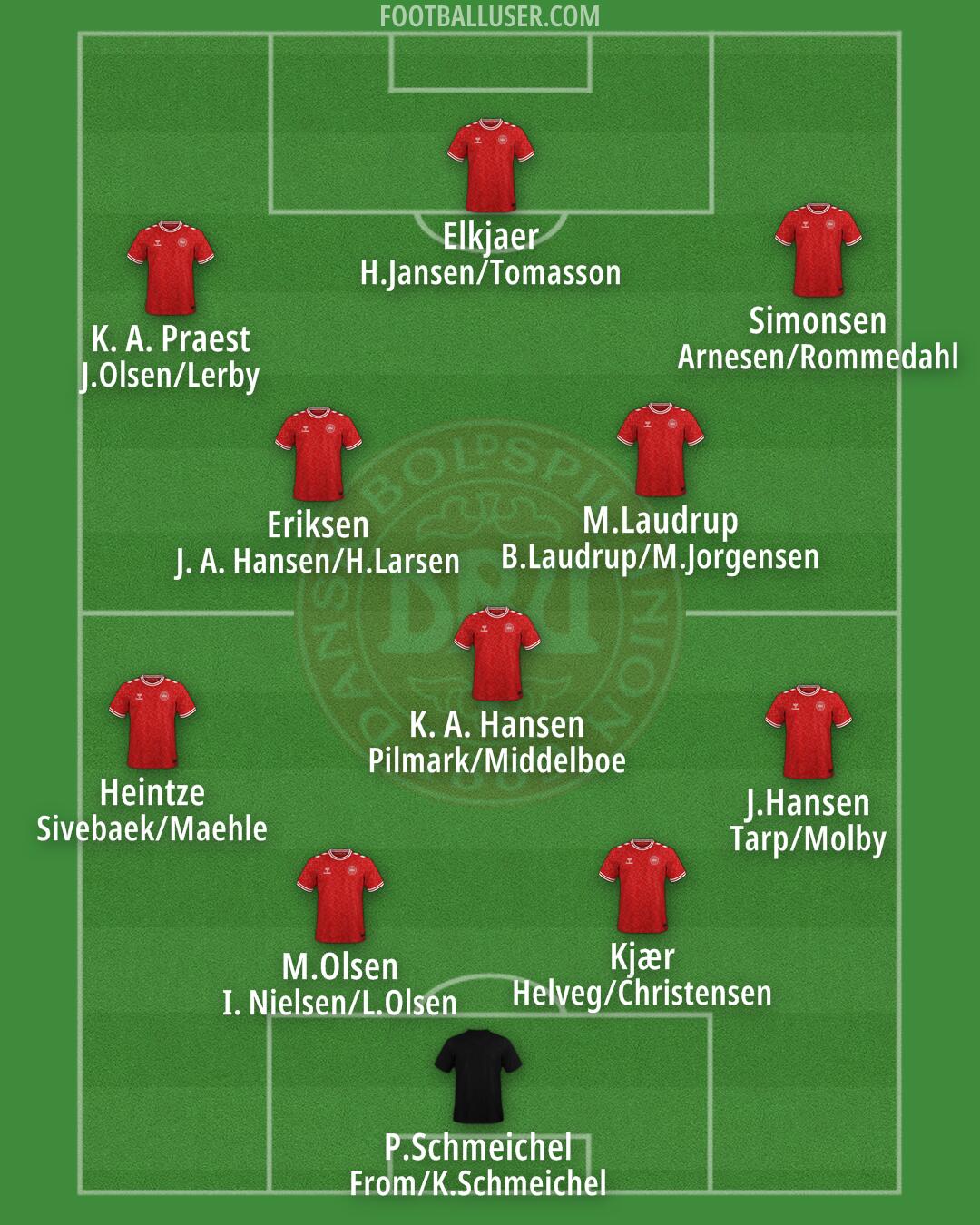

Denmark National Football Team Formation
 January 1, 2025


Starting Lineup
M.Laudrup (B.Laudrup/M.Jorgensen) · Elkjaer (H.Jansen/Tomasson) · K. A. Praest (J.Olsen/Lerby) · Eriksen (J. A. Hansen/H.Larsen) · K. A. Hansen (Pilmark/Middelboe) · M.Olsen (I. Nielsen/L.Olsen) · Kjær (Helveg/Christensen) · J.Hansen (Tarp/Molby) · Simonsen (Arnesen/Rommedahl) · Heintze (Sivebaek/Maehle) · P.Schmeichel (From/K.Schmeichel)Denmark relies on a direct and reactive identity using a 5-2-3 formation. This lineup focuses on absorbing pressure before hitting teams in transition. The Red Devils look to use the width of the pitch to stretch opponents while keeping a solid base behind the ball.
P.Schmeichel acts as the last line of defense, organizing the back five. The defensive unit operates with a central trio of K. A. Hansen, Kjær, and M. Olsen. Kjær provides aerial strength and leadership, while M. Olsen and K. A. Hansen cover the central spaces. Heintze and J. Hansen act as attacking wing backs, tasked to push high up the pitch to provide width. This allows the central defenders to hold a line and protect the middle during defensive phases.
The midfield operates with a two-man pairing. Eriksen and M.Laudrup occupy the central zones to connect the defense to the front line. Eriksen uses his passing range to find teammates and drive the tempo, while M.Laudrup works to support the buildup. These two must work hard to cover the space between the midfield and the back three, often dropping deep to help the defenders when the team sits in a mid-block.
In the attacking third, Denmark uses three attackers to pressure the opposition. Elkjaer acts as the lone striker, holding up the ball to bring others into play. K. A. Praest and Simonsen play as wide attackers, looking to cut inside to create chances or pull defenders away from the center. The team looks to exploit the space behind the opposition full backs with quick runs in behind and direct deliveries from the wing backs.
Denmark finds success through several tactical advantages. The five-man back line provides great compactness when defending, making it hard for teams to play through the middle. The wing backs, Heintze and J. Hansen, create wide overloads that force the opposition to defend much larger areas of the pitch. This setup also allows for a very fast speed of transition once the ball is won back.
This 5-2-3 formation is built to frustrate dominant sides by denying them space in central areas. It is best suited for matches where Denmark needs to sit deep and strike on the counter.