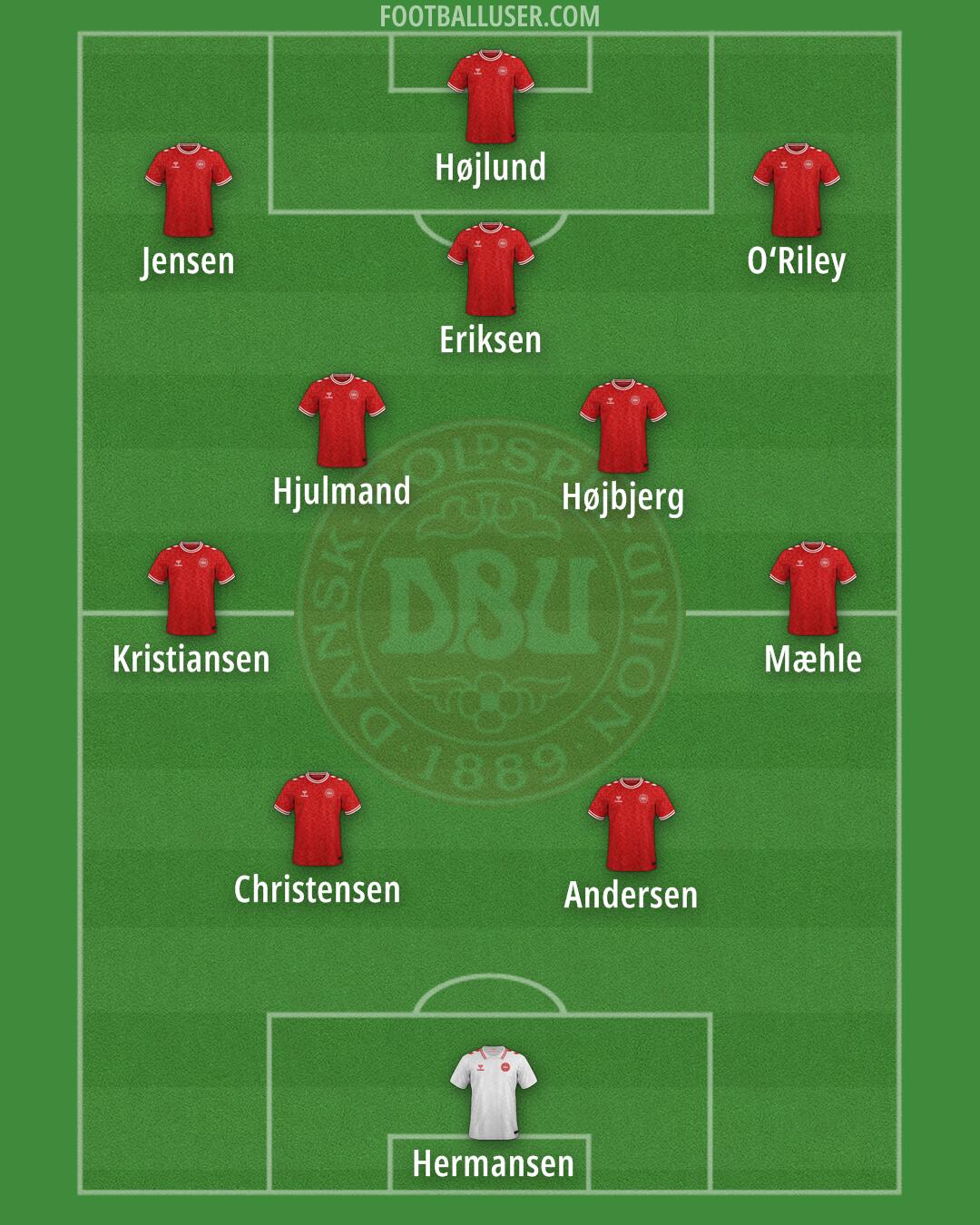

Denmark National Football Team Formation
 January 5, 2025


Starting Lineup
Kristiansen · Mæhle · Christensen · Andersen · Hjulmand · Højbjerg · Højlund · Eriksen · O‘Riley · Jensen · HermansenDenmark plays with high intensity and an aggressive intent, utilizing a 2-4-4 formation. The identity of the Red Devils is focused on winning the ball high up the pitch and attacking with large numbers. This lineup is built to play vertical football that relies on rapid transitions and constant pressure on the opposition.
Hermansen acts as the lone goalkeeper to guard the goal. The defensive unit is a narrow back two composed of Andersen and Christensen. Andersen is dominant in the air to win headers, while Christensen functions as a ball playing defender to help play out from the back. Because the back line is so small, they must step up to set the offside trap and squeeze the space to avoid being bypassed.
The midfield operates with a four man block to control the center of the pitch. Mæhle and Kristiansen act as a double pivot to shield the defense and win the second ball. Højbjerg and Hjulmand sit ahead of them in the half spaces to connect the defensive and attacking lines. Højbjerg uses his passing range to switch play, while Hjulmand presses aggressively to win the ball high up the pitch. This unit works to compress the midfield and deny the turn of the opposition.
In the final third, Denmark employs four attackers to stretch the defense. Jensen and O‘Riley play as wide wingers, with O‘Riley looking to cut inside and Jensen to spread wide. In the center, Eriksen and Højlund work as a partnership. Eriksen often drops into midfield to receive on the half-turn and play through the lines, while Højlund acts as a pressing centre-forward to pin the last defender. The team attacks in combinations, with the wingers trying to get to the byline and deliver early balls into the box.
A major advantage of this formation is the ability to press high in coordinated waves. With four players in the front line, Denmark can trigger a press and force a long ball from the opposition. Another strength is the numerical superiority in the final third, which allows the team to create wide overloads and quickly hit in behind on the transition.
This 2-4-4 formation is built for relentless offensive pressure and quick ball movement. It is best suited for matches against teams that sit deep and need to be broken down by constant attacking waves and high intensity.