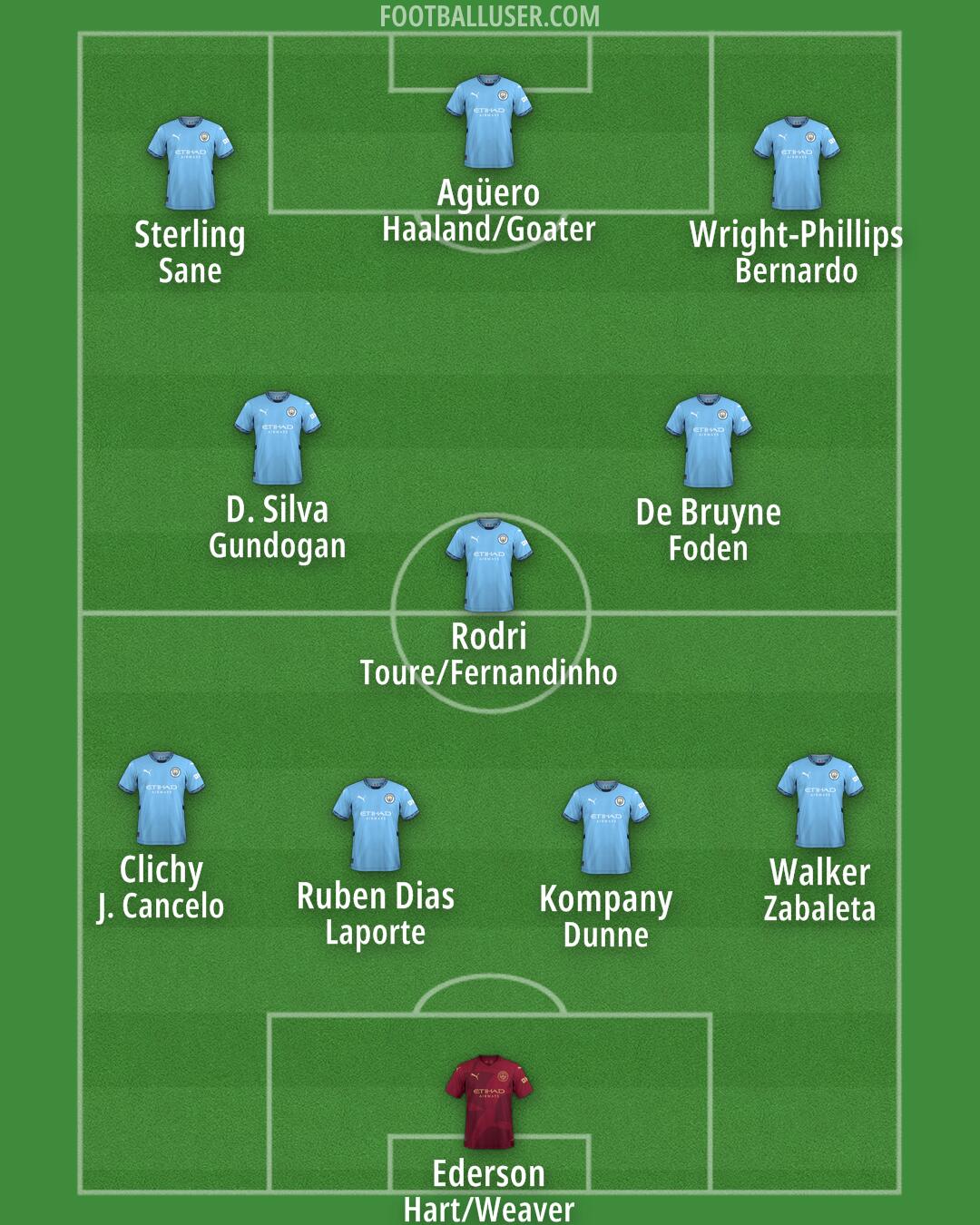
Man City Football Formation
 January 7, 2025


Starting Lineup
Ederson (Hart/Weaver) · Walker (Zabaleta) · Kompany (Dunne) · Ruben Dias (Laporte) · Clichy (J. Cancelo) · Rodri (Toure/Fernandinho) · De Bruyne (Foden) · D. Silva (Gundogan) · Wright-Phillips (Bernardo) · Sterling (Sane) · Agüero (Haaland/Goater)Man City relies on a high possession based identity to control matches. They use a 4-3-3 formation to dominate the ball and push the opposition back. This lineup is built to keep the ball in tight spaces and work the ball through the thirds to create chances.
Ederson plays between the posts to start the build up. The defensive unit works in a flat back four. Walker acts as an overlapping full back to provide width on the right, while Clichy pushes up from the left. Kompany and Ruben Dias form the central pair. Ruben Dias is dominant in the air and works to cover the space, while Kompany acts as a ball playing defender to help play short from the back.
The midfield features a single pivot with two advanced players. Rodri sits in front of the defense to shield the back four and recycle possession. Beside him, De Bruyne and D. Silva operate in the half spaces. De Bruyne uses his incredible passing range to break the line and find runners, while D. Silva carries the ball forward to connect the defensive and attacking lines. This trio works to compress the midfield and win it back high up the pitch.
Up front, the team uses three attackers. Agüero acts as a pressing centre forward who can hold up the ball and finish moves. On the flanks, Sterling and Wright-Phillips stretch the defence. Sterling often cuts inside to find space between the lines, while Wright-Phillips stays wide to whip it in or find space to play a one two. The goal is to create runs in behind and isolate wide players in one on one situations through quick combination play.
Manchester City gains numerical superiority in the middle of the park using this formation. The ability to press high in coordinated waves allows the team to win the ball back quickly. By using the full backs to overlap, they create wide overloads that force the opposition to shift across the pitch and leave gaps.
This 4-3-3 formation is designed for teams that want to dictate the tempo through ball control. It works best when facing opponents that sit deep and allow the team to spread wide and search for openings.