
São Paulo Football Formation
 January 10, 2025
 RPLemos


Starting Lineup
12 Rafael22 Igor V
14 Juan J
13 Sabino
16 E Dias
15 Alisson
19 André S
20 Luciano
17 Ferreira
18 L Gustavo
21 W Gomes
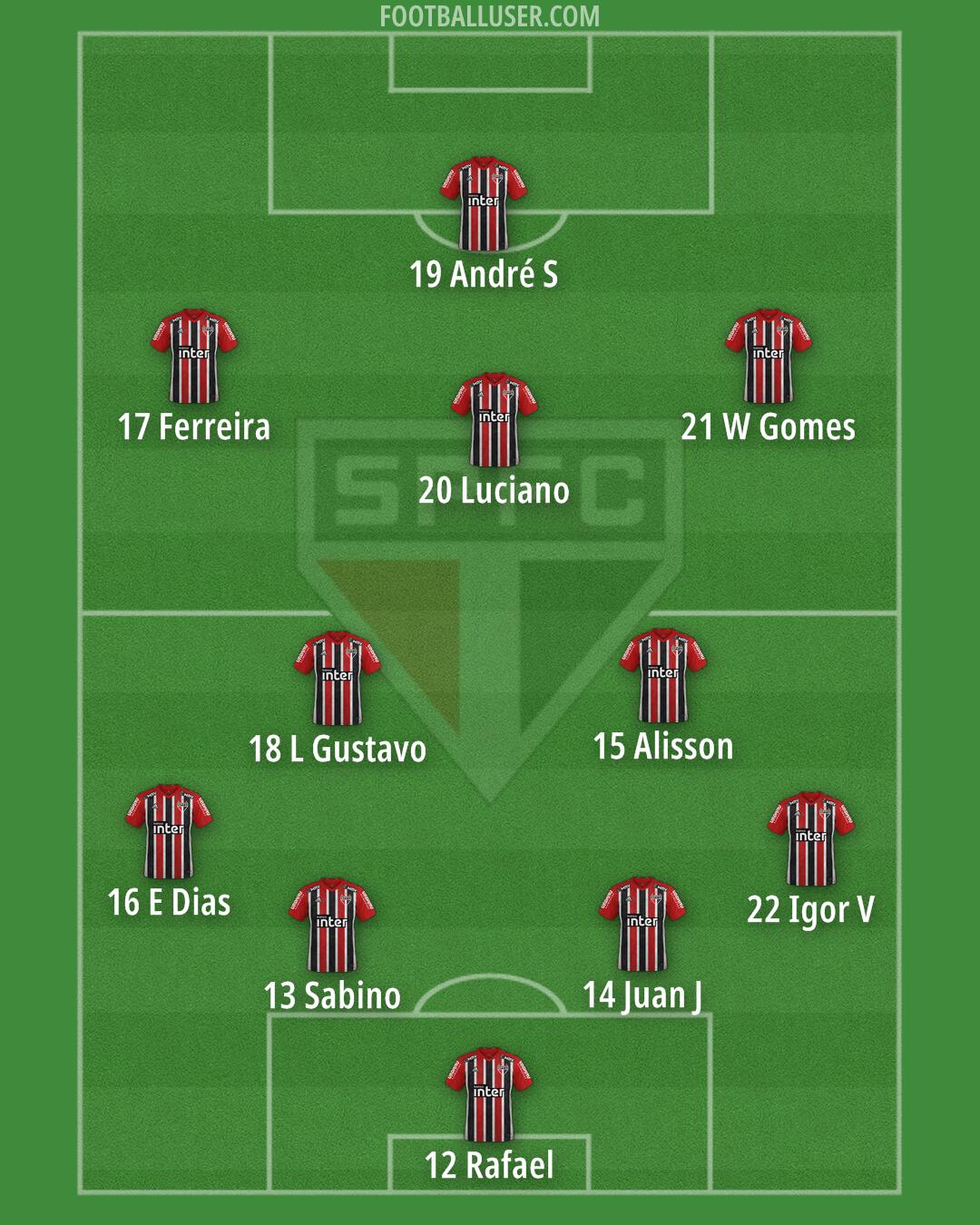
Seeking to catch opponents on the break with high verticality, São Paulo utilizes a 4-2-4 formation. This lineup aims to pin the opposition back through aggressive attacking numbers and rapid transitions. The goal is to overwhelm the back line by forcing high turnovers and playing quickly to the wide areas or the central strikers.
In front of the defense, Rafael stays between the posts to organize the back line. The defensive unit operates as a flat back four where Igor V acts as a defensive wing back on the right to hold the line. E Dias covers the left side to prevent crosses, while Juan J and Sabino sit in the center as the two central defenders. Juan J and Sabino must stay compact to defend zonally and win the header when teams go direct. This unit works to squeeze the space between the defense and midfield to prevent easy passes.
The midfield consists of a double pivot designed to shield the defense and recycle possession. Alisson and L Gustavo work as the two central midfielders tasked with protecting the center. Alisson focuses on winning the second ball and disrupting the opposition, while L Gustavo looks to carry the ball forward to connect the lines. They must remain disciplined to avoid being bypassed by central runners, often dropping deeper to pick up players when the team sits deep in a mid-block.
The attacking unit is built around four players who press from the front to force a long ball. Ferreira and W Gomes stay wide as wingers to stretch the defence, with Ferreira looking to cut inside to create chances. Luciano and André S operate as two forwards in a partnership, often using their movement to create runs in behind. Luciano works to link up play between the lines, while André S acts to find the feet of the striker or hold up the ball for the wingers to run onto.
One major strength of this São Paulo lineup is the ability to create wide overloads when the wingers and full backs combine. Another advantage is the speed of transition, as the team can move from a defensive block to an attacking wave very quickly. By keeping four players high, they often isolate wide players in one on one situations during quick breaks.
This 4-2-4 formation focuses on high-risk, high-reward attacking football. It is best suited for matches where the team needs to hunt for goals against a side that sits deep.