Man City Football Formation
 January 12, 2025


Starting Lineup
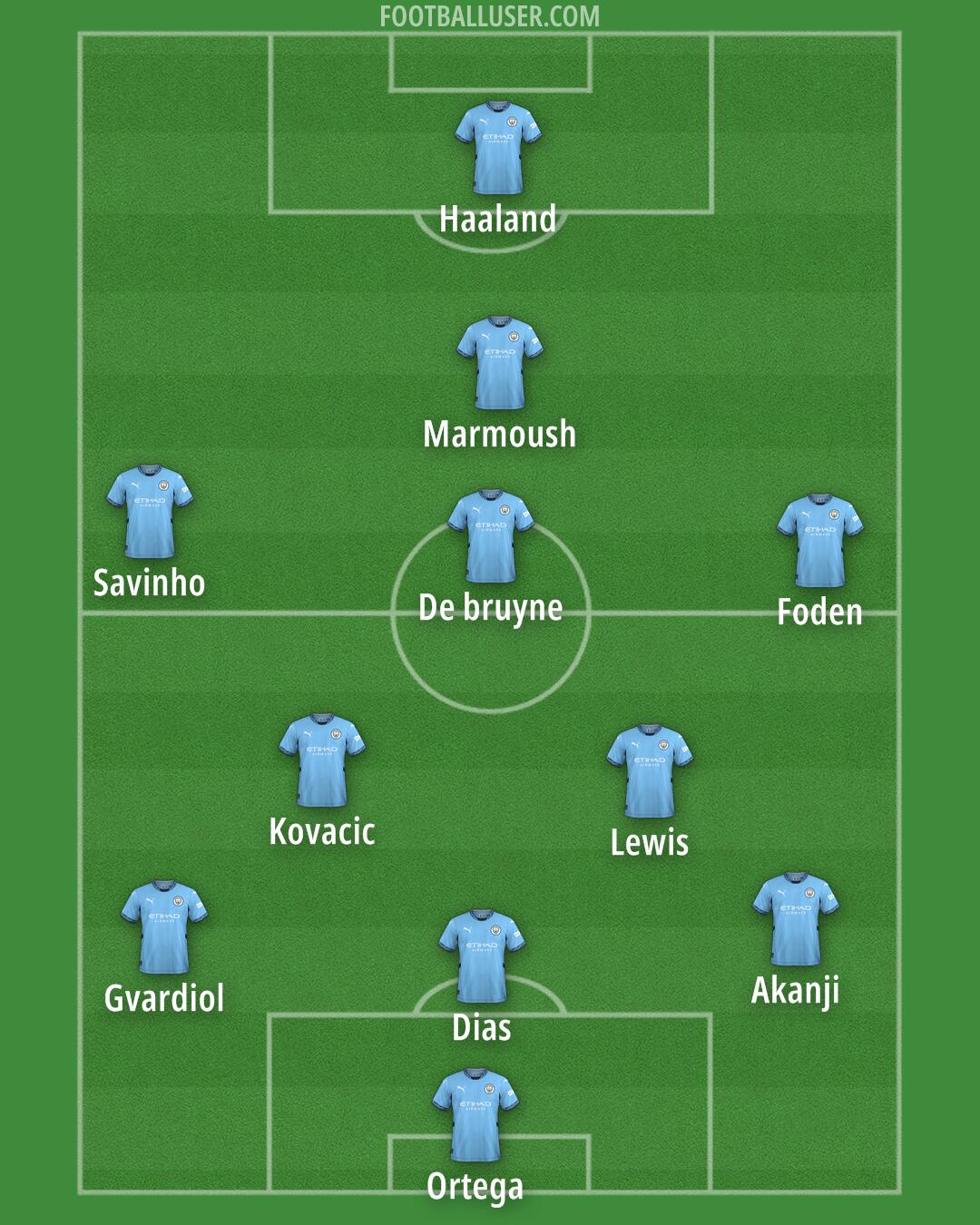
Haaland · Marmoush · Savinho · Foden · De bruyne · Akanji · Dias · Gvardiol · Kovacic · Lewis · OrtegaMan City relies on a heavy high press and rapid transitions using a 5-4-1. This formation is built to suffocate opponents in their own half and strike with lethal precision when the ball is won. The team looks to dominate much of the ball but maintains a compact setup to prevent any breaks.
Ortega stays between the posts to act as a sweeper behind a high line. The back five consists of Akanji as the right wing back, Lewis and Dias as the central defenders, Kovacic as the left centre back, and Gvardiol as the left wing back. Akanji and Gvardiol are tasked to push up and provide width, while Dias and Lewis defend the central zone and win the headers. Kovacic acts as a ball playing defender to help play short from the back. The defensive unit stays close together to squeeze the space in the final third.
A four man midfield acts as the engine to connect the defence and attack. Savinho and Foden operate in the half spaces, while De Bruyne and Marmoush occupy central roles to press aggressively and win it back high up the pitch. De Bruyne uses his passing range to find players between the lines, and Marmoush plays as an attacking ten to support the striker. Savinho and Foden are expected to carry the ball forward into the attacking third to create overloads.
The attack features Haaland as a lone pressing centre forward. He stays high to pin the last defender and prepare for runs in behind. When the team wins the ball, the wing backs Akanji and Gvardiol overlap the wide players to stretch the defence. Haaland looks to find the feet of the striker or run onto through balls delivered by De Bruyne. The front line works together to force a long ball from the opposition, allowing the back five to recycle possession.
Man City gains a massive advantage through the ability to press high in coordinated waves. This setup allows for wide overloads from the wing backs when they push up alongside the midfielders. The team also maintains compactness when defending against counters, making it hard for opponents to find passing lanes through the middle.
This formation provides a heavy defensive block that can instantly transform into a vertical attacking force. It is best suited for matches where the team needs to control the tempo while remaining extremely dangerous on the break.