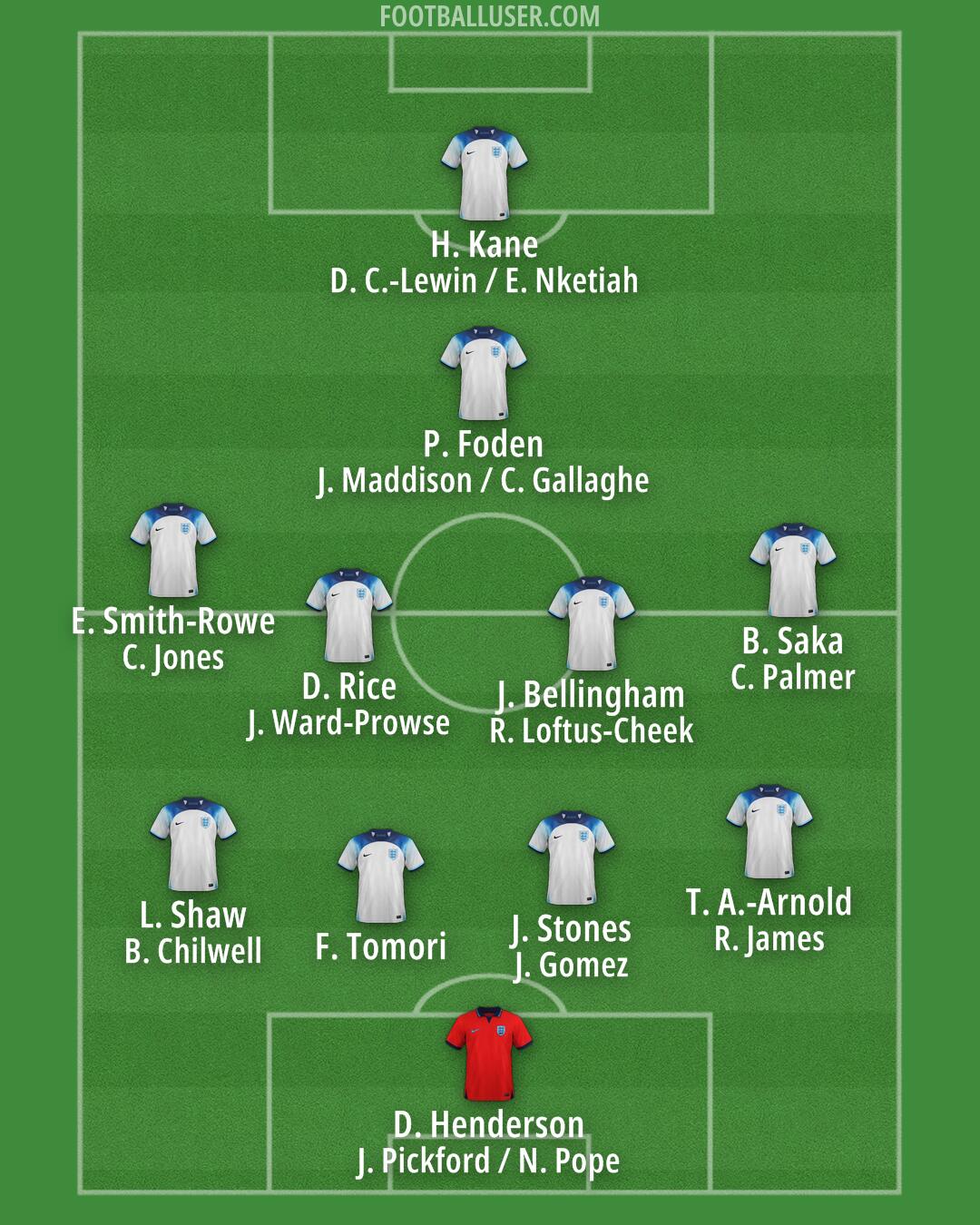
England National Football Team Formation
 January 20, 2025


Starting Lineup
H. Kane (D. C.-Lewin / E. Nketiah) · J. Bellingham (R. Loftus-Cheek) · D. Rice (J. Ward-Prowse) · B. Saka (C. Palmer) · P. Foden (J. Maddison / C. Gallaghe) · J. Stones (J. Gomez) · T. A.-Arnold (R. James) · L. Shaw (B. Chilwell) · F. Tomori · D. Henderson (J. Pickford / N. Pope) · E. Smith-Rowe (C. Jones)The Three Lions aim to control matches through a high press and rapid transition, operating within a 4-5-1 formation. This lineup focuses on squeezing the space in the opponent's half and using a dense midfield block to regain possession quickly. England looks to use their technical ability to move the ball through the thirds and create chances in the final third via direct verticality or patient combinations.
D. Henderson guards the goal while the defensive unit works in a flat back four. J. Stones and F. Tomori act as the central defenders, with Stones often stepping into midfield to help build play from the back. L. Shaw provides balance on the left as a full back, while T. A.-Arnold operates as an attacking full back on the right to provide width. The back line maintains a high line to compress the pitch and keep the team compact when they do not have the ball.
The midfield acts as the engine room of the England side, using a five man line to dominate the center. D. Rice sits in a holding role to shield the defense and intercept passes, while J. Bellingham acts as a carrier to drive the ball forward. P. Foden operates as the attacking ten behind the striker, looking to find pockets of space between the lines. On the flanks, B. Saka and E. Smith-Rowe provide energy and help the team transition from a mid block to an attacking position by covering wide areas.
In the attacking phase, H. Kane operates as a lone striker who can drop deep to link play. This movement allows the midfield to push higher and creates space for late runs into the box. B. Saka stays wide to stretch the defense, while E. Smith-Rowe can cut inside to create overloads in the half spaces. The team relies on the movement of H. Kane to hold up the ball and find the feet of incoming runners like J. Bellingham or P. Foden to break the line.
One major advantage of this formation is the ability to press high in coordinated waves, using the front four to force a long ball. The midfield provides numerical superiority in the center, making it difficult for opponents to play through the middle. Additionally, the team creates wide overloads when T. A.-Arnold overlaps the winger to pin the last defender.
This 4-5-1 formation is built to suffocate opponents through intense pressing and midfield control. It is best suited for games against teams that struggle to play out from the back under pressure.