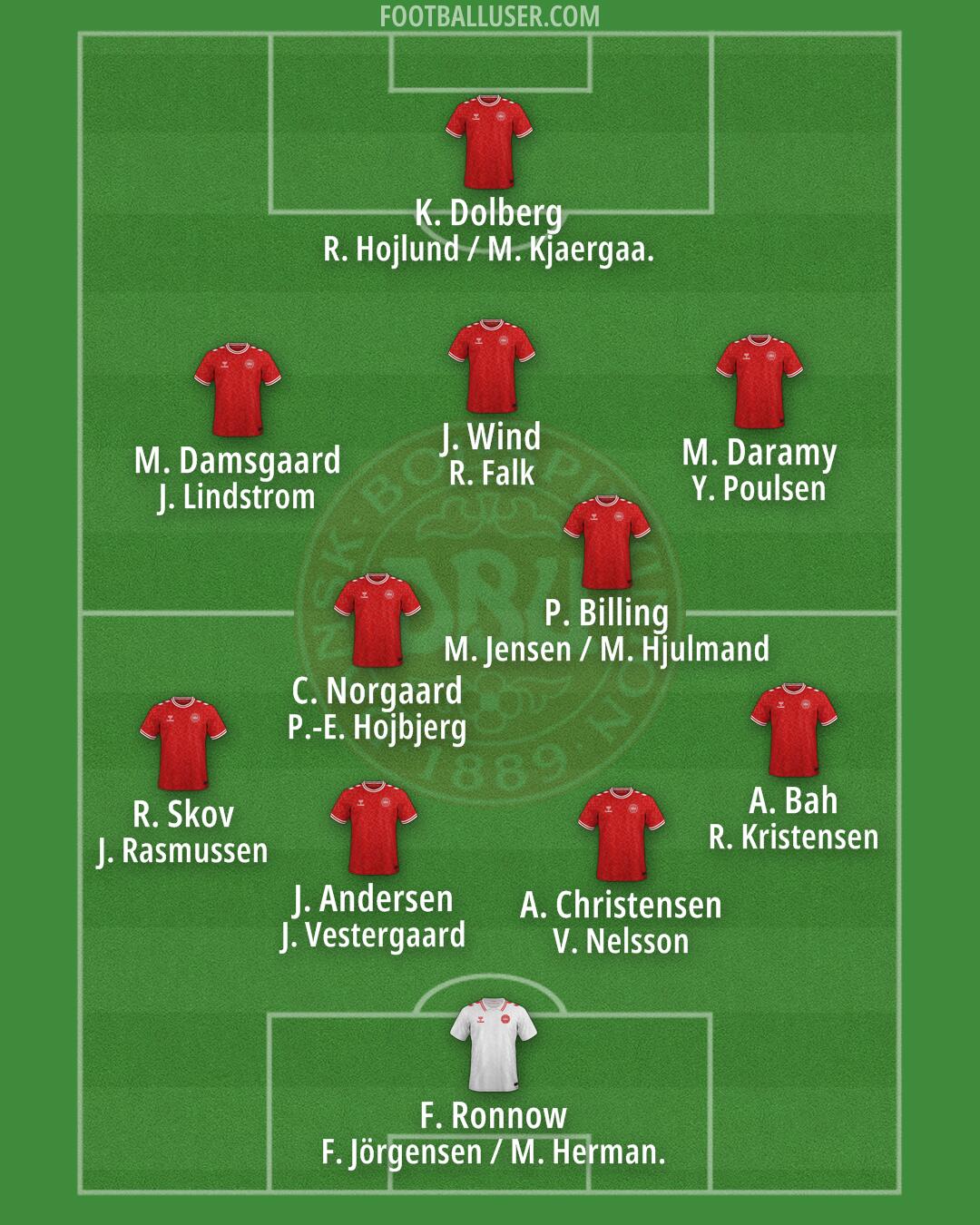

Denmark National Football Team Formation
 January 20, 2025


Starting Lineup
F. Ronnow (F. Jörgensen / M. Herman.) · A. Christensen (V. Nelsson) · J. Andersen (J. Vestergaard) · P. Billing (M. Jensen / M. Hjulmand) · C. Norgaard (P.-E. Hojbjerg) · J. Wind (R. Falk) · K. Dolberg (R. Hojlund / M. Kjaergaa.) · A. Bah (R. Kristensen) · M. Damsgaard (J. Lindstrom) · M. Daramy (Y. Poulsen) · R. Skov (J. Rasmussen)Denmark aims to play a direct and disciplined game through a 4-5-1 formation. This lineup relies on defensive solidity and quick transitions to unsettle the opposition. The goal is to remain compact in the middle and use the movement of the forwards to punish teams on the break.
F. Ronnow guards the goal as the defensive unit sits in a mid-block. The back line consists of a flat four with A. Bah acting as a full back on the right and R. Skov on the left. In the center, A. Christensen and J. Andersen work together to hold the line and defend zonally. Christensen uses his composure to play out from the back while Andersen provides strength to win the header during aerial duels. The defensive unit moves as one to squeeze the space between the lines.
The midfield functions as a five man unit that controls the central areas. C. Norgaard acts as the single pivot who shields the defence and breaks up play. Beside him, P. Billing provides energy to win the second ball and connects the defensive and attacking lines. The central trio of M. Damsgaard, M. Daramy, and J. Wind provides the engine room. Damsgaard looks to create from deep with his passing range while Daramy and Wind push forward to support the transition. This midfield group works to compress the midfield and deny the turn to opposition playmakers.
In the attacking phase, the team relies on a lone striker, K. Dolberg, to lead the line. Dolberg works to hold up the ball and find the feet of the striker when the team moves forward. The midfielders M. Damsgaard and J. Wind often arrive late into the box to support the central presence. Wide areas are used to stretch the defence, allowing the midfielders to drive forward with the ball. Denmark looks to hit in behind on the transition by using quick vertical passes to find Dolberg.
One major advantage of this formation is the ability to maintain compactness when defending in a mid-block. The five man midfield makes it difficult for opponents to play through the lines. Another strength is the speed of transition once the ball is won in the middle. The team can quickly switch play to the wide areas or go direct to the lone striker to catch the opposition off guard.
The Danish national team uses this 4-5-1 to stay solid against dominant sides. This formation is best suited for games where the team must sit deep and counter at pace.