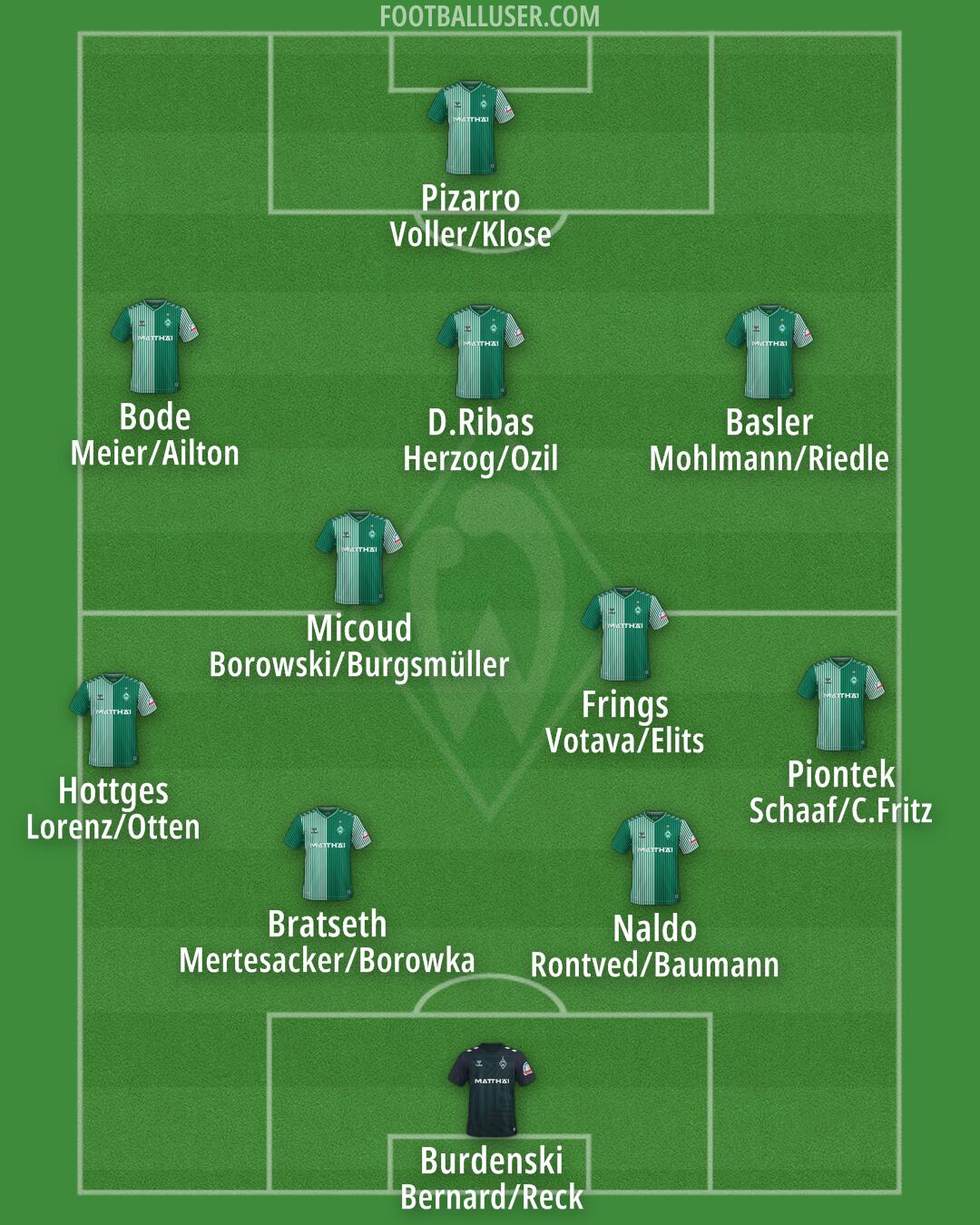

Werder Bremen Football Formation
 January 25, 2025


Starting Lineup
Pizarro (Voller/Klose) · Micoud (Borowski/Burgsmüller) · Frings (Votava/Elits) · Hottges (Lorenz/Otten) · Bratseth (Mertesacker/Borowka) · Burdenski (Bernard/Reck) · Piontek (Schaaf/C.Fritz) · Naldo (Rontved/Baumann) · Bode (Meier/Ailton) · D.Ribas (Herzog/Ozil) · Basler (Mohlmann/Riedle)Werder Bremen uses an aggressive intent to overwhelm the opponent, often playing with a heavy high press. The team utilizes a 2-4-4 formation to dominate the attacking third and hunt the ball high up the pitch. This lineup is built to pin the opposition back and win it back high up the pitch.
Burdenski acts as the last line of defence in goal. The back line relies on a narrow defensive block with only two central defenders, Naldo and Bratseth, who must play a high line. Naldo uses his aerial strength to win the header and his passing range to play out from the back. Bratseth must track back to cover the space behind when the team is caught out. This pair must be ready to defend man to man in wide areas if the opposition breaks.
The midfield contains four players who work to compress the midfield and link the lines. Micoud operates as an attacking ten, looking to play through the lines and find the feet of the striker. Frings works to shield the defence and wins the second ball to keep play moving. Hottges and Piontek carry the ball forward to drive into the half spaces. This group allows the team to recycle possession and move quickly from the middle to the front.
The front line features four attackers designed to stretch the defence. Basler and Bode operate as wide players, with Basler looking to cut inside and Bode to whip it in from the flank. In the centre, D.Ribas and Pizarro form a striking partnership. Pizarro uses his ability to hold up the ball, while D.Ribas makes runs in behind to find space. These forwards press from the front to force a long ball and create chances in transition.
A major strength of this formation is the numerical superiority in the final third. The team can trigger a press in coordinated waves to squeeze the space and win the ball back quickly. This allows Werder Bremen to hit in behind on the transition and catch the opposition before they can set the offside trap.
This 2-4-4 formation is a high risk method of play centered on total offensive dominance. It is best suited for situations where the team must break down a low block or chase a goal late in the game.