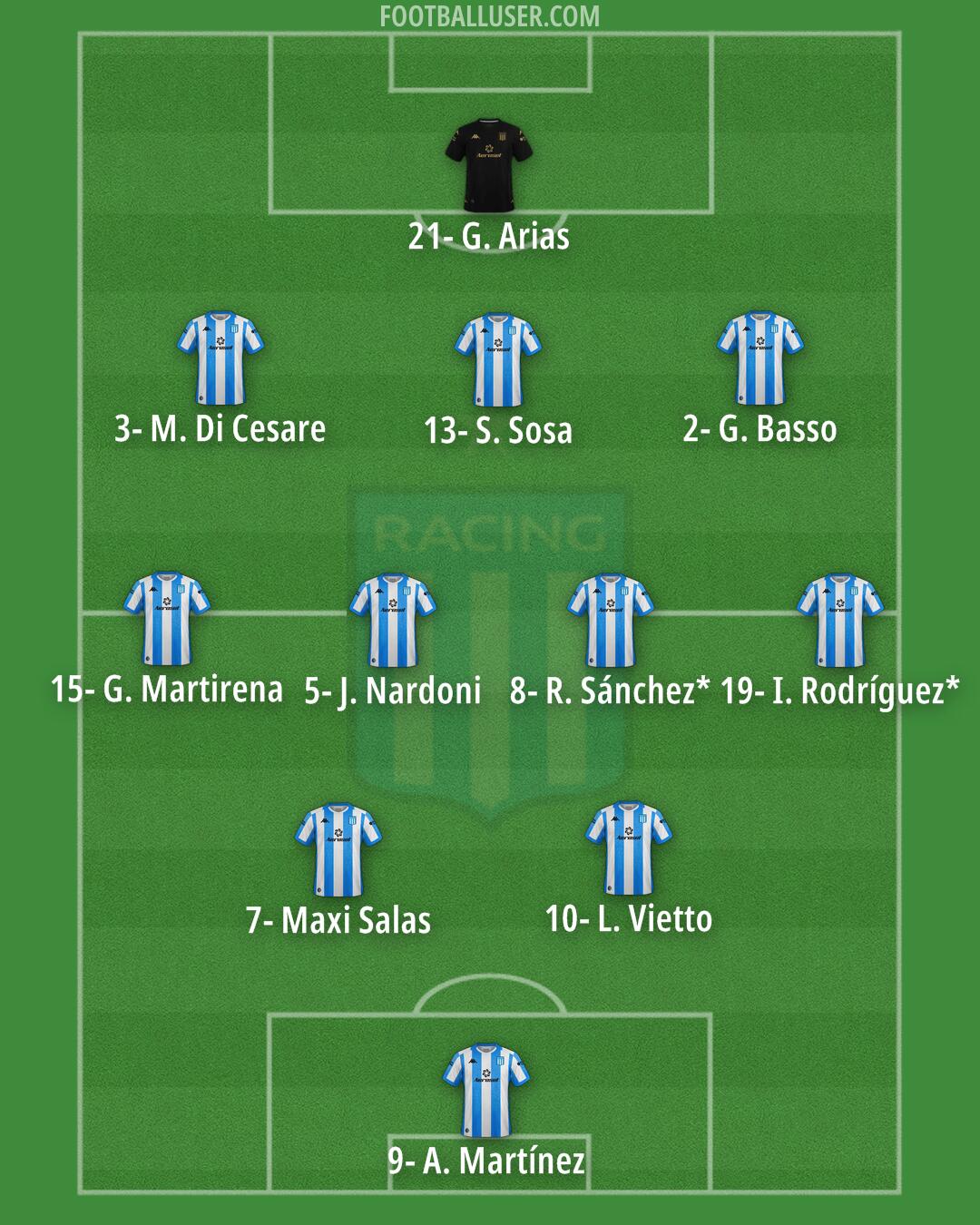

Racing Club Football Formation
 January 30, 2025


Starting Lineup
21- G. Arias3- M. Di Cesare
13- S. Sosa
2- G. Basso
15- G. Martirena
5- J. Nardoni
8- R. Sánchez*
19- I. Rodríguez*
7- Maxi Salas
10- L. Vietto
9- A. Martínez
Racing Club relies on a high press and quick transitions using a 3-4-3 formation. This lineup is built to pin the opposition back and win the ball high up the pitch to catch teams out of position. The team looks to play with verticality, moving from a defensive block to an attacking wave in seconds.
G. Arias acts as the last line of defense in goal. The back line consists of a central trio where S. Sosa leads the way as the main center back. M. Di Cesare plays as the right center back and G. Basso occupies the left center back role. This three man unit works to hold a high line and squeeze the space between the defense and midfield. When the team is under pressure, the defenders look to clear the lines and maintain a compact shape.
The midfield functions with two central players and two wide players who provide much width. J. Nardoni and R. Sánchez operate in the center to win the second ball and control the tempo. J. Nardoni works to protect the defense while R. Sánchez looks to drive forward with the ball to link the play. On the flanks, G. Martirena and I. Rodríguez act as wing backs to stretch the defense. They are tasked to provide width and overlap the attackers to create numbers in the final third.
In the attacking phase, Racing Club utilizes three forwards to stress the opposition back line. A. Martínez plays as the lone striker and focuses on his physical presence to hold up the ball. L. Vietto and Maxi Salas operate as wide attackers who cut inside to find space between the lines. This setup allows the team to attack in combinations, using the width of Martirena and Rodríguez to deliver crosses. The front three work together to press the opposition and force a long ball.
One major advantage for Racing Club is the ability to create wide overloads through the wing backs. When Martirena and Rodríguez push high, they force the opposing wingers to track back, creating numerical superiority. Another strength is the speed of transition, as the midfield can quickly find the front three to hit in behind on the transition. This makes the team very dangerous when they win the ball in the middle third.
This 3-4-3 formation creates a heavy presence in both the wide areas and the central attacking zone. It is best suited for games against teams that play a high line or leave space behind their midfield.