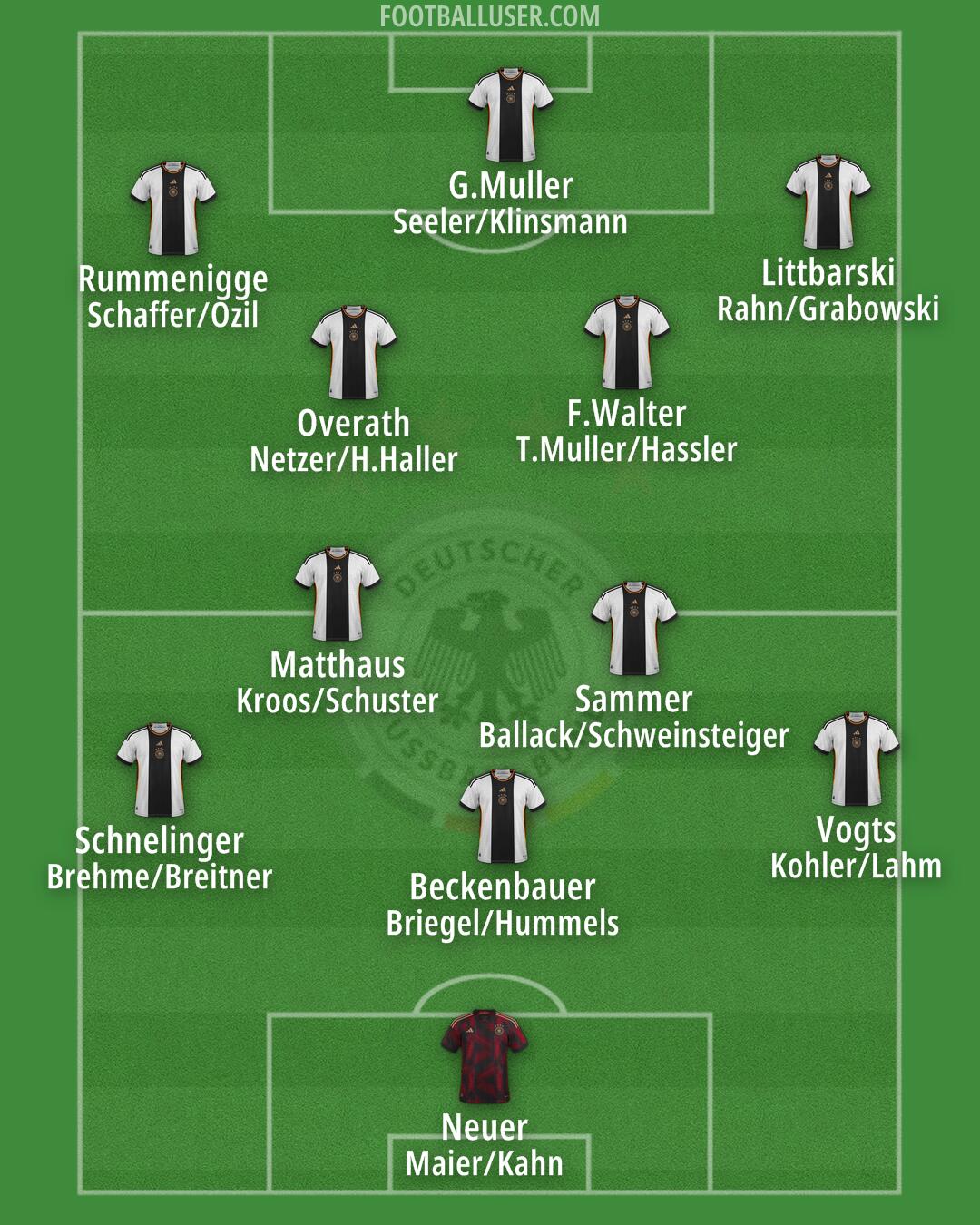

Germany National Football Team Formation
 January 31, 2025


Starting Lineup
Beckenbauer (Briegel/Hummels) · Matthaus (Kroos/Schuster) · Overath (Netzer/H.Haller) · G.Muller (Seeler/Klinsmann) · Rummenigge (Schaffer/Ozil) · Littbarski (Rahn/Grabowski) · Vogts (Kohler/Lahm) · Neuer (Maier/Kahn) · Schnelinger (Brehme/Breitner) · Sammer (Ballack/Schweinsteiger) · F.Walter (T.Muller/Hassler)Germany relies on a direct and aggressive attacking identity through a 5-2-3 formation. This lineup is built to hit teams in transition and use width to stretch the opposition. The team aims to win the ball and move forward quickly to exploit spaces left by advancing defenders.
Manuel Neuer plays between the posts to start the build up from the back. The defensive unit operates in a back five with Beckenbauer acting as a ball playing defender who can step into midfield. Matthaus and Sammer sit as central defenders to provide aerial strength and cover the space behind the wing backs. Vogts works as an attacking wing back on the right to provide width, while Schnelinger plays as an attacking wing back on the left to support the advance. The unit maintains a compact shape to deny the turn to opposition strikers.
The midfield functions as a two man central unit designed to link the defense to the front three. F.Walter plays as a deep lying playmaker to control the tempo and recycle possession. Overath acts as a carrier to drive forward with the ball and connect the lines. Together, they work to win the second ball and ensure the team does not get bypassed in the middle of the pitch.
Germany utilizes three attackers across the front to pin the last defender. G.Muller acts as a pressing centre forward who finds the feet of his teammates and arrives late into the box. Rummenigge plays as an inverted winger on the left to cut inside and create goalscoring chances, while Littbarski operates on the right to provide crosses from wide areas. These attackers press from the front to force a long ball and create chances through quick combinations.
The tactical advantages of this formation include the ability to create wide overloads through the wing backs Vogts and Schnelinger. Germany also benefits from numerical superiority in the defensive third when defending in a low block. The speed of transition allows the team to exploit teams that play a high line.
This 5-2-3 formation provides a solid foundation for a team that wants to attack with pace and intensity. It is best suited for games where the opponent leaves space behind their defensive line.