Arsenal Football Formation
 February 5, 2025


Starting Lineup
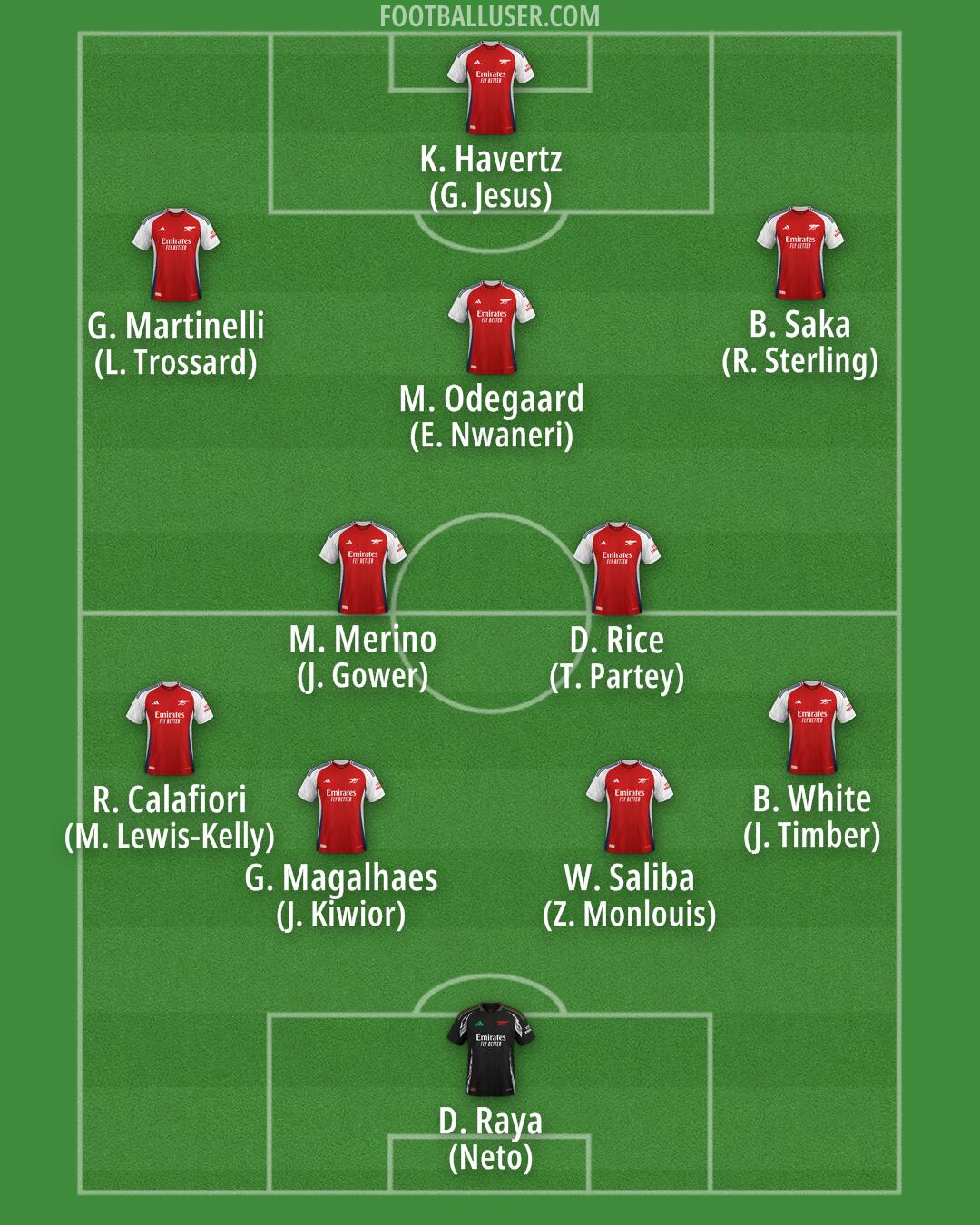
D. Raya (Neto) · B. White (J. Timber) · W. Saliba (Z. Monlouis) · G. Magalhaes (J. Kiwior) · R. Calafiori (M. Lewis-Kelly) · D. Rice (T. Partey) · M. Merino (J. Gower) · B. Saka (R. Sterling) · M. Odegaard (E. Nwaneri) · G. Martinelli (L. Trossard) · K. Havertz (G. Jesus)Arsenal prioritizes an aggressive high press and rapid verticality through a 4-2-4 formation. This lineup aims to overwhelm the opposition by pinning their defenders back and creating chaos in the final third. The goal is to win the ball high up the pitch and move through the lines with speed to exploit gaps before the opponent can settle.
David Raya operates between the posts to start the build up. Behind a flat back four, William Saliba and Gabriel Magalhaes act as the central pillars, with Saliba providing recovery pace and Magalhaes using his aerial strength to defend set pieces. Ben White and Riccardo Calafiori fill the wide roles, with Ben White often providing width while Calafiori can tuck inside to bolster the middle. The defensive unit works to squeeze the space and maintain a high line to keep the team compact.
The midfield operates as a double pivot designed to control the center. Declan Rice acts as the primary shield for the defense, using his high pressing intensity to win the ball back immediately. Mikel Merino plays alongside him to connect the defensive and attacking lines, helping to recycle possession when the tempo needs to slow down. This pairing allows the team to transition from a mid-block into an attacking force very quickly.
In the final third, Arsenal utilizes two strikers and two wide attackers to stretch the defense. Kai Havertz and Martin Odegaard operate as the central duo, with Havertz often working as a pressing centre-forward and Odegaard finding pockets of space to play through the lines. Gabriel Martinelli and Bukayo Saka provide width on the flanks, with Saka looking to cut inside to create chances while Martinelli uses his pace to run in behind. This front four is designed to isolate wide players in one on one situations.
One major strength of this Arsenal formation is the ability to press high in coordinated waves, making it very difficult for opponents to play out from the back. The team also benefits from the speed of transition when the double pivot recovers the ball. By using four attackers, they create wide overloads that force the opposition to pull defenders out of position, leaving central gaps for the strikers to exploit.
This 4-2-4 formation is built to dominate matches through high intensity and direct attacking movements. It is best suited for games where the team needs to break down a low block or punish an opponent through quick transitions.