Liverpool Football Formation
 February 5, 2025


Starting Lineup
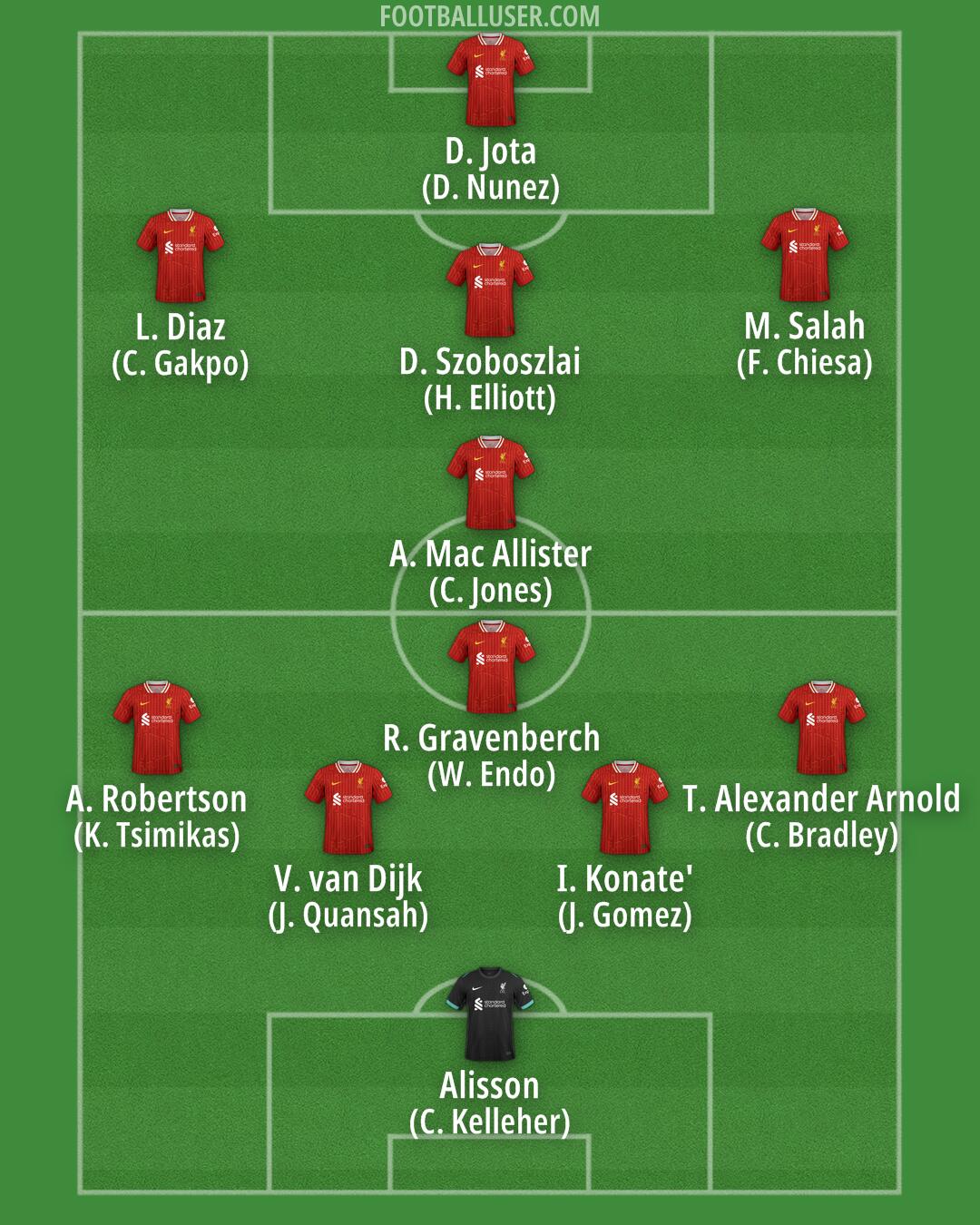
Alisson (C. Kelleher) · T. Alexander Arnold (C. Bradley) · I. Konate' (J. Gomez) · V. van Dijk (J. Quansah) · A. Robertson (K. Tsimikas) · R. Gravenberch (W. Endo) · A. Mac Allister (C. Jones) · M. Salah (F. Chiesa) · D. Szoboszlai (H. Elliott) · L. Diaz (C. Gakpo) · D. Jota (D. Nunez)Liverpool focuses on a high press and rapid transitions, playing with a 5-4-1 formation. This lineup is built to win the ball high up the pitch and hit the opposition before they can settle. The tactical identity relies on being defensively solid while maintaining the threat of quick breaks.
Alisson stays between the posts to command his area and sweep behind a high line. The defensive unit operates with a back three consisting of V. van Dijk, I. Konate', and R. Gravenberch, who act as ball playing defenders to progress play. V. van Dijk uses his aerial strength and composure to lead the line, while I. Konate' provides recovery speed. A. Robertson and T. Alexander Arnold act as attacking wing backs, pushing high to provide width and stretch the defence. This group works to squeeze the space and maintain a compact defensive block.
The midfield functions as a four man unit that connects the back line to the attack. A. Mac Allister sits in a deep role to shield the defence and recycle possession. D. Szoboszlai drives forward with the ball to break the line, using his impressive engine and passing range to move the team up. L. Diaz and M. Salah operate in the half spaces, where they can press aggressively to win the ball high up the pitch. This midfield group is tasked to press in pairs and cut off the passing lane to the opposition pivot.
Liverpool employs a lone striker in D. Jota, who functions as a pressing centre forward. He works to pin the last defender and create space for the midfielders to arrive late into the box. The attack relies on the movement of L. Diaz and M. Salah, who act as inverted wingers to cut inside and threaten the goal. T. Alexander Arnold and A. Robertson provide the necessary width through overlaps, allowing the front four to combine in tight spaces. The team looks to hit in behind on the transition by finding the feet of the striker or playing through the lines.
This formation offers significant advantages through its ability to press high in coordinated waves. Liverpool can create wide overloads when the wing backs push up, forcing the opposition to defend deep. The presence of three central defenders provides compactness when defending, making it hard for opponents to play through the middle. Furthermore, the speed of transition allows the team to exploit spaces left by attacking opponents.
The 5-4-1 formation provides a strong foundation for a team that wants to control games through intense pressing. This setup is best suited for facing heavy possession sides that can be caught out during their attacking phases.