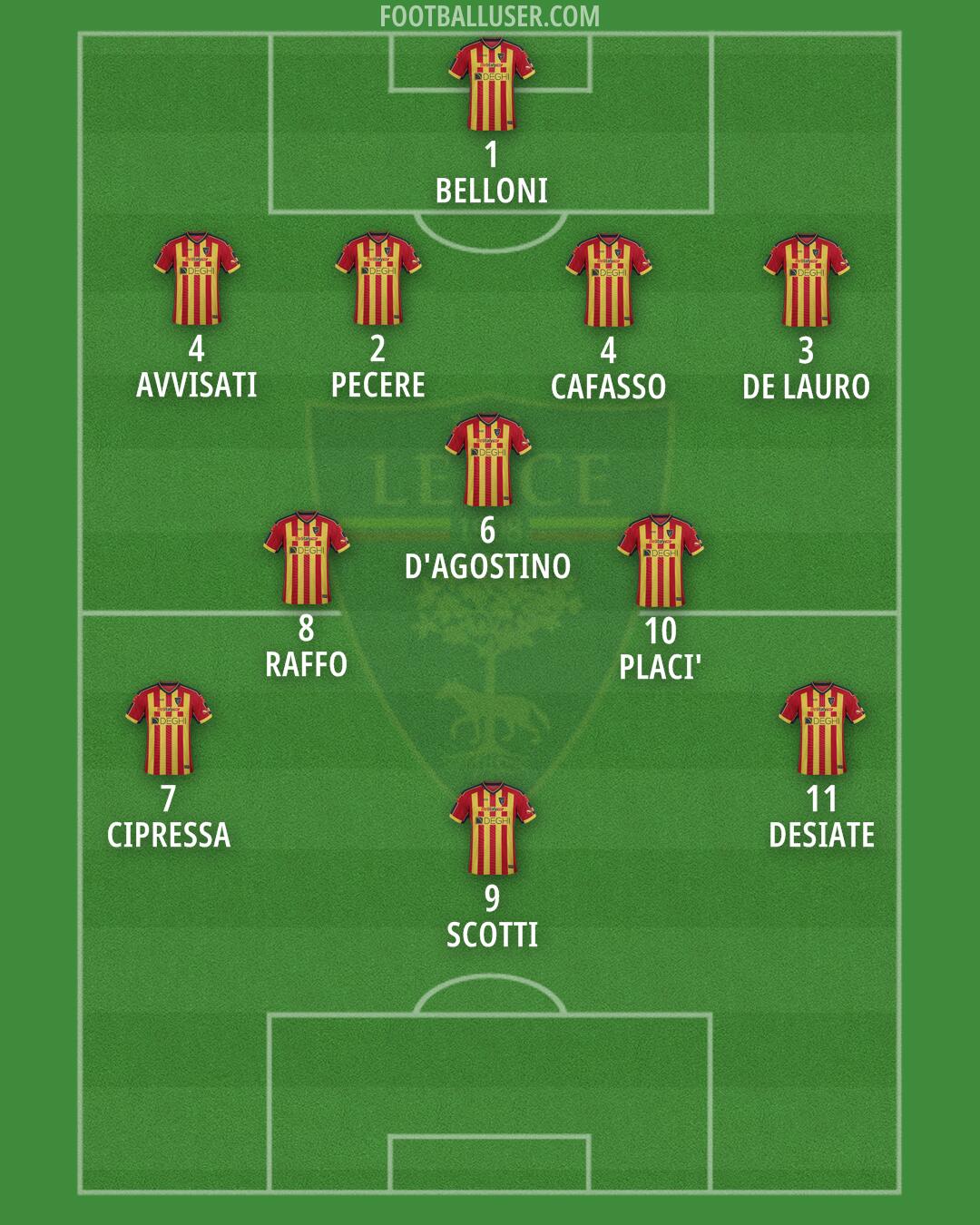

Lecce Football Formation
 February 10, 2025


Starting Lineup
1 (BELLONI)2 (PECERE)
4 (AVVISATI)
4 (CAFASSO)
3 (DE LAURO)
6 (D'AGOSTINO)
8 (RAFFO)
10 (PLACI')
7 (CIPRESSA)
9 (SCOTTI)
11 (DESIATE)
Lecce aims to play a high press and vertical game using a 4-3-3. This lineup is built to win the ball high up the pitch and break quickly once possession is regained. The team looks to stretch the defence and attack with speed through the channels to catch the opposition off guard.
1 starts the play from the goalkeeper position. The back line functions as a flat back four where 4 (RB) and 3 (LB) act as attacking full backs to provide width. Central defenders 2 (RCB) and 4 (LCB) maintain a high line to squeeze the space. 2 (RCB) is responsible for covering the space behind while 4 (LCB) helps to play out from the back. The defensive unit works to hold the line and set the offside trap to deny the opponent time on the ball.
The midfield is built around a single pivot. 6 (DM) sits in front of the back four to shield the defence and deny the pivot of the opponent. 8 (LCM) and 10 (RCM) operate as two eights who connect the defensive and attacking lines. 8 (LCM) is tasked to carry the ball forward, while 10 (RCM) works to play through the lines to find the feet of the striker. This unit helps Lecce to recycle possession and win the second ball to keep the pressure on.
Lecce uses three attackers across the front to pressure the opponent. 9 (ST) acts as a pressing centre-forward to harass the opposition back line. 7 (RW) and 11 (LW) play as inverted wingers who cut inside to create central presence. This movement allows 4 (RB) and 3 (LB) to overlap the winger and deliver crosses. The forwards look to hit in behind on the transition and use combinations to split the defence and find space.
A major strength of this 4-3-3 is the ability to press high in coordinated waves. By having 9 (ST), 7 (RW), and 11 (LW) lead the press, the team can win it back high up the pitch. Another advantage is the wide overloads created when the full backs push up. This creates one on one situations for the wingers and allows the team to whip it in from the flanks.
This formation relies on high intensity and quick transitions. It is best suited for matches against opponents that struggle to play short from the back or cannot handle a high press.