
Tokyo-V Football Formation
 February 13, 2025


Starting Lineup
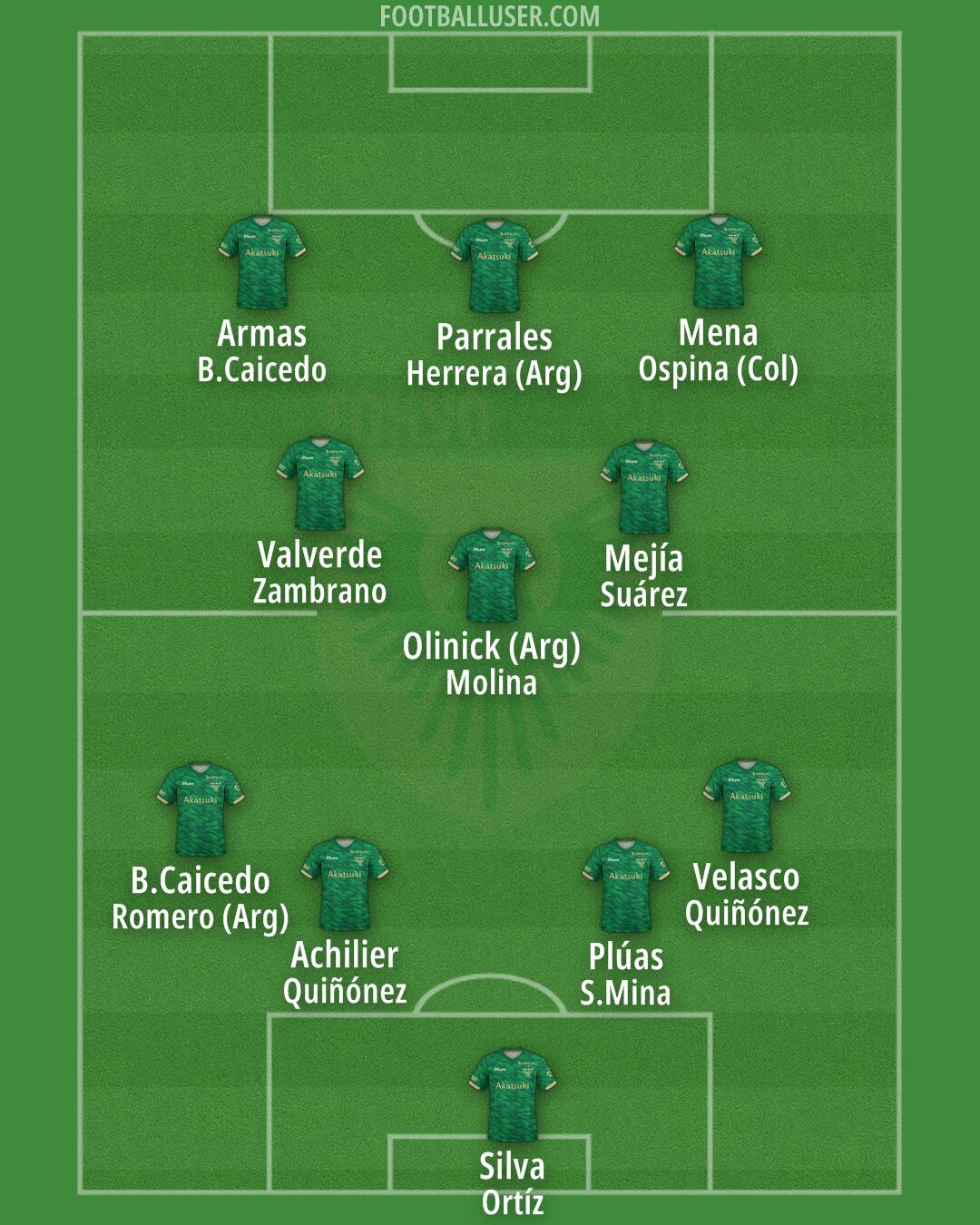
Mena (Ospina (Col)) · Armas (B.Caicedo) · Parrales (Herrera (Arg)) · B.Caicedo (Romero (Arg)) · Velasco (Quiñónez) · Achilier (Quiñónez) · Plúas (S.Mina) · Valverde (Zambrano) · Mejía (Suárez) · Silva (Ortíz) · Olinick (Arg) (Molina)Tokyo-V looks to control the game through high pressing and rapid transitions, employing a 4-3-3 formation. This lineup is built to dominate the pitch by winning the ball back high up the pitch and using the width of the field to stretch the opposition. The team wants to move the ball quickly through the thirds to catch defenders out of position.
Silva acts as the last line of defense in goal. The defensive unit sits in a flat back four, where Velasco plays as the right back and B.Caicedo occupies the left back position. Both wide defenders are expected to push up to provide width. In the middle, Plúas and Achilier work as the central defensive pairing, with Plúas acting as a ball playing defender while Achilier focuses on covering space and winning headers. The unit works to hold a compact shape when the team sits deep in a mid-block.
A single pivot manages the center of the park, with Olinick sitting in front of the defense to shield the back four and recycle possession. Alongside him, Mejía and Valverde operate as two inverted eights who link the defensive and attacking lines. Mejía focuses on driving forward with the ball to carry it into the half spaces, while Valverde is tasked to press aggressively to win the ball high and make late runs into the box. This midfield trio ensures the team can progress through the thirds effectively.
The attacking front line consists of three players, featuring Armas on the left wing and Mena on the right wing. Armas acts as an inverted winger who likes to cut inside to find goal scoring opportunities, while Mena stays wider to stretch the defense and deliver crosses. Parrales operates as a lone striker and a pressing centre-forward, constantly looking to pin the last defender and make runs in behind. The team builds play through combinations in the final third, using the wingers to isolate wide players in one on one situations.
Tokyo-V gains a significant advantage through their ability to press high in coordinated waves, forcing the opposition into mistakes. The presence of Mejía and Valverde in the midfield creates numerical superiority in the center, allowing the team to control the tempo. Additionally, the movement of the wide players allows for effective wide overloads when the full backs overlap the wingers.
This 4-3-3 formation is designed for a high intensity game where controlling the ball and pressing the opponent is vital. Tokyo-V will find success with this lineup against teams that struggle to play out from the back under pressure.