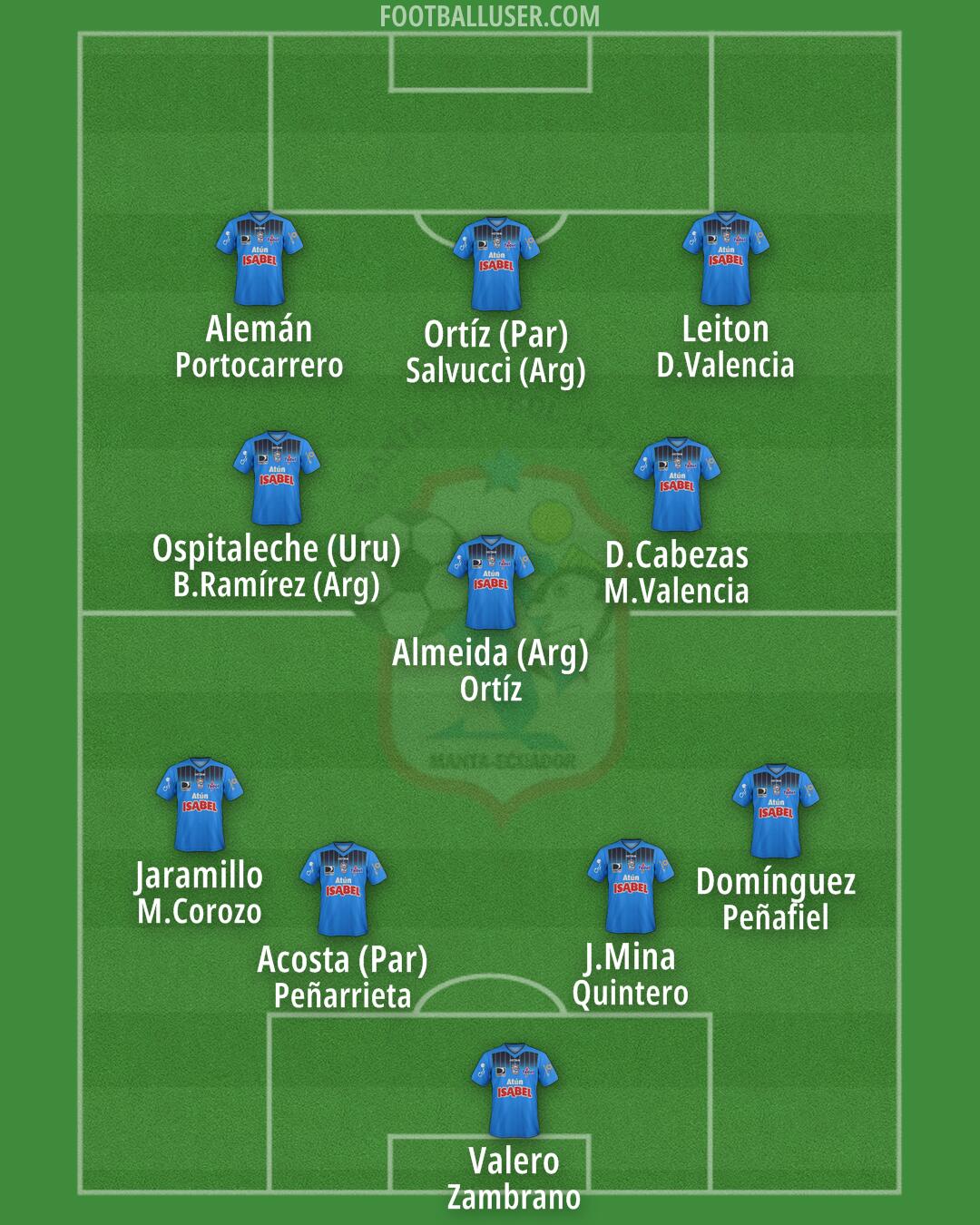

Manta Football Formation
 February 13, 2025


Starting Lineup
Valero (Zambrano) · Jaramillo (M.Corozo) · J.Mina (Quintero) · Acosta (Par) (Peñarrieta) · Domínguez (Peñafiel) · Almeida (Arg) (Ortíz) · Ospitaleche (Uru) (B.Ramírez (Arg)) · Alemán (Portocarrero) · D.Cabezas (M.Valencia) · Leiton (D.Valencia) · Ortíz (Par) (Salvucci (Arg))Manta seeks to control the tempo through a high press and a proactive 4-3-3. This formation is built to dominate the ball and squeeze the opposition in their own half. By using a high line, the team aims to win the ball back high up the pitch and immediately punish the opponent.
Valero starts in goal to organize the defensive unit from the back. The back line functions as a flat back four where Domínguez and Jaramillo act as full backs to provide width. Acosta and J.Mina form the central defensive pair, with Acosta playing as a ball playing defender to initiate attacks. J.Mina focuses on being dominant in the air and covering the space behind the high line. This defensive unit works to stay compact and maintain a high line to keep the team close together.
The midfield operates as a three-man midfield with a carrier and a dedicated holding role. Almeida sits as the single pivot to shield the defence and recycle possession. Beside him, D.Cabezas and Ospitaleche act as inverted eights who connect the defensive and attacking lines. D.Cabezas looks to drive forward with the ball into the half-spaces, while Ospitaleche works to press aggressively to win the ball high. This midfield trio links the back four to the front line by playing through the lines.
In the attacking phase, Manta utilizes three attackers across the front. Ortíz acts as a pressing centre-forward who works to pin the last defender and find the feet of the striker. On the flanks, Alemán and Leiton operate as inverted wingers who cut inside to create central overloads. These wide players pull wide to stretch the defence before cutting into the box. The team looks to attack in combinations, using the movement of the wingers to create runs in behind for Ortíz to exploit.
One major advantage for Manta is the ability to press high in coordinated waves, which forces many opponents into mistakes. The team also finds success through wide overloads when Jaramillo and Domínguez push up to overlap the winger. This setup creates constant pressure in the final third and forces the opposition to defend deep.
This 4-3-3 formation is designed for a team that wants to dictate the rhythm of the match. It is best suited for games against opponents that struggle to play out from the back under heavy pressure.