
New Zealand National Football Team Formation
 February 15, 2025


Starting Lineup
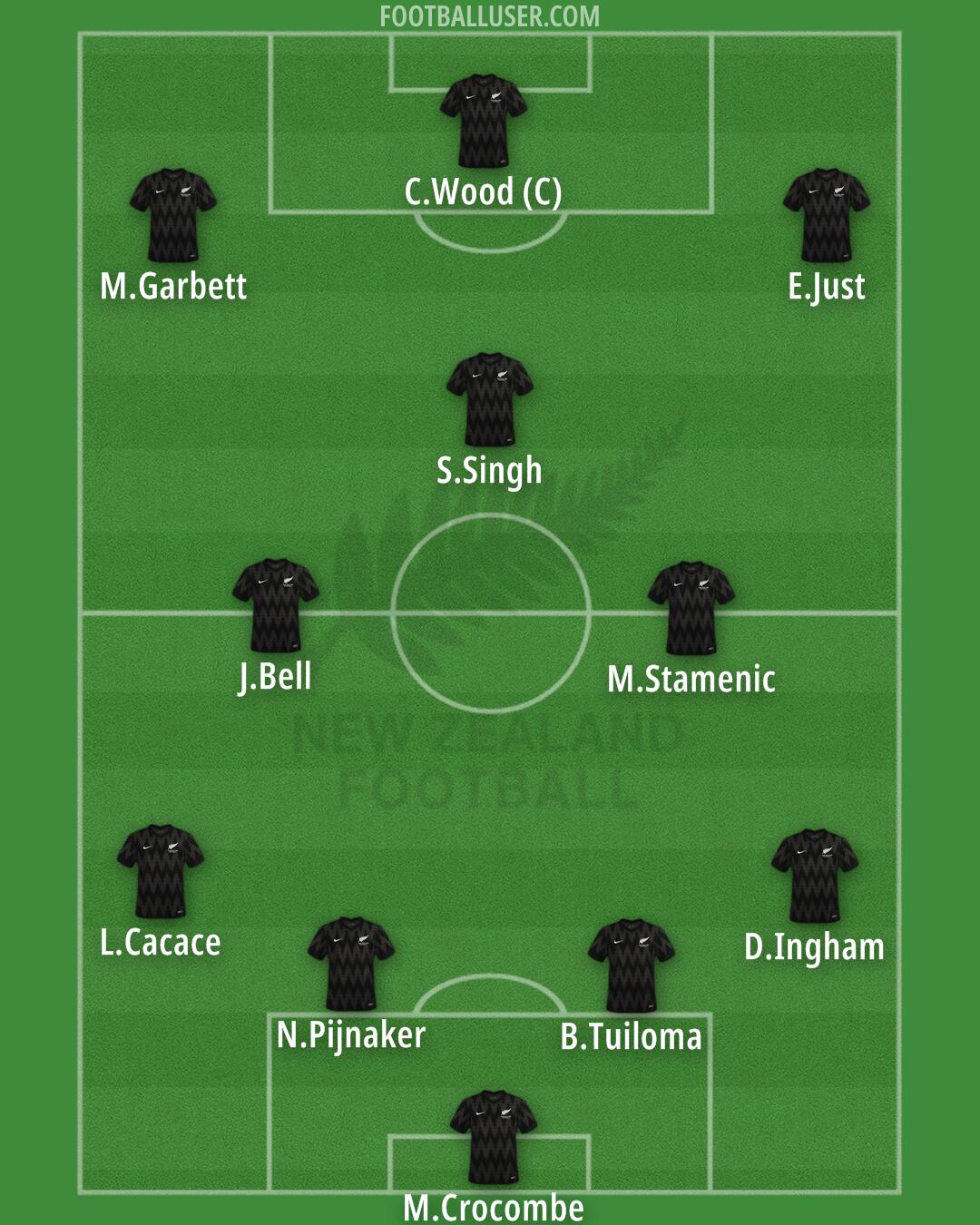
M.Crocombe · L.Cacace · N.Pijnaker · B.Tuiloma · D.Ingham · M.Stamenic · J.Bell · M.Garbett · E.Just · C.Wood (C) · S.SinghNew Zealand focuses on high pressing and quick transitions, utilizing a 4-3-3 formation to stretch the opposition. This lineup aims to win the ball high up the pitch and strike immediately through vertical passing. By using this setup, the team seeks to control the tempo while remaining dangerous in the moments after a turnover.
M.Crocombe guards the goal as the last line of defense. The back four operates as a flat defensive unit, with D.Ingham and L.Cacace acting as full backs who provide width. In the middle, B.Tuiloma and N.Pijnaker form the central pairing, where B.Tuiloma uses his strength to defend aerial duels while N.Pijnaker focuses on covering space. The unit works to maintain a compact shape to prevent through balls.
The midfield operates with a three-man system designed to control the center of the pitch. M.Stamenic and J.Bell act as the engine, with J.Bell looking to connect the defensive and attacking lines through his passing range. S.Singh plays as an attacking ten, pushing high to support the forward line. M.Stamenic helps to shield the defense, while S.Singh looks to find pockets of space to create chances.
New Zealand employs three attackers to pin the opposition back line. C.Wood, the captain, acts as the target man, using his aerial strength to hold up the ball and bring others into play. On the wings, M.Garbett and E.Just provide width and look to cut inside to create goalscoring opportunities. This front three works to press the defenders, often looking to hit in behind on the transition to catch the opposition out of position.
One major advantage of this formation is the ability to press high in coordinated waves, with the front three triggering the press. The team can also create wide overloads when D.Ingham and L.Cacace push forward to support the wingers. This setup allows New Zealand to quickly shift from a defensive block to an attacking movement, creating immediate pressure on the opponent.
This 4-3-3 formation is built for a high intensity game that relies on winning the second ball. It is best suited for facing teams that play a high line and leave space behind their defenders.