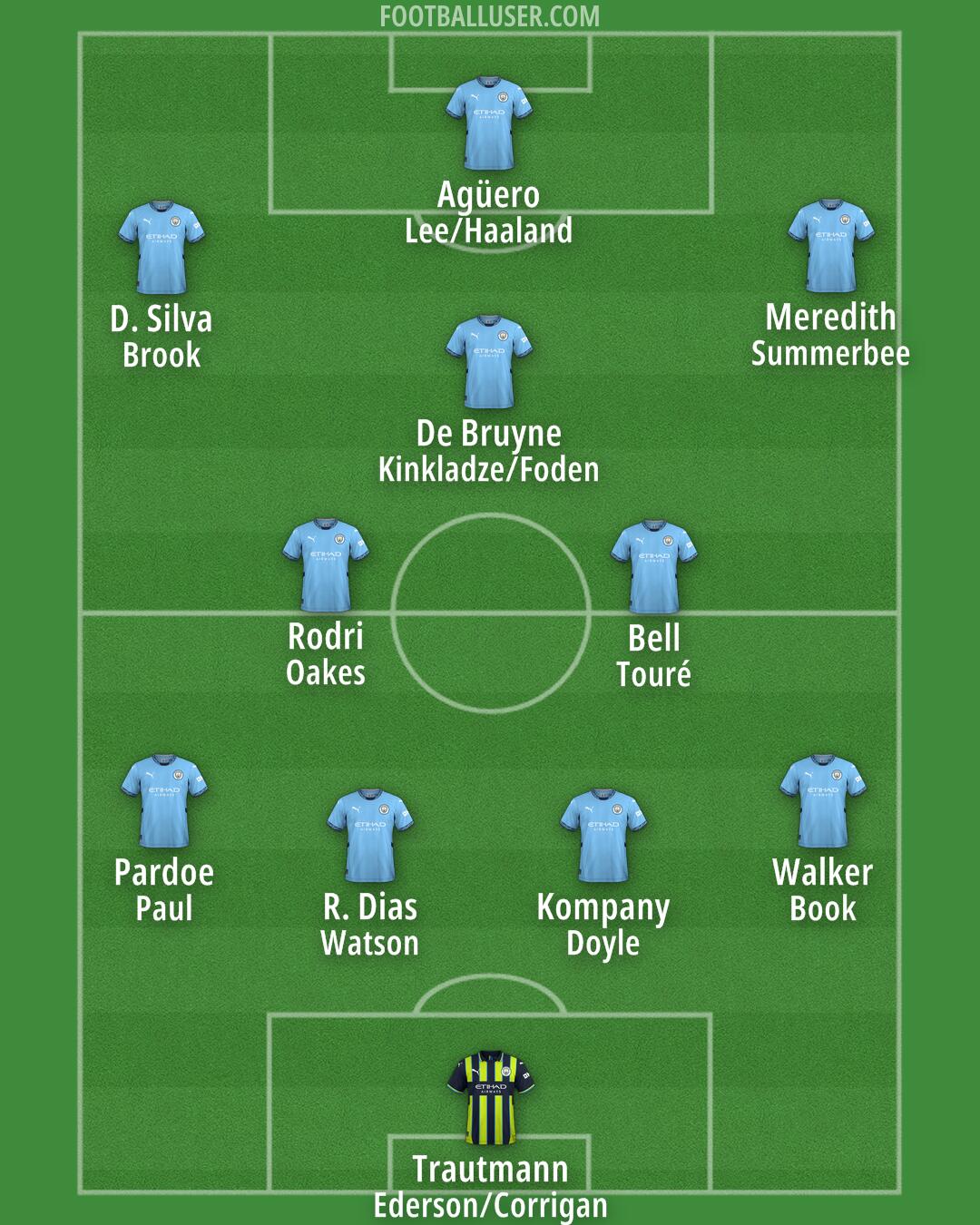
Man City Football Formation
 February 17, 2025


Starting Lineup
Trautmann (Ederson/Corrigan) · Walker (Book) · Pardoe (Paul) · Kompany (Doyle) · R. Dias (Watson) · Rodri (Oakes) · De Bruyne (Kinkladze/Foden) · Bell (Touré) · Meredith (Summerbee) · D. Silva (Brook) · Agüero (Lee/Haaland)Dominating the ball and controlling the tempo is the primary goal for Man City. The team operates in a 4-3-3 formation to maintain control through possession. This lineup is built to squeeze the space and keep the opposition pinned in their own half through constant pressure.
Trautmann stays in goal to command the area. The defensive unit uses a flat back four to maintain a compact shape. Walker plays as an attacking full back using his pace to overlap the winger and stretch the defense. Pardoe sits at left back to cover the wide area and maintain the defensive line. Kompany and R. Dias act as the central defenders. Kompany is dominant in the air and helps to clear the lines, while R. Dias uses his strength to defend zonally and cover his partner. They work together to hold the line and prevent runs in behind.
Midfield control is provided by a three-man group designed to dictate play. Rodri acts as a deep lying playmaker who drops between the centre-backs to receive the ball and shield the defence. Bell plays as an inverted eight, driving forward to connect the defensive and attacking lines. De Bruyne operates as an attacking ten with a wide passing range to break the line with through balls. He moves between the lines to create chances and makes late runs into the box. This midfield group allows Manchester City to recycle possession and switch play effectively.
Up front, the team uses three attackers across the front to stretch the opposition. Agüero acts as a striker who makes runs in behind to finish chances. D. Silva plays as an inverted winger on the left, looking to cut inside and combine in tight spaces. Meredith stays wide on the right to provide width and cross. The front three press from the front to trigger a press and force the opponent into mistakes. They look to hit in behind on the transition to catch the defense out of position.
One major advantage is the ability to create numerical superiority in the middle of the pitch. Wide overloads also occur when the full backs push up to support the wingers. High pressing intensity in coordinated waves helps the side win the ball back high up the pitch. This allows for quick attacks before the opposition can set their defensive block.
This 4-3-3 formation is built on high possession and relentless pressure. It is most effective when facing teams that play a high line or try to play short from the back.