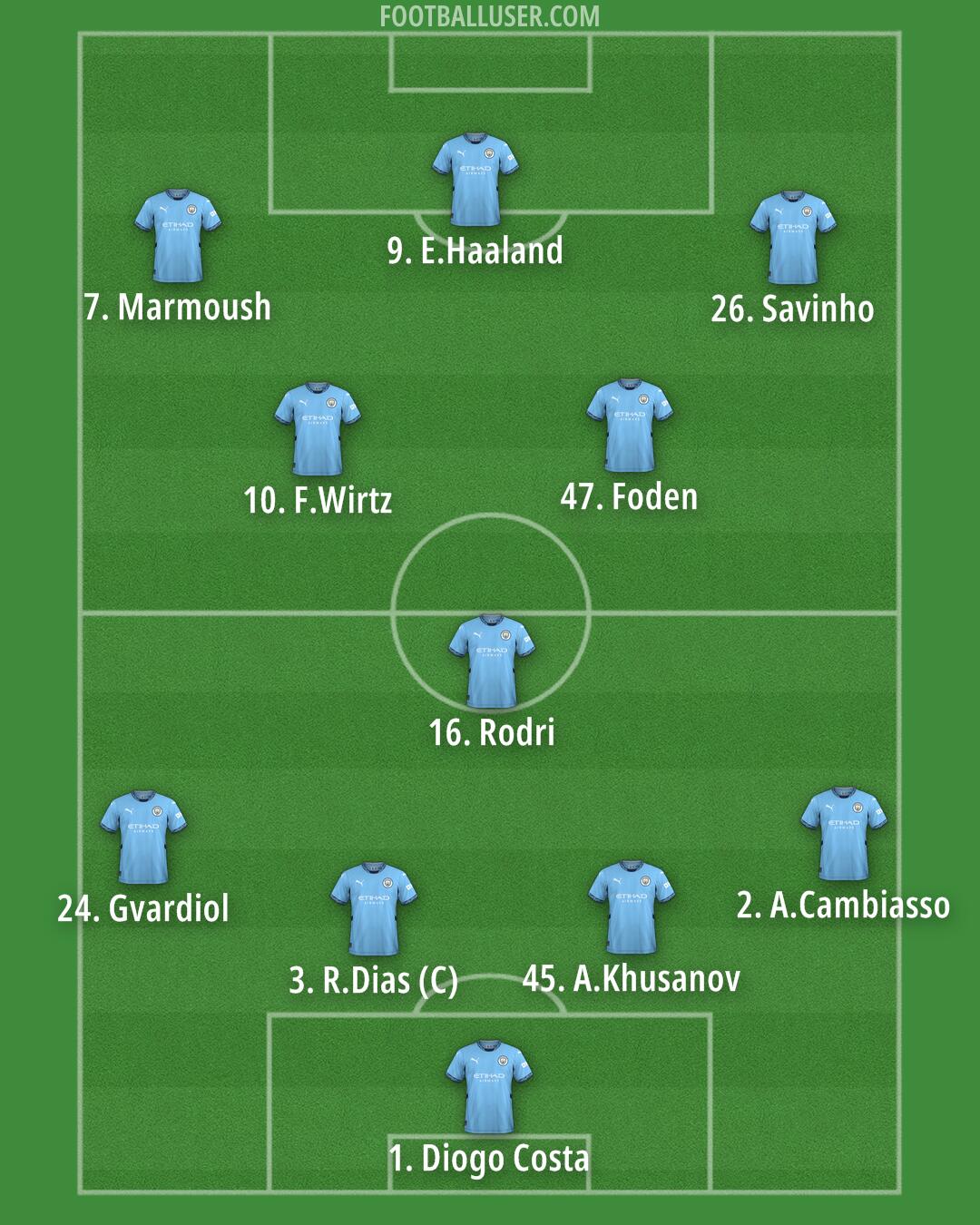
Man City Football Formation
 February 18, 2025


Starting Lineup
1. Diogo Costa2. A.Cambiasso
3. R.Dias (C)
45. A.Khusanov
24. Gvardiol
16. Rodri
10. F.Wirtz
47. Foden
9. E.Haaland
7. Marmoush
26. Savinho
Man City look to dominate games through heavy possession and high intensity, utilizing a 5-2-3 formation. This lineup is built to control the tempo by keeping the ball in advanced areas while using wide players to stretch the opposition. The team aims to win the ball back high up the pitch to sustain constant pressure on the opponent.
Diogo Costa sits between the posts to start the build up play from the back. The defensive unit operates as a back five, with Rodri acting as the central defender to sweep behind the line and cover space. R.Dias (C), the captain, leads the defensive line as a dominant ball playing centre back, while A.Khusanov provides strength on the right side of the central trio. Gvardiol operates as a left wing back, expected to push high and provide width, whereas A.Cambiasso works as a right wing back to overlap the wide attackers.
The midfield relies on a two man central pairing to connect the defence to the attack. F.Wirtz operates in the left half space to create chances and press aggressively, while Foden drives forward from the right to find space between the lines. These two midfielders are tasked to receive the ball from the centre backs, recycle possession, and break the line with vertical passes. They must also track back to protect the back five when the team loses control of the ball.
In the final third, Man City employ three attackers to pin the last defender. E.Haaland acts as a powerful pressing centre forward who holds up the ball and looks to run in behind. Marmoush plays as a left winger who likes to cut inside to create shooting opportunities, while Savinho operates on the right wing to beat his marker and whip it in. This front three works to force the opposition into a low block, using combinations to move the ball quickly into the box.
This formation offers Man City several tactical advantages, such as the ability to create wide overloads through the wing backs and the forwards. The presence of a back five provides great compactness when defending deep, making it difficult for opponents to find gaps. Furthermore, the high press from the front three allows the team to win the ball back high up the pitch and attack quickly in transition.
This 5-2-3 formation focuses on controlling the game through width and central creativity. It is best suited for matches against teams that sit deep and require a heavy offensive presence to break them down.