
Lithuania National Football Team Formation
 February 22, 2025
 bosan
bosan


Starting Lineup
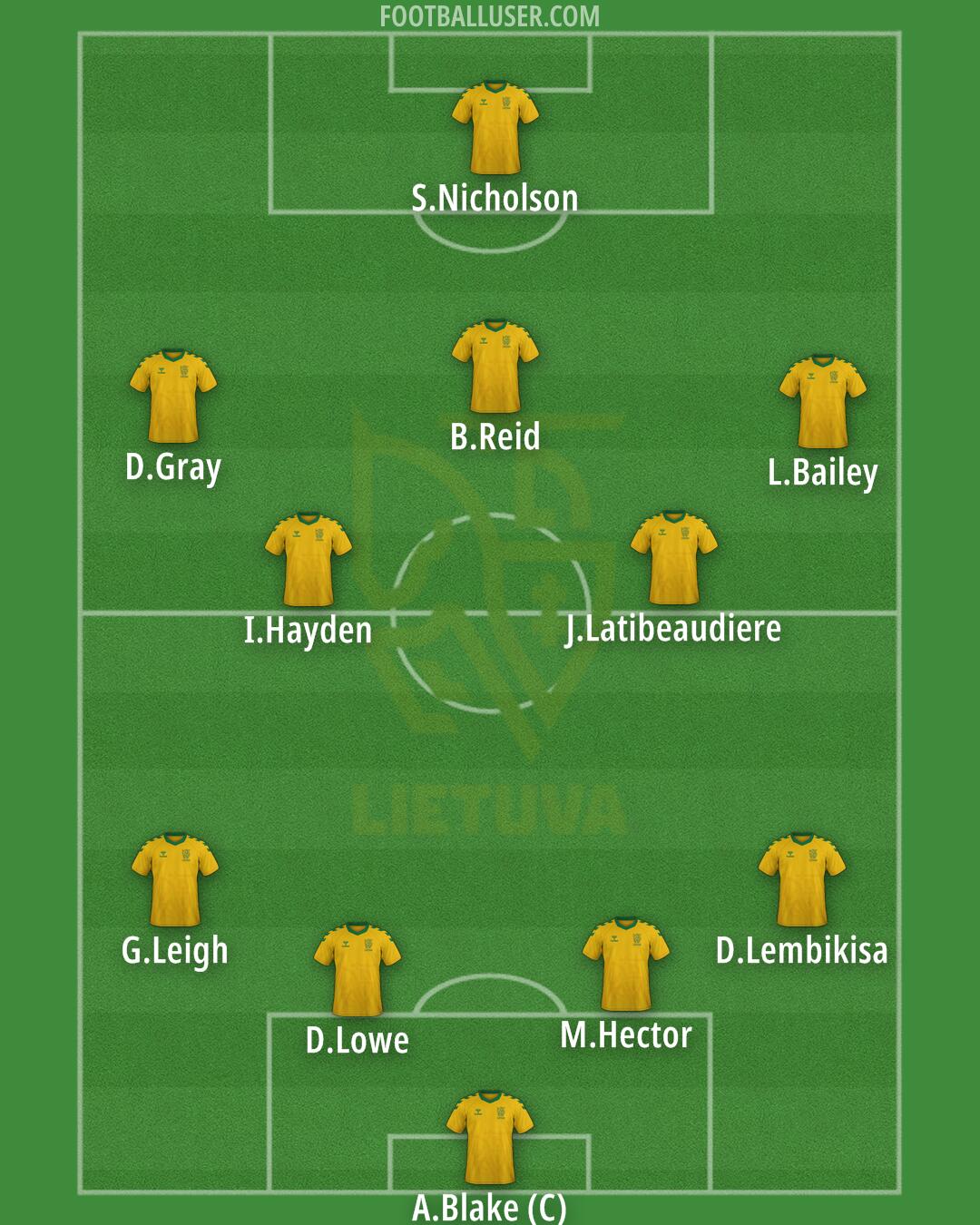
A.Blake (C) · D.Lembikisa · G.Leigh · D.Lowe · M.Hector · J.Latibeaudiere · D.Gray · L.Bailey · I.Hayden · B.Reid · S.NicholsonLithuania focuses on a compact defensive identity built for a mid-block and quick transitions, using a 4-5-1 formation. This lineup aims to squeeze the space between the lines and make it very difficult for opponents to play through the center. The goal is to remain hard to beat and use the narrow banks of players to force the opposition into wide areas before launching direct attacks.
A.Blake (C) commands the area from goal to keep the back line organized. The defensive unit works as a flat back four with G.Leigh acting as the left back to cover the wide flank. D.Lembikisa plays as the right back to defend the wing and support the wide areas when needed. In the center, D.Lowe and M.Hector operate as the two central defenders, focusing on winning the second ball and marking the opponent striker to deny space.
The midfield consists of a five man group that can shift to protect the center. I.Hayden and J.Latibeaudiere form a double pivot to shield the defense and break up play. In front of them, B.Reid works to connect the defensive and attacking lines, while L.Bailey and D.Gray operate in the central and half spaces to press aggressively. This group works to win the ball high up the pitch and recycle possession quickly to find the front line.
Lithuania utilizes a lone striker in S.Nicholson to lead the line. He acts as a pressing centre-forward to harass the opposition back line and hold up the ball to bring others into play. The four midfielders behind him provide the width and central presence, often making late runs into the box to support the attack. When the team wins the ball, they look to hit in behind on the transition, using quick passes to exploit the gaps left by a pushing opponent.
One major strength of this 4-5-1 formation is the compactness when defending, which makes it very hard for teams to find passing lanes through the middle. The double pivot of I.Hayden and J.Latibeaudiere provides stability, allowing the wider midfielders to push up. Another advantage is the ability to create numerical superiority in the center of the pitch, which helps Lithuania win the second ball and maintain control during defensive phases.
This formation is built to be defensively solid and relies on a strong work rate from the midfield. It is best suited for games against dominant teams where Lithuania needs to sit deep and counter at pace.