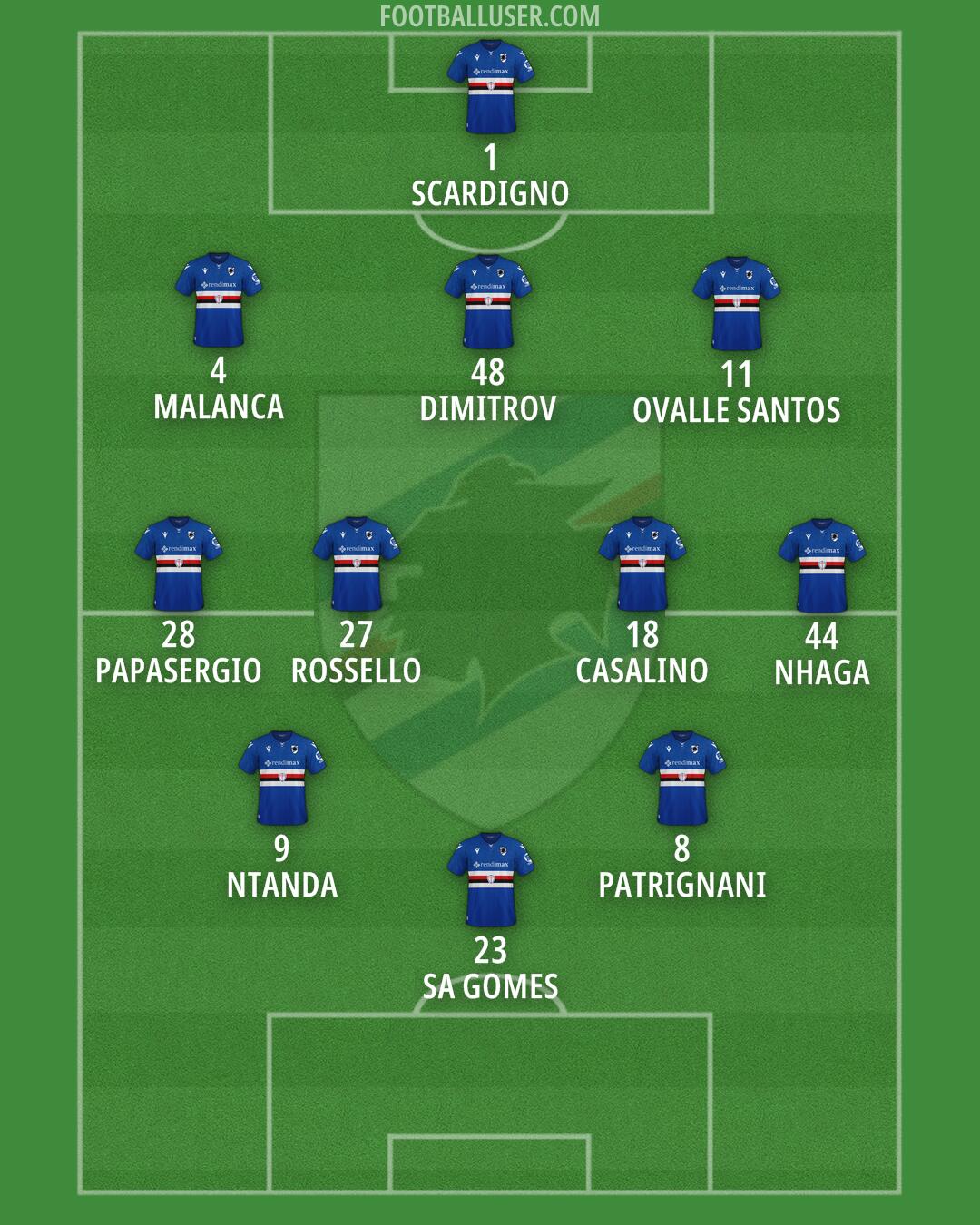

Sampdoria Football Formation
 February 24, 2025


Starting Lineup
1 (SCARDIGNO)4 (MALANCA)
48 (DIMITROV)
11 (OVALLE SANTOS)
28 (PAPASERGIO)
27 (ROSSELLO)
18 (CASALINO)
44 (NHAGA)
9 (NTANDA)
8 (PATRIGNANI)
23 (SA GOMES)
Sampdoria looks to play a high tempo, vertical game that targets the opposition immediately upon winning the ball. This intent is driven by their 3-4-3 formation. The goal is to stretch the defense and create chances through rapid movement and directness across the pitch.
The goalkeeper 1 starts the play from the back. The defensive unit operates with a back three where 4, 48, and 11 form a compact line. 48 acts as the central defender to win the header and cover the space behind the others. 4 and 11 operate as wide centre-backs who can step up to intercept passes or tuck in to defend zonally. They must hold the line to keep the distance between the defenders and the midfield small.
In the middle of the pitch, the team uses a double pivot with 27 and 18. These two players work to shield the defense and win the second ball. 27 and 18 are responsible to recycle possession and find the feet of the attackers. To provide width, 28 and 44 occupy the left and right channels. 28 and 44 can push high to overlap the wingers, which helps to spread wide and move the opposition defense.
The front line is built around 23 who acts as a pressing centre-forward. 23 works to pin the last defender and hold up the ball to allow others to join the attack. On the flanks, 9 and 8 act as inverted wingers. 9 and 8 cut inside to occupy the half-spaces and look to strike from distance. This movement creates space for 28 and 44 to deliver crosses or for 27 and 18 to arrive late into the box.
The tactical advantages of this Sampdoria lineup include the ability to create wide overloads. When 28 and 44 move forward, they create a numerical advantage against the opposition full backs. Additionally, the team can press from the front with the three attackers working together. This coordinated movement can force a long ball and allow the back three to recover the ball and start again.
This 3-4-3 formation is built for attacking football and quick transitions. It is most effective when facing opponents who play a high line and leave space behind their defenders for the wingers and striker to exploit.