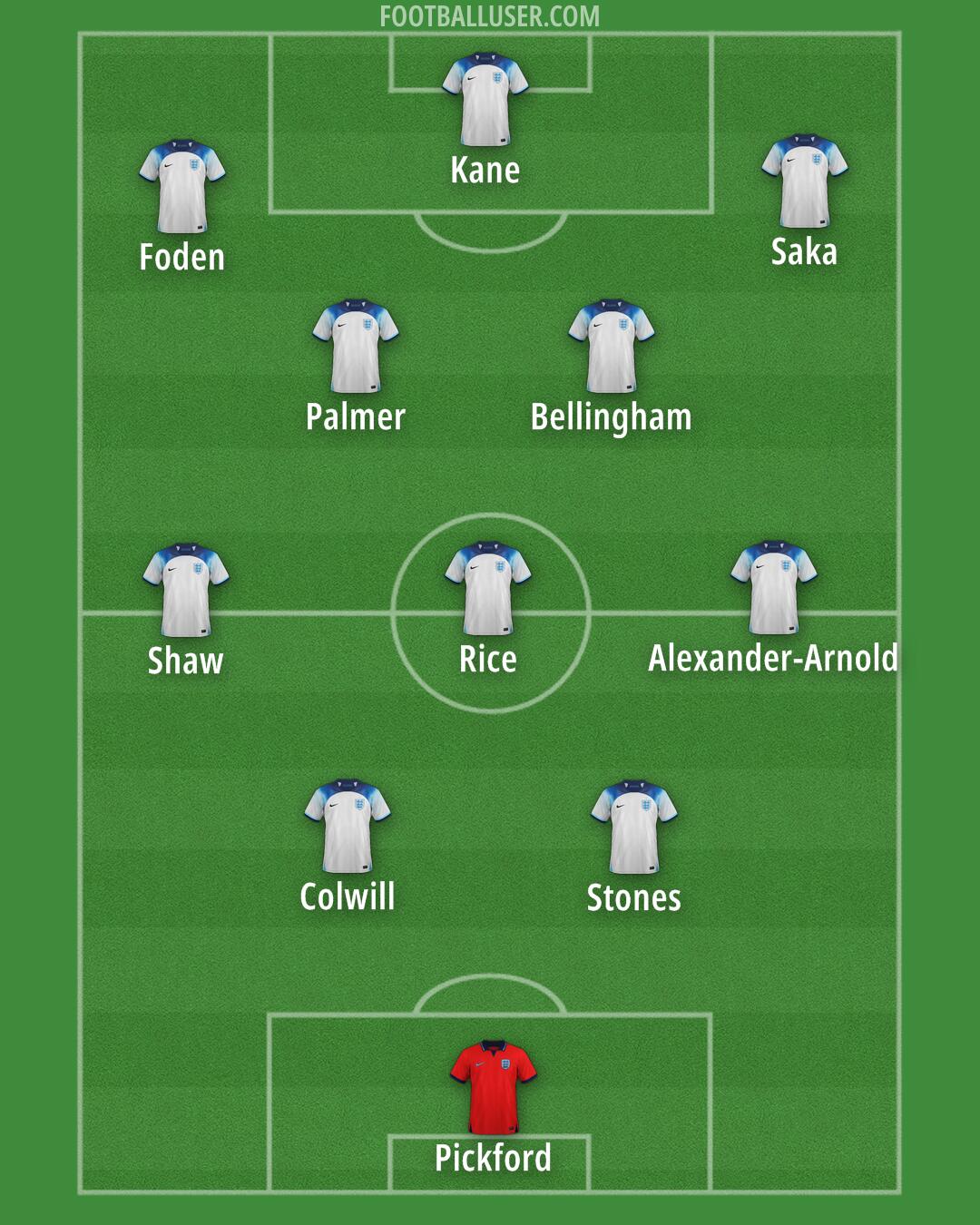
England National Football Team Formation
 February 28, 2025


Starting Lineup
Shaw · Alexander-Arnold · Colwill · Stones · Rice · Foden · Bellingham · Palmer · Saka · Kane · PickfordEngland look to win the ball back high up the pitch and use rapid transitions through a 5-2-3 formation. This lineup focuses on a high press to force mistakes and quickly move the ball forward to the front three. The tactical identity relies on the speed of the wide players to stretch the opposition.
Pickford stays between the posts to command the area and sweep behind a high line. The defensive unit operates with a back three consisting of Stones, Colwill, and Rice. Stones acts as a ball playing defender to initiate play, while Colwill provides cover and Rice uses his strength to win the second ball. The wide defenders, Alexander-Arnold and Shaw, act as attacking wing backs to provide width. Alexander-Arnold looks to whip it in from deep or switch play to the opposite side, while Shaw pushes high to overlap the winger.
The midfield functions as a two man unit with Bellingham and Palmer working in the half spaces. Bellingham drives forward with the ball to carry the ball forward into the final third, while Palmer connects the defensive and attacking lines. These two must work hard to press in a mid block and cover the space left behind the advancing wing backs. They are responsible for recycling possession and finding the feet of the striker.
England use three attackers across the front to pin the last defender. Kane operates as a striker who can drop deep to link up play, often pulling defenders out of position. Saka and Foden play as wide attackers who cut inside to create goal scoring chances. Saka looks to isolate a one on one wide, while Foden moves into the pockets to arrive late into the box. The front three press from the front to trigger a press in the high areas of the pitch.
This formation offers great width through the overlapping wing backs of Alexander-Arnold and Shaw. It also creates numerical superiority in the final third when the midfielders join the attack. The ability to win the ball back high up the pitch allows the team to hit in behind on the transition.
The 5-2-3 formation provides a strong foundation for teams that want to control the game through high pressing. It is best suited for matches against opponents that struggle to play out from the back.