
River Football Formation
 March 2, 2025


Starting Lineup
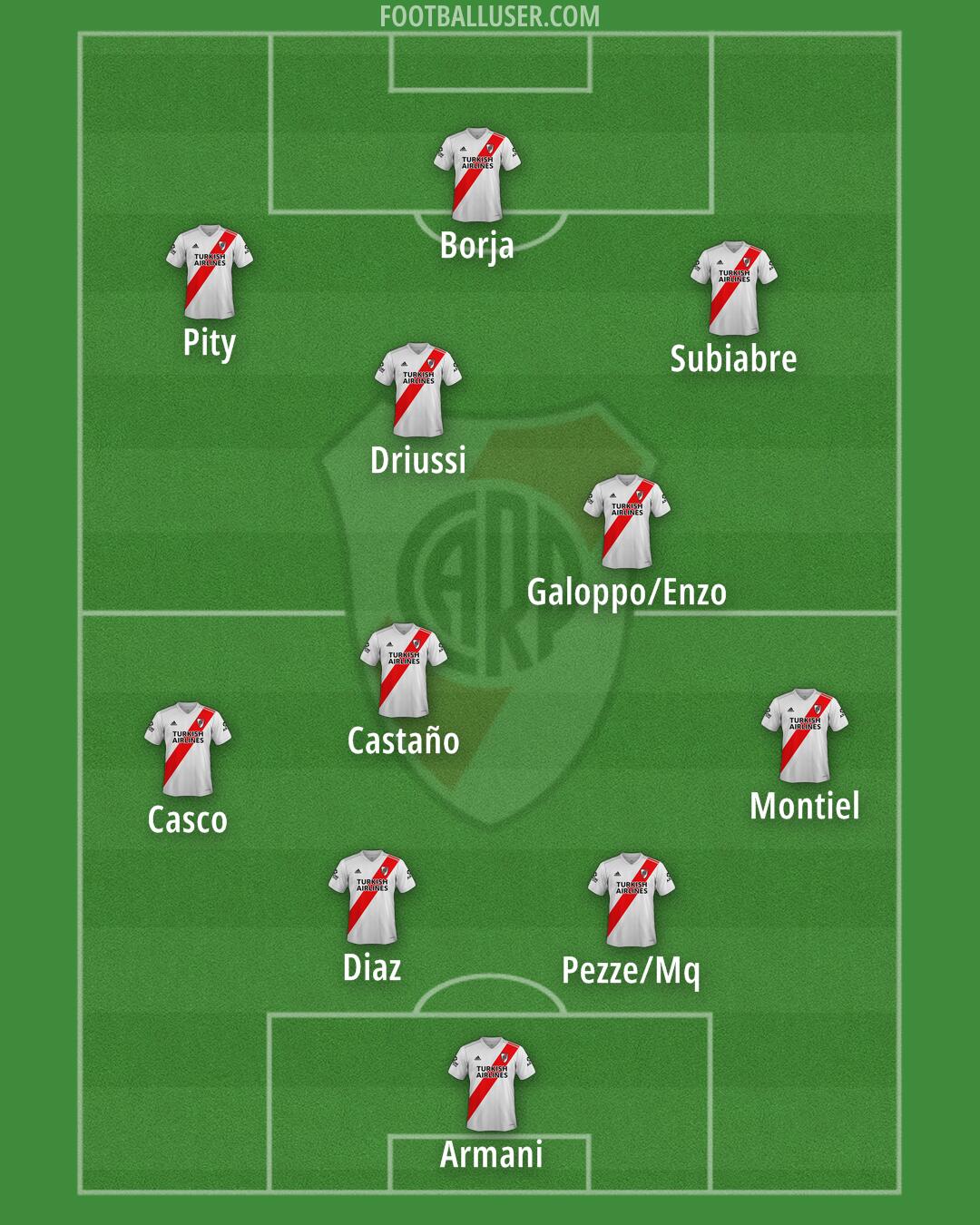
Armani · Montiel · Pezze/Mq · Diaz · Casco · Castaño · Borja · Galoppo/Enzo · Subiabre · Pity · DriussiRiver plays with a heavy focus on verticality and pressing, utilizing a 2-5-3 formation. This lineup is built to dominate through constant pressure and quick transitions. The intention is to pin the opposition in their own half and win the ball back high up the pitch to create immediate scoring chances.
Armani guards the goal, acting as the last line of defense for River Plate. The defensive unit features a narrow back two with Pezze/Mq and Diaz playing as the central defenders. Because this formation relies on a high line, Pezze/Mq and Diaz must be ready to cover wide areas and step up to catch opponents offside. They act as ball playing defenders who look to play short from the back to move the ball into the midfield.
In the middle of the park, Casco acts as a single pivot to shield the defense and sit in front of the two center backs. Montiel and Castaño form a central pair where Montiel can carry the ball forward while Castaño works to recycle possession. Galoppo/Enzo and Driussi operate as two tens in the half spaces, pushing into advanced positions to link the lines. This five man midfield allows the team to compress the midfield and control the rhythm of the game.
The attacking unit consists of three players working in close proximity. Subiabre and Pity act as inverted wingers who use their dribbling to cut inside and trouble the opposition. They look to deliver early crosses or play one-twos with the central striker. Borja plays as a pressing centre-forward and a target man, using his aerial strength to win the header and hold up the ball. The movement of the wide players is designed to create space for Borja to receive through balls or combine in tight spaces.
This formation provides significant numerical superiority in the attacking third. By pushing five players into the midfield and three into the front line, River can overwhelm the opponent's defensive block. The ability to press in coordinated waves makes it very difficult for opponents to play out from the back. Additionally, the movement of the wingers allows the team to isolate wide players in one on one situations during transitions.
This 2-5-3 formation is built for teams that want to dictate the tempo through aggressive ball recovery. It is best suited for matches against opponents that struggle to handle high pressure and lack the pace to exploit the space behind the high defensive line.